


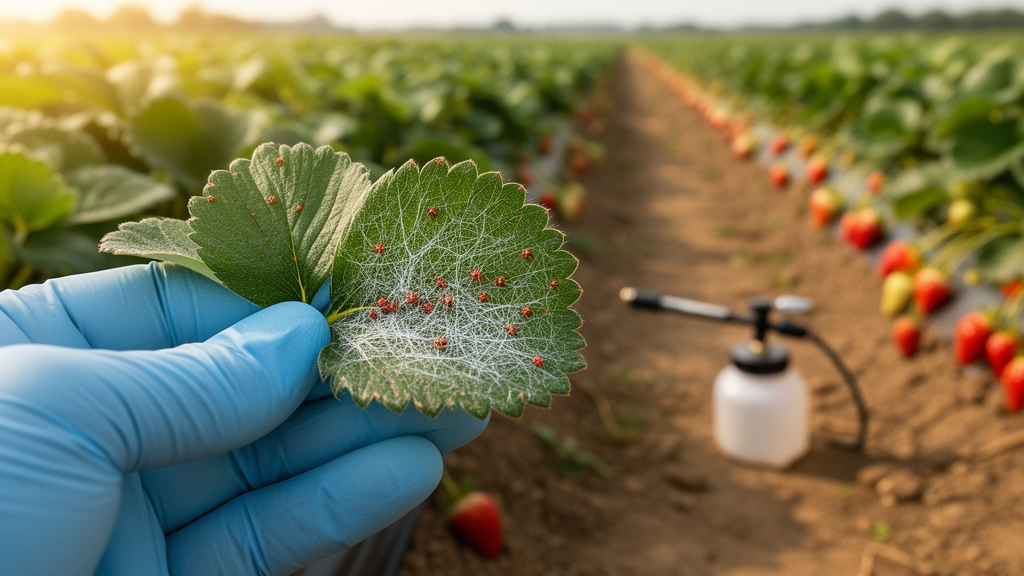
A native strain of the entomopathogenic fungus Metarhizium anisopliae, isolated from Colombian strawberry fields, has killed more than 84 percent of adult two-spotted spider mites under laboratory conditions and outperformed the widely used chemical acaricide abamectin in direct comparisons. The isolate, designated HF234, also suppressed eggs, larvae, and nymphs of the pest more strongly than the chemical treatment in greenhouse trials on strawberry plants. The findings, published in Frontiers in Agronomy by researchers at the Agroindustrial Biotechnology Center of the University of Cauca, position HF234 as a promising biological control candidate against Tetranychus urticae, the two-spotted spider mite that ranks among the most damaging pests of strawberry crops worldwide. The authors caution, however, that their evidence comes from laboratory and greenhouse experiments only, and that field validation remains a necessary next step before the fungus can be integrated into commercial pest management programs.
The two-spotted spider mite is a highly polyphagous arachnid reported on more than 200 plant species, including tomato, cotton, soybean, maize, and strawberry. Its feeding damage results from the penetration of epidermal and mesophyll leaf tissues by its chelicerae and the subsequent removal of cellular contents, producing chlorosis, necrosis, reduced photosynthetic area, and yield losses. In strawberry, these effects compromise both productivity and fruit marketability while raising pest management costs. The mite’s high reproductive capacity and short life cycle allow populations to increase rapidly under favorable conditions, and it can establish under both open-field and protected cultivation. Globally, plant pests are estimated to cause losses of up to 40 percent of crop production annually, underscoring the scale of the challenge for a perishable, high-value crop such as strawberry.
In Colombia, strawberry is considered a strategic crop within the horticultural sector because of its production and export potential. In the department of Cauca, particularly the municipalities of Sotará and Silvia, cultivated areas exceeded 300 hectares in 2024. The research team sampled eight farms in these municipalities between February and September 2024, covering established crops of the cultivars Sabrina, Ventana, and Frontera across an altitudinal range of 2,465 to 3,132 meters above sea level. On each farm, the team collected 250 trifoliate leaves from 50 visibly symptomatic plants and 250 trifoliate leaves from 50 apparently healthy plants, following diagonal sampling patterns within strawberry beds, and examined all 500 leaves per farm under a stereomicroscope.
The survey confirmed T. urticae on every farm evaluated, in both symptomatic and apparently healthy plants. In visibly symptomatic plants, the percentage of infested trifoliate leaves ranged from 40 to 100 percent, with the highest level recorded on Farm 4, where every evaluated plant harbored mites. Strikingly, the mite was also detected in apparently healthy plants on all eight farms, at infestation levels ranging from 10 to 100 percent. The authors note that the farms were selected based on previous infestations, so the pest’s presence was expected, but its detection in plots without visible symptoms indicates that population establishment can precede evident foliar damage. Because the mite is small and preferentially inhabits the abaxial leaf surface, visual inspection alone may underestimate early colonization stages.
To find biological control agents adapted to local conditions, the team drew on seven fungal isolates previously obtained from soil and root samples of strawberry crops in Sotará and Silvia and preserved in glycerol at the University of Cauca. Four isolates, HF177, HF197, HF232, and HF437, belonged to the genus Paecilomyces, while HF152, HF188, and HF234 belonged to Metarhizium. Entomopathogenic fungi infect phytophagous mites through a sequence beginning with conidial adhesion to the host cuticle, followed by germination, penetration of the integument, colonization of the hemocoel, and in some cases the production of metabolites that intensify host physiological deterioration. Differences among isolates at any of these infection stages can translate into large differences in killing capacity, which is why screening studies frequently identify only a subset of isolates with sufficient activity for further evaluation.
For the laboratory bioassays, the researchers cultured each isolate on YGC medium, harvested conidia, and adjusted suspensions to a concentration of 1 × 10⁸ conidia per milliliter in a 0.02 percent Tween 80 solution. Groups of ten two-day-old adult female mites were placed on strawberry leaflets and treated topically with 300 microliters of suspension using an airbrush, with five replicates per treatment under a completely randomized design. Mortality was assessed at 240 hours after application, and values were corrected for natural mortality in the untreated control using Abbott’s formula. Corrected mortality differed significantly among isolates. HF234 produced the highest corrected mortality at 84.3 ± 8.9 percent, followed by HF188 at 74.2 ± 3.5 percent and HF232 at 73.7 ± 5.8 percent, all exceeding 70 percent, while the remaining isolates ranged from 10.1 to 61.2 percent.
The performance of HF234 falls within the upper range of mortality previously reported for M. anisopliae against T. urticae. Earlier studies have recorded 85 percent mortality seven days after exposure at the same conidial concentration, and mortality between 45.3 and 85.3 percent among seven M. anisopliae isolates, with comparable activity also documented against other Tetranychus species. Although HF234 did not differ statistically from HF188 and HF232 in the screening, it was selected for subsequent experiments because it produced the highest numerical mean corrected mortality. Molecular identification then confirmed its taxonomic identity: sequencing of the ribosomal DNA ITS region showed 99.81 percent identity with reference sequences of M. anisopliae in the NCBI database, and the sequence was deposited in GenBank under accession number PZ694451.
In a direct comparison, HF234 was tested against the commercial product Abafed, whose active ingredient is abamectin at 18 grams per liter, applied at the manufacturer’s recommended rate. Abamectin belongs to IRAC Group 6, a class of glutamate-gated chloride channel allosteric modulators, and resistance management guidelines recommend avoiding successive treatments with the same mode of action while integrating alternative control methods. Under the evaluated conditions, HF234 produced a corrected mortality of 84.31 ± 2.06 percent, significantly higher than the 68.14 ± 2.98 percent achieved by abamectin. The authors argue that this performance is particularly relevant because the fungus represents a biologically distinct control tool compared with this commonly used neuroactive compound, potentially reducing chemical dependence and selection pressure for resistance within integrated pest management programs.
The greenhouse phase added variables absent under laboratory conditions, including plant architecture, foliar microclimate, mite behavior, and continuous population reproduction. Twenty adult female mites were released onto three central trifoliate leaves of each strawberry plant, colonies were allowed to establish for five days, and treatments were then applied at 4 milliliters per plant with emphasis on the lower leaf surface. Thirteen days after application, nine leaflets per plant were examined and individuals at four developmental stages were counted. HF234 significantly reduced the abundance of eggs, larvae, nymphs, and adults compared with the negative control. Eggs averaged 78.40 per plant with HF234 versus 192.60 with abamectin and 336.00 in the control; larvae averaged 4.60 versus 23.00 and 117.60; and nymphs averaged 11.50 versus 69.08 and 128.75. Adult abundance did not differ significantly between HF234 and abamectin, at 24.80 and 26.20 individuals respectively, against 73.00 in the control.
From a population perspective, the greatest value of HF234 lies not only in its impact on existing adults but in its simultaneous reduction of the developmental stages responsible for population renewal. In a pest characterized by overlapping generations, suppressing eggs, larvae, and nymphs may be as important as, or more important than, killing adults, because the net effect occurs through decreased recruitment of new cohorts. The results also reinforce the case for monitoring programs that include trifoliate leaves from apparently healthy plants and inspection of the abaxial leaf surface before chlorosis or stippling becomes visible, since early intervention offers greater opportunities for population suppression than delayed control of established infestations. The authors emphasize that the study was limited to laboratory and greenhouse conditions, and that field efficacy and persistence, formulation stability, application rate and frequency, compatibility with other integrated pest management components, and potential effects on non-target organisms must all be evaluated before HF234 can be practically integrated into sustainable strawberry production.
Subject of Research: Evaluation of native entomopathogenic fungi as biological control agents against the two-spotted spider mite in strawberry cultivation
Article Title: Native entomopathogenic fungi as potential biocontrol agents against Tetranychus urticae in strawberry cultivation
Article References: Mosquera Noriega, N. R., Sanchez-Trujillo, S., Hoyos Concha, J. L., & Paz Narvaez, I. E. (2026). Native entomopathogenic fungi as potential biocontrol agents against Tetranychus urticae in strawberry cultivation. Frontiers in Agronomy, 8, Article 1940106. https://doi.org/10.3389/fagro.2026.1940106
Image Credits: AI Generated
DOI: 10.3389/fagro.2026.1940106
Keywords: Tetranychus urticae, Metarhizium anisopliae, entomopathogenic fungi, strawberry, biological control, abamectin, spider mites, integrated pest management, Colombia, biopesticides, greenhouse trials, sustainable agriculture
Cite Scienmag News
Roger Howard. (October 26, 2026). Native Fungus Outperforms Commercial Acaricide Against Strawberry Spider Mites. Scienmag. https://scienmag.com/native-fungus-outperforms-commercial-acaricide-against-strawberry-spider-mites/
Roger Howard. "Native Fungus Outperforms Commercial Acaricide Against Strawberry Spider Mites." Scienmag, 26 October 2026, https://scienmag.com/native-fungus-outperforms-commercial-acaricide-against-strawberry-spider-mites/. Accessed 26 October 2026.
Roger Howard. "Native Fungus Outperforms Commercial Acaricide Against Strawberry Spider Mites." Scienmag. October 26, 2026. https://scienmag.com/native-fungus-outperforms-commercial-acaricide-against-strawberry-spider-mites/


