


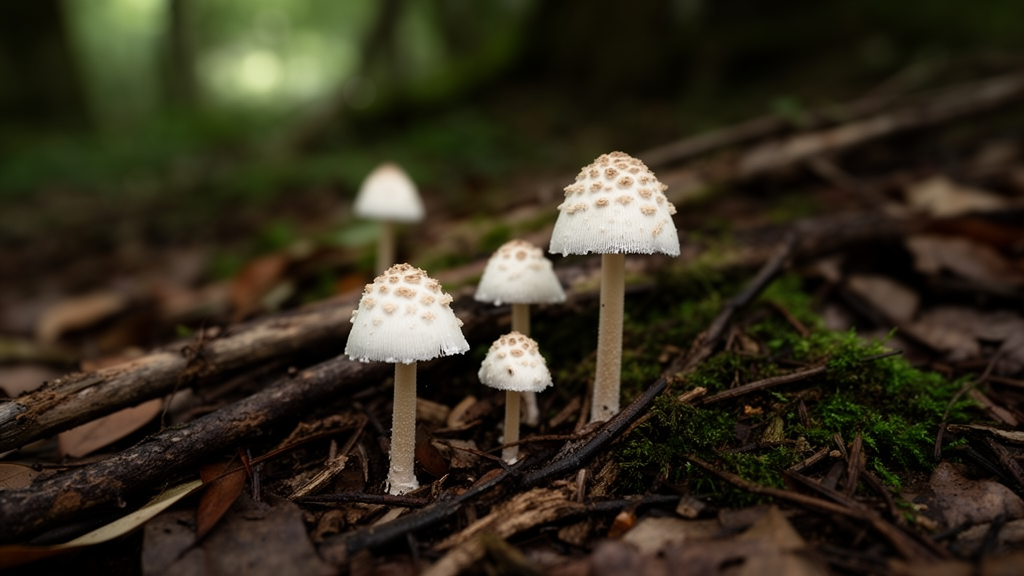
Deep in the temperate forests of Hebei Province, northern China, mycologists have formally described four previously unknown species of Lepiota, a genus of small litter-decomposing mushrooms notorious for confounding taxonomists. The new species, Lepiota huangyangshanensis, L. maojingbaensis, L. varia, and L. xiaowutaishanensis, were identified through a combination of detailed morphological study and multilocus phylogenetic analysis, and each was assigned to a well-defined section of the genus: sect. Eriophorae, sect. Stenosporae, and sect. Cristatae. The discovery, part of a broader survey of macrofungal diversity in Hebei, adds to a growing body of evidence that the fungal flora of northern China remains substantially underexplored.
Lepiota is one of the most species-rich genera of agaricoid fungi, currently estimated at roughly 610 recognized species according to the Index Fungorum and MycoBank databases as of 22 September 2026, a figure that may include taxa not yet formally transferred to other genera. The mushrooms are distributed from tropical to temperate regions worldwide and grow mainly in forest and grassland soils rich in humus. Historically, the genus was accommodated within Agaricaceae, but recent taxonomic work recognizes the lineage as a distinct family, Verrucosporaceae. Modern classification characterizes Lepiota species by basidiomata with universal or partial veils, free lamellae, whitish spore prints, predominantly dextrinoid basidiospores, and clamp connections throughout the fruiting bodies.
What makes Lepiota so taxonomically difficult is the substantial variation in macromorphology, coloration, and microscopic characters, which has historically produced considerable disagreement over infrageneric classification and the status of related lineages such as Echinoderma. That picture changed with recent multilocus phylogenetic analyses based on ITS, nrLSU, RPB2, and mtSSU sequences, which established Echinoderma as an independent genus and resolved Lepiota into seven stable sections: sect. Eriophorae, sect. Lepiota, sect. Fuscovinaceae, sect. Stenosporae, sect. Cristatae, sect. Helveolae, and sect. Lilaceae. Approximately 85 Lepiota species have been reported from China, including 25 originally described from the country, but only eight of those 25 new taxa have been recorded in northern China, suggesting that regional diversity has been significantly underestimated.
The research team collected fresh basidiomata from natural habitats across Hebei Province, depositing specimens at the herbaria of Hezhou University and Langfang Normal University. Macromorphological descriptions of color, size, and stipe characteristics were based on on-site records of fresh specimens, with colors strictly following established fungal color standards. Microscopic work involved mounting tissue sections in 10% potassium hydroxide solution and Congo red, with cotton blue, Melzer’s reagent, and brilliant cresyl blue used as auxiliary reagents to identify specific structures such as spore wall reactions. Twenty basidia and cystidia were measured from each collection, and basidiospore dimensions were reported using standardized statistical notation covering minimum, 90% range, and maximum values.
On the molecular side, genomic DNA was extracted from dried specimens and polymerase chain reaction was used to amplify sequences of four regions: the internal transcribed spacer (ITS), the nuclear ribosomal large subunit (nrLSU), the mitochondrial small subunit (mtSSU), and the RNA polymerase II second largest subunit gene (RPB2). Specific primer pairs were chosen for each locus, and purified PCR products were sequenced commercially, with all newly generated sequences submitted to GenBank. The combined four-gene dataset ultimately included 284 sequences, 33 of them newly generated in this study, aligned with reference sequences downloaded from GenBank and selected to represent all species within the genus’s sections, with Cystolepiota bucknallii serving as the outgroup.
Phylogenetic analyses using maximum likelihood and Bayesian inference algorithms produced largely congruent topologies and revealed that Lepiota is divided into eight well-supported clades recognized as sections. The analyses employed RAxML-NG with 1,000 bootstrap replicates for maximum likelihood support and MrBayes under best-fit nucleotide substitution models selected by the Bayesian information criterion, with branches considered significantly supported at bootstrap values of 50% or higher and posterior probabilities of 0.95 or higher. Critically, the four proposed new species each formed monophyletic groups with maximum support. Lepiota varia and L. maojingbaensis were nested within sect. Stenosporae, L. xiaowutaishanensis was recovered within sect. Cristatae, and L. huangyangshanensis was placed within sect. Eriophorae. The study also found that subsection Paralilaceae did not form a monophyletic clade within sect. Lilaceae and consequently raised it to the rank of section.
Each new species carries distinctive technical features. Lepiota huangyangshanensis, from Huangyangshan National Forest Park at 1,300 meters elevation, produces small gregarious fruiting bodies with cream to straw-yellow pilei bearing straw-yellow to olivaceous buff squamules. It is distinguished by a pileus covering and stipe covering composed of chains of either spherical or cylindrical cells, narrowly clavate to clavate cheilocystidia, and smaller thick-walled basidiospores measuring 3.1 to 4.8 by 2.0 to 3.1 micrometers. Phylogenetically it formed a well-supported lineage with L. pseudoasperula within sect. Eriophorae, but that species differs in its light to pale cream pileus with dark brown scales and the absence of cheilocystidia, while L. omninoflava, which has similarly colored basidiomata, lacks cheilocystidia and has longer, thin-walled basidiospores.
Lepiota maojingbaensis, described from Maojingba National Forest Park at 1,450 meters, is characterized by a conical, cream to pale clay-buff pileus that cracks at maturity, a farinaceous to rancid farinaceous odor, and long-ellipsoid to sub-fusiform basidiospores averaging 7.16 by 3.18 micrometers. It is resolved as a sister group to a subclade comprising L. boudieri, L. aureofulvella, L. rhodophylla, and L. andegavensis, species that differ in their cutis-like pileus coverings or longer basidiospores. Lepiota varia, whose epithet refers to the variable color of its pileus and stipe, produces the largest fruiting bodies of the four, with pilei of 29 to 37 millimeters covered in flesh-pink, brownish vinaceous to rose squamules. It is closely related to L. citrophylla and L. flavonigrescens but differs in having smaller basidiospores, and among recently described sect. Stenosporae species it stands apart in pileus coloration and micromorphological features such as cheilocystidia and terminal cell dimensions.
The fourth species, Lepiota xiaowutaishanensis, was collected in Xiaowutaishan National Nature Reserve at 1,350 to 1,400 meters and is notable for its white, flesh-pink to clay-pink pileus and comparatively large stipe measuring 60 to 88 by 3 to 6 millimeters. Its pileus covering is a hymeniderm composed of erect, broadly clavate elements, and its thick-walled basidiospores average 4.37 by 2.94 micrometers. Phylogenetically it clusters with L. thiersii, L. recondita, and L. sinorecondita, but unlike the new species those relatives exhibit dark pilei and non-dextrinoid basidiospores. Lepiota psalion, which shares a hymeniform pileus covering and similarly sized basidiospores, can be distinguished by concentric, non-uplifted squamules and a much smaller stipe of 22 to 33 by 1.5 to 2 millimeters. All four species were collected on the ground in mixed coniferous and broad-leaved forests dominated by trees such as Pinus tabuliformis, Quercus species, Betula platyphylla, Larix principis-rupprechtii, and Populus davidiana.
The findings carry broader significance for understanding fungal diversity in northern China. Previous work described one new sect. Cristatae species from Shanxi Province and documented six new species and one new record in sect. Stenosporae from the temperate forests of Northeast China, but systematic sampling across the entire temperate zone of northern China remains fragmentary, and large-scale biogeographic comparisons are constrained by limited specimen-based occurrence records and by the absence of sequence data for several species recorded from the region. The new taxa also align well with the morphological features established for their respective sections: L. huangyangshanensis shows the chains of spherical or cylindrical cells and small ellipsoid to amygdaliform basidiospores typical of sect. Eriophorae, L. maojingbaensis and L. varia exhibit trichodermal pileus coverings and truncate to spurred basidiospores consistent with sect. Stenosporae, and L. xiaowutaishanensis features a hymeniform pileus covering and ellipsoid to oblong basidiospores characteristic of sect. Cristatae. Although the precise ecological roles of Lepiota species have not been fully elucidated, they are widely recognized as saprotrophic fungi with potential functions in forest litter decomposition and nutrient dynamics. The four new species provide baseline morphological and molecular data for future taxonomic, ecological, and biogeographic investigations of this challenging genus.
Subject of Research: Taxonomy and phylogenetics of four new Lepiota mushroom species from Hebei Province, China
Article Title: Molecular and morphological evidence reveals four new species of the genus Lepiota ( Agaricales , Verrucosporaceae ) in Hebei Province, China
Article References: An, Q., Zhao, X.-Y., Li, R.-M., Shui, W.-R., Zhang, W.-B., Liu, Y.-M., Zhang, Y.-J., Wang, L.-A., Zhao, X., & Han, M.-L. (2026). Molecular and morphological evidence reveals four new species of the genus Lepiota (Agaricales, Verrucosporaceae) in Hebei Province, China. MycoKeys, 142, 185-213. https://doi.org/10.3897/mycokeys.142.200915
Image Credits: AI Generated
DOI: 10.3897/mycokeys.142.200915
Keywords: Lepiota, Agaricales, Verrucosporaceae, new species, taxonomy, phylogenetics, Hebei Province, China, mycology, litter-decomposing fungi, ITS, multilocus analysis
Cite Scienmag News
Roger Howard. (October 26, 2026). Four New Lepiota Mushroom Species Uncovered in Hebei Province, China. Scienmag. https://scienmag.com/four-new-lepiota-mushroom-species-uncovered-in-hebei-province-china/
Roger Howard. "Four New Lepiota Mushroom Species Uncovered in Hebei Province, China." Scienmag, 26 October 2026, https://scienmag.com/four-new-lepiota-mushroom-species-uncovered-in-hebei-province-china/. Accessed 26 October 2026.
Roger Howard. "Four New Lepiota Mushroom Species Uncovered in Hebei Province, China." Scienmag. October 26, 2026. https://scienmag.com/four-new-lepiota-mushroom-species-uncovered-in-hebei-province-china/


