


Distant recurrence in glioblastoma has long been one of the most feared trajectories in neuro-oncology, and a new study published in the Journal of Neuro-Oncology offers a detailed explanation of why it happens. Rather than arising from new genetic drift, the research finds that distant recurrent tumors are defined by a deliberately reconfigured immune microenvironment, orchestrated by a small subpopulation of tumor cells that communicate directly with macrophages to make distant brain tissue hospitable to cancer growth.
The research team, led by Xiuwei Yan, Jiahe Hu, Yahui Hu and colleagues including Shaoshan Hu, performed single-cell RNA sequencing on paired primary and distant recurrence specimens from glioblastoma patients, alongside an independent cohort of local recurrences for comparison. This design allowed them to map how the cellular composition of tumors shifts when the disease re-emerges in spatially isolated neural niches rather than at the original site.
The atlas revealed a profound remodeling of the immune landscape in distant recurrent lesions. Two features stood out: a specific expansion of anti-inflammatory, monocyte-derived tumor-associated macrophages, and a paradoxical co-enrichment of both CD8-positive cytotoxic T cells and regulatory T cells. This combination suggests that distant recurrence sites are not simply immunologically cold, but actively shaped into a niche where suppressive myeloid cells and regulatory lymphocytes coexist with an apparent antitumor T cell presence.
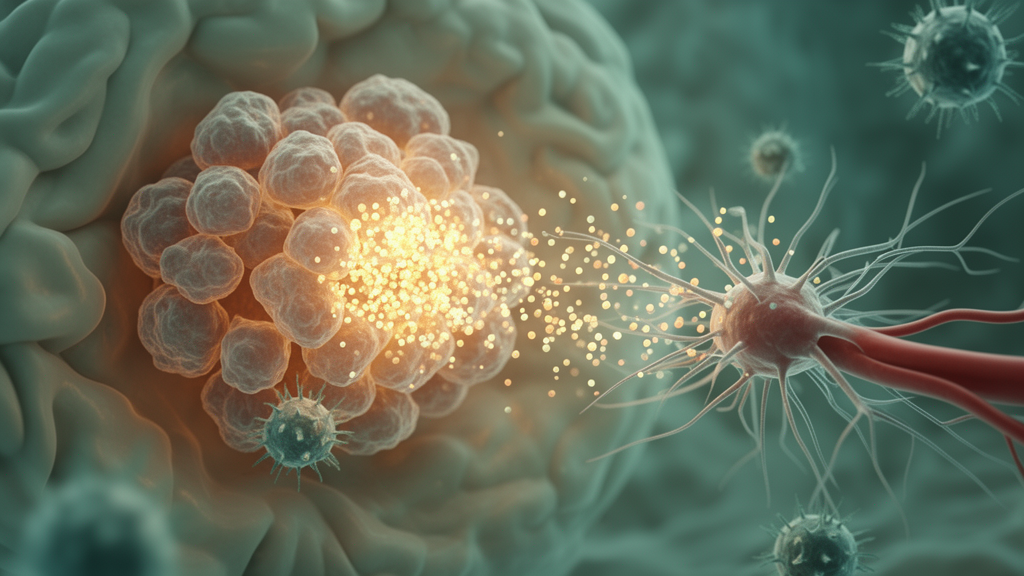
The mechanistic centerpiece of the study is a subpopulation of tumor cells resembling oligodendrocyte precursor cells that express the protein pleiotrophin, or PTN. The authors describe these PTN-positive cells as a paracrine architect, a term that captures their role in remotely conditioning the environment. Through the interaction between PTN and its partner protein nucleolin, or NCL, these tumor cells promote the polarization of macrophages toward the anti-inflammatory state that dominates distant recurrent lesions.
The evidence for this physical interaction is not purely computational. Co-immunoprecipitation assays carried out on human distant recurrence tissues confirmed that PTN and NCL bind directly to each other in patient material. This validation matters because cell-cell communication inference tools such as CellChat, which the team used alongside differential abundance testing with Milo and copy number variation analysis, generate predictions that require experimental confirmation in real tissue.
Functional experiments then tested whether this crosstalk actually drives malignant behavior. In bidirectional knockdown assays and in vitro co-culture systems, the researchers disrupted the communication axis from either side: targeting PTN in the tumor cells or NCL in the macrophages. Both interventions significantly attenuated glioma cell proliferation, migration and invasion, and both reduced the polarization of macrophages toward the anti-inflammatory phenotype. The symmetry of the result strengthens the case that the PTN-NCL interaction is a genuine dependency rather than a bystander correlation.
The in vivo work extended these findings to an orthotopic xenograft mouse model. When the team silenced PTN, they observed a marked reduction in anti-inflammatory tumor-associated macrophage infiltration, suppression of intracranial tumor burden, and prolonged overall survival in tumor-bearing mice. This is the strongest evidence in the study that the paracrine axis is not merely associated with distant recurrence but functionally supports it, at least in the preclinical setting.
The conceptual significance of the work lies in its reframing of recurrence biology. Glioblastoma recurrence has often been interpreted through the lens of clonal evolution, with resistant genetic subpopulations surviving therapy and repopulating the tumor. The new data indicate that distant recurrence is instead characterized by a reconfigured immune niche, in which disseminated tumor cells actively cultivate a permissive soil rather than passively adapting to it. The tumor subclone, in this view, behaves as an ecosystem engineer.
Therapeutically, the study points to the PTN-NCL interaction as a targetable vulnerability. Because decoupling the communication from either the tumor side or the macrophage side produced measurable anti-tumor effects in vitro and extended survival in mice, the axis offers a rationale for therapies designed to disrupt the supportive microenvironment in distant recurrent glioblastoma. The authors position this paracrine crosstalk as a promising therapeutic target, though the findings remain at the preclinical and mechanistic stage.
Important limitations frame the interpretation. The human evidence comes from a patient cohort analyzed by single-cell sequencing with validation in recurrence tissues, while the survival benefit was demonstrated only in mouse xenografts, not in patients. The paradoxical co-enrichment of CD8-positive T cells and regulatory T cells in distant lesions also raises questions about the functional state of the antitumor immune response that this study maps but does not fully resolve. Even so, the work delivers a coherent mechanistic account of how a defined tumor subclone remodels the immune ecosystem to overcome the anatomical and immunological barriers that normally keep glioblastoma from colonizing distant neural niches.
Subject of Research: Immune reprogramming of distant glioblastoma recurrence by a PTN-positive tumor subclone
Article Title: A PTN+ glioblastoma subclone orchestrates immune reprogramming to drive distant recurrence
Article References: Yan, X., Hu, J., Hu, Y., Xu, M., Gao, S., Han, X., Zhao, D., Li, Q., Zhou, L., & Hu, S. (2026). A PTN+ glioblastoma subclone orchestrates immune reprogramming to drive distant recurrence. Journal of Neuro-Oncology, 180(2), Article 32. https://doi.org/10.1007/s11060-026-05840-9
Image Credits: AI Generated
DOI: 10.1007/s11060-026-05840-9
Keywords: glioblastoma, distant recurrence, tumor-associated macrophages, single-cell RNA sequencing, pleiotrophin, nucleolin, immune microenvironment, paracrine signaling, orthotopic xenograft, tumor niche, Journal of Neuro-Oncology, subclone
Cite Scienmag News
Nathaniel Bowman. (October 26, 2026). PTN-Secreting Glioblastoma Subclone Rebuilds the Immune Niche to Seed Distant Recurrence. Scienmag. https://scienmag.com/ptn-secreting-glioblastoma-subclone-rebuilds-the-immune-niche-to-seed-distant-recurrence/
Nathaniel Bowman. "PTN-Secreting Glioblastoma Subclone Rebuilds the Immune Niche to Seed Distant Recurrence." Scienmag, 26 October 2026, https://scienmag.com/ptn-secreting-glioblastoma-subclone-rebuilds-the-immune-niche-to-seed-distant-recurrence/. Accessed 26 October 2026.
Nathaniel Bowman. "PTN-Secreting Glioblastoma Subclone Rebuilds the Immune Niche to Seed Distant Recurrence." Scienmag. October 26, 2026. https://scienmag.com/ptn-secreting-glioblastoma-subclone-rebuilds-the-immune-niche-to-seed-distant-recurrence/


