

Monday, October 26, 2026
Science
No Result
View All Result
  • Login
  • HOME
  • SCIENCE NEWS
  • CONTACT US
  • HOME
  • SCIENCE NEWS
  • CONTACT US
No Result
View All Result
Scienmag
No Result
View All Result
Home Science News Cancer

NRAS mutation renders ovarian cancer cells vulnerable to MEK inhibitor trametinib

October 26, 2026
in Cancer
Nathaniel Bowman
By Nathaniel Bowman Scienmag Editorial Profile - Precision Oncology
Reading Time: 3 mins read
0
NRAS mutation renders ovarian cancer cells vulnerable to MEK inhibitor trametinib

NRAS mutation renders ovarian cancer cells vulnerable to MEK inhibitor trametinib

65
SHARES
587
VIEWS
Share on FacebookShare on Twitter
ADVERTISEMENT

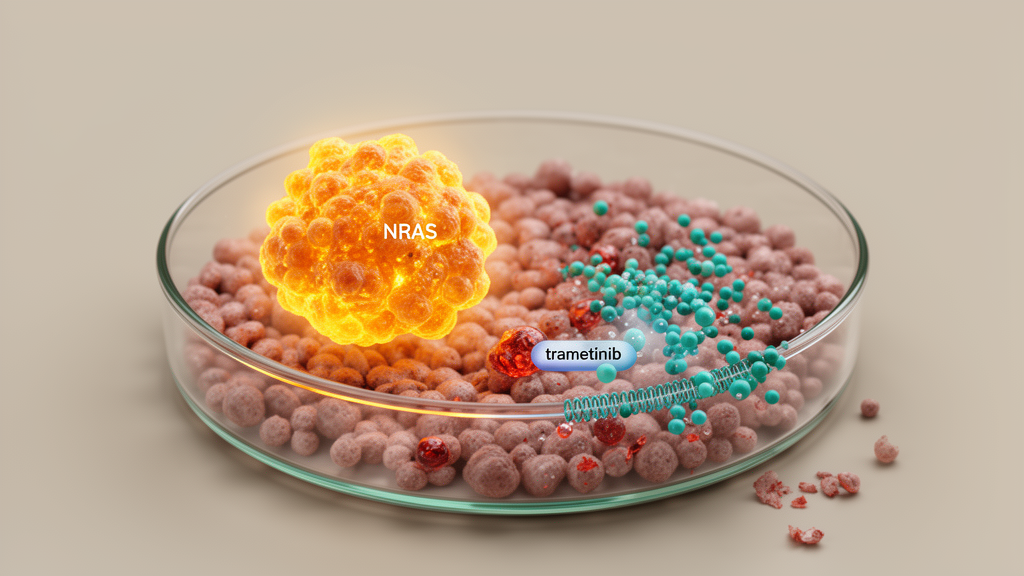
A new laboratory study suggests that an activating mutation in the NRAS gene, or simple overexpression of the wild-type gene, can make ovarian cancer cells unusually vulnerable to the MEK inhibitor trametinib. The finding, published open access in the Journal of Cancer Research and Clinical Oncology, points to a possible route for extending MEK-targeted strategies beyond low-grade serous carcinoma, the setting from which this study deliberately excluded itself, although the evidence comes entirely from engineered cell models rather than patients.

Ovarian cancer remains difficult to diagnose early and frequently recurs, and recurring tumors are often resistant to the platinum-based chemotherapy that forms the backbone of first-line treatment. The RAS/RAF/MEK/ERK signaling pathway, which can be distorted by mutations in RAS-family proteins, influences tumor progression and chemoresistance. Trametinib targets this pathway by blocking MEK. The research team, led by Hugo T. H. Chen and Mingo M. H. Yung with senior authors including David W. Chan and Karen K. L. Chan, set out to test whether NRAS activity determines how non-low-grade serous ovarian cancer cells respond to this drug.

Methodologically, the group used retroviral transduction to force three established ovarian cancer cell lines — TOV112D, OVCA433 and ES2 — to express either wild-type NRAS or the gain-of-function NRASQ61K variant. These engineered models were then run through functional assays measuring proliferation, migration and invasion, with and without trametinib and with and without cisplatin, allowing direct comparison of cell behavior before and after treatment. Because the cell lines were manipulated to express NRAS at elevated levels or to carry the Q61K mutation, the models test a specific engineered condition rather than the natural mutation landscape of ovarian tumors.

The results showed that NRAS expression promoted proliferation as well as the migratory and invasive capacities of the ovarian cancer cells. Cells carrying the NRASQ61K mutation were more migratory and invasive still, and they displayed heightened susceptibility to MEK inhibition by trametinib. In a second, clinically relevant twist, trametinib also enhanced the cytotoxicity of cisplatin in the mutated models, indicating that MEK blockade may sensitize NRASQ61K cells to standard chemotherapy rather than merely acting as a standalone agent.

The authors conclude that the NRASQ61K mutation confers susceptibility to trametinib in selected engineered ovarian cancer models outside the low-grade serous carcinoma setting. The study type matters for interpretation: these are cell-line experiments with induced NRAS expression or mutation, so the findings establish a mechanistic vulnerability and a testable biomarker hypothesis, not demonstrated efficacy in patients. Whether NRAS upregulation or Q61K-type mutations can identify trametinib-responsive tumors in the clinic will require validation in patient-derived models and clinical trials. Nevertheless, the work adds a concrete piece to the puzzle of chemoresistant ovarian cancer, linking a specific RAS-family alteration to both aggressive cell behavior and a druggable dependence on the MEK/ERK pathway.

Subject of Research: NRAS-driven susceptibility to the MEK inhibitor trametinib in non-LGSC ovarian cancer cell models

Article Title: NRAS upregulation or gain-of-function mutation confers susceptibility to the MEK inhibitor trametinib in ovarian cancer models outside the LGSC setting

Article References: Chen, H. T. H., Yung, M. M. H., Siu, M. K. Y., Tang, C., Hui, L. M. H., Zhong, K. X., Lu, H., Liu, K., Ngan, H. Y. S., Tsui, S. K. W., Chan, D. W., & Chan, K. K. L. (2026). NRAS upregulation or gain-of-function mutation confers susceptibility to the MEK inhibitor trametinib in ovarian cancer models outside the LGSC setting. Journal of Cancer Research and Clinical Oncology. https://doi.org/10.1007/s00432-026-06645-z

Image Credits: AI Generated

DOI: 10.1007/s00432-026-06645-z

Keywords: ovarian cancer, NRAS, trametinib, MEK inhibitor, RAS/RAF/MEK/ERK pathway, Q61K mutation, cisplatin, cell line models, low-grade serous carcinoma, targeted therapy, gain-of-function, chemoresistance

Cite Scienmag News

Nathaniel Bowman. (October 26, 2026). NRAS mutation renders ovarian cancer cells vulnerable to MEK inhibitor trametinib. Scienmag. https://scienmag.com/nras-mutation-renders-ovarian-cancer-cells-vulnerable-to-mek-inhibitor-trametinib/


Nathaniel Bowman. "NRAS mutation renders ovarian cancer cells vulnerable to MEK inhibitor trametinib." Scienmag, 26 October 2026, https://scienmag.com/nras-mutation-renders-ovarian-cancer-cells-vulnerable-to-mek-inhibitor-trametinib/. Accessed 26 October 2026.

Nathaniel Bowman. "NRAS mutation renders ovarian cancer cells vulnerable to MEK inhibitor trametinib." Scienmag. October 26, 2026. https://scienmag.com/nras-mutation-renders-ovarian-cancer-cells-vulnerable-to-mek-inhibitor-trametinib/

Tags: cell line modelschemoresistancecisplatinengineered cell models in cancer researchgain-of-functiongenetic mutations influencing ovarian cancer responselow-grade serous carcinomaMEK inhibitorMEK inhibitor efficacy in ovarian cancer cellsNRASNRAS mutation ovarian cancer vulnerability to MEK inhibitor trametinibOvarian cancerovarian cancer cell line models for targeted therapyovarian cancer treatment resistancepotential for expanded use of MEK inhibitorsQ61K mutationRAS-RAF-MEK-ERK pathwayRAS/RAF/MEK/ERK pathway in ovarian cancerrole of NRAS mutations in chemoresistanceTargeted therapytargeted therapy for ovarian cancertrametinibtrametinib mechanism of action in ovarian cancer
Share26Tweet16
Previous Post

Two Muscle Stem Cell Fates Track Hyperplasia and Hypertrophy in Growing Trout

Next Post

Ketamine Infusions Rise Sharply Among the Sickest Preterm Infants With Severe Lung Disease

Related Posts

Gene Mutations Flag Poor Survival in Advanced Myeloproliferative Neoplasms
Cancer

Gene Mutations Flag Poor Survival in Advanced Myeloproliferative Neoplasms

October 26, 2026
Ginger-Derived Silver Nanoparticles Show Anticancer Activity in Lab and Mouse Studies
Cancer

Ginger-Derived Silver Nanoparticles Show Anticancer Activity in Lab and Mouse Studies

October 26, 2026
AI models fuse multi-omics data to predict immunotherapy response in cancer
Cancer

AI models fuse multi-omics data to predict immunotherapy response in cancer

October 26, 2026
Study Finds 26% of Young Adult Cancer Survivors Sexually Inactive
Cancer

Study Finds 26% of Young Adult Cancer Survivors Sexually Inactive

October 26, 2026
Advanced Diffusion MRI Outperforms Standard Method in Telling Atypical Glioma from Brain Lymphoma
Cancer

Advanced Diffusion MRI Outperforms Standard Method in Telling Atypical Glioma from Brain Lymphoma

October 26, 2026
Symbolic AI digital twins predict breast cancer treatment response in trial simulation
Cancer

Symbolic AI digital twins predict breast cancer treatment response in trial simulation

October 26, 2026
Next Post
Ketamine Infusions Rise Sharply Among the Sickest Preterm Infants With Severe Lung Disease

Ketamine Infusions Rise Sharply Among the Sickest Preterm Infants With Severe Lung Disease

  • Mothers who receive childcare support from maternal grandparents show more optimized

    Mothers who receive childcare support from maternal grandparents show more parental warmth, finds NTU Singapore study

    27656 shares
    Share 11059 Tweet 6912
  • University of Seville Breaks 120-Year-Old Mystery, Revises a Key Einstein Concept

    1061 shares
    Share 424 Tweet 265
  • Bee body mass, pathogens and local climate influence heat tolerance

    682 shares
    Share 273 Tweet 171
  • Researchers record first-ever images and data of a shark experiencing a boat strike

    546 shares
    Share 218 Tweet 137
  • Groundbreaking Clinical Trial Reveals Lubiprostone Enhances Kidney Function

    531 shares
    Share 212 Tweet 133
Science

Embark on a thrilling journey of discovery with Scienmag.com—your ultimate source for cutting-edge breakthroughs. Immerse yourself in a world where curiosity knows no limits and tomorrow’s possibilities become today’s reality!

RECENT NEWS

  • Gene Mutations Flag Poor Survival in Advanced Myeloproliferative Neoplasms
  • Plasma Protein Signatures Predict Rheumatoid Arthritis Years Before Symptoms Appear
  • Ketamine Infusions Rise Sharply Among the Sickest Preterm Infants With Severe Lung Disease
  • NRAS mutation renders ovarian cancer cells vulnerable to MEK inhibitor trametinib

Categories

  • Agriculture
  • Anthropology
  • Archaeology
  • Athmospheric
  • Biology
  • Biotechnology
  • Blog
  • Bussines
  • Cancer
  • Chemistry
  • Climate
  • Earth Science
  • Editorial Policy
  • Marine
  • Mathematics
  • Medicine
  • Pediatry
  • Policy
  • Psychology & Psychiatry
  • Science Education
  • Science News
  • Social Science
  • Space
  • Technology and Engineering

Subscribe to Blog via Email

Enter your email address to subscribe to this blog and receive notifications of new posts by email.

Join 5,151 other subscribers

© 2025 Scienmag - Science Magazine

Welcome Back!

Login to your account below

Forgotten Password?

Retrieve your password

Please enter your username or email address to reset your password.

Log In
No Result
View All Result
  • HOME
  • SCIENCE NEWS
  • CONTACT US

© 2025 Scienmag - Science Magazine

Discover more from Science

Subscribe now to keep reading and get access to the full archive.

Continue reading