


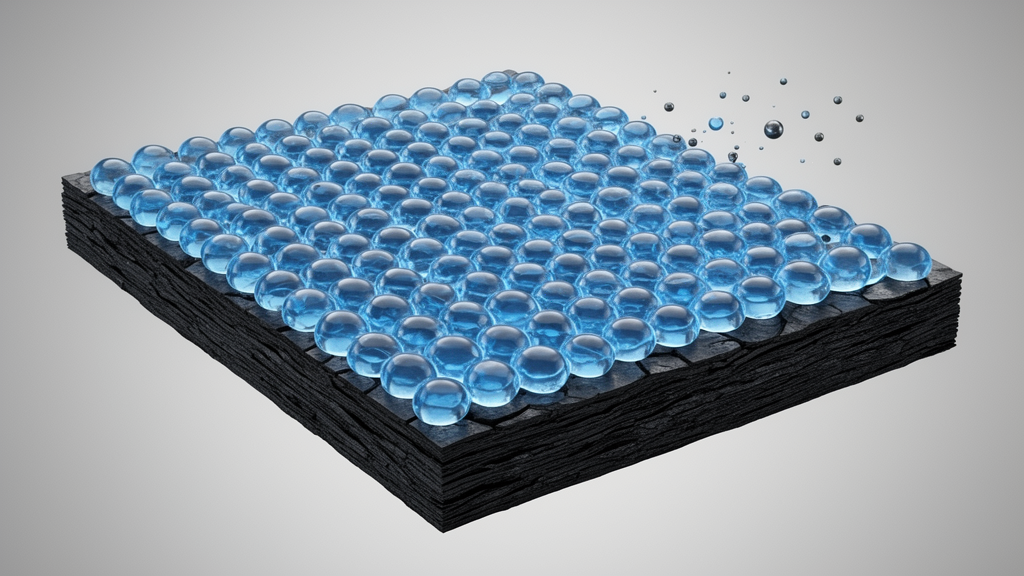
Carbon electrodes are the quiet workhorses of modern electrochemistry. They are inexpensive, electrically conductive, and widely used in technologies such as fuel cells and water electrolyzers. Yet carbon has a persistent weakness: under the strongly oxidizing conditions that occur at anodes, it slowly corrodes, oxidizing into carbon dioxide and degrading the devices that depend on it. Now a research team at The University of Osaka, working with international collaborators, has identified an unexpected factor that governs this degradation, and it is not the carbon itself. It is the water.
The researchers monitored both carbon corrosion and the structure of water molecules at the electrode surface during operation, and they found a striking correlation. When the network of hydrogen bonds connecting water molecules immediately adjacent to the electrode was intact and ordered, the carbon surface remained stable. When that network became disrupted, corrosion accelerated. The team’s measurements indicated that weakly connected water molecules were preferentially involved in the oxidation of carbon to carbon dioxide, and when the researchers deliberately disturbed the interfacial water network, corrosion increased further. In other words, the microscopic arrangement of water at the electrode boundary acts as a kind of protective architecture, and breaking that architecture opens the door to chemical attack on the carbon underneath.
This observation reframes a long-standing problem in electrode design. Rather than altering the carbon itself, the Osaka-led team altered its immediate environment. They deployed different ion-conducting polymers, known as ionomers, to reorganize the water structure at the electrode surface. Among the materials tested, an ionomer called Sustainion created a more strongly connected water network than Nafion, the commonly used polymer. The effect on durability was substantial: carbon corrosion dropped by about 51 percent compared with the Nafion-based configuration.
The concept then faced a more demanding test. The researchers applied it to a chlorine-producing system that used a platinum catalyst supported on carbon, a setup in which both catalytic performance and electrode longevity matter. Sustainion improved durability, but it came at a cost, initially reducing the catalytic activity of the electrode. To resolve this trade-off, the team combined Sustainion with Nafion in a blended ionomer layer. The hybrid approach retained high initial activity while limiting performance loss to 19 percent after 500 operating cycles, suggesting that water-network engineering can be tuned to balance reactivity and stability rather than sacrificing one for the other.
“Electrodes are often considered the main players in electrochemical reactions, but the water immediately surrounding them is also important,” said Dr. Yu Katayama, one of the corresponding authors at The University of Osaka. “Our results show that designing the environment around an electrode, not only the electrode material itself, could help improve its durability.” The finding carries practical weight because interfacial water structure is not a fixed property of an electrode. As this study demonstrates, it can be reshaped through the ionomers placed around the electrode, making the water network itself a designable variable.
The study, published in Angewandte Chemie International Edition, was an experimental investigation, and its findings were drawn from laboratory measurements of corrosion and interfacial water structure during electrode operation. As with any new design principle, the durability gains reported here will need to be validated across longer operating times, larger electrodes, and commercially relevant device architectures before they translate into industrial practice. The chlorine-system test, while encouraging, involved 500 cycles in a laboratory configuration, and the release does not report performance data beyond that point.
Even so, the central message is likely to resonate widely in electrochemistry. The water molecule, so often treated as an inert solvent, emerges from this work as an active structural participant in electrode stability. A well-connected water network shields carbon from oxidation; a fragmented one invites it. The researchers highlight control of interfacial water as a promising design principle for carbon electrodes, one that could contribute to longer-lasting electrochemical technologies, including green hydrogen production, chlorine manufacturing, and fuel cells. That insight transforms interfacial water from a background detail into a design target, and it suggests that the next generation of durable carbon electrodes may be built not by perfecting the carbon, but by perfecting the water that touches it.
Subject of Research: Interfacial water structure and carbon electrode corrosion
Article Title: Keeping water connected helps carbon electrodes last longer
Article References: Keeping water connected helps carbon electrodes last longer. Original publication (Bibliographic details unavailable.)
Image Credits: AI Generated
DOI: Not provided
Keywords: carbon electrodes, interfacial water, electrochemistry, corrosion, ionomers, fuel cells, water electrolysis, green hydrogen, The University of Osaka, Angewandte Chemie International Edition, Keeping, water
Cite Scienmag News
Bethany Barker. (October 26, 2026). Ordered Water Networks Shield Carbon Electrodes from Corrosion. Scienmag. https://scienmag.com/ordered-water-networks-shield-carbon-electrodes-from-corrosion/
Bethany Barker. "Ordered Water Networks Shield Carbon Electrodes from Corrosion." Scienmag, 26 October 2026, https://scienmag.com/ordered-water-networks-shield-carbon-electrodes-from-corrosion/. Accessed 26 October 2026.
Bethany Barker. "Ordered Water Networks Shield Carbon Electrodes from Corrosion." Scienmag. October 26, 2026. https://scienmag.com/ordered-water-networks-shield-carbon-electrodes-from-corrosion/


