


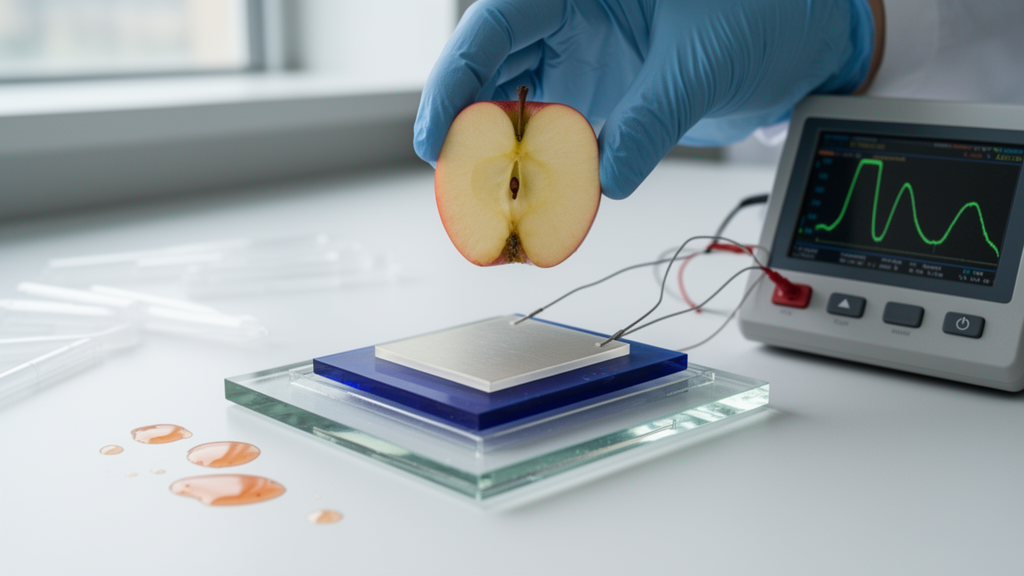
Researchers at the University of Gondar in Ethiopia have built a simple, low-cost electrochemical sensor that can trace minute amounts of diazinon, a widely used organophosphate pesticide, in papaya, watermelon, mango, and avocado. The device relies on a glassy carbon electrode coated with two complementary layers: an electroactive film of the polymerized dye methylene blue and a chelating layer of 1,5-diphenylcarbazide. In differential pulse voltammetry measurements, the sensor responded linearly to diazinon concentrations from 0.01 to 1.6 micromolar and reached a detection limit of 0.093 micromolar, with spike recoveries in real fruit extracts ranging from 97.3 to 99.5 percent. The team reports the findings as a demonstration that a carefully designed bilayer, rather than an elaborate nanocomposite, can deliver reliable pesticide monitoring in complex food matrices.
Diazinon is one of the workhorse insecticides of modern agriculture, particularly in developing countries such as Ethiopia, where farmers apply it extensively to protect crops and control insect pests. Only a fraction of the applied chemical ever reaches its intended target; the rest can linger in soil, water, air, and food chains, exposing non-target organisms and people. The World Health Organization classifies diazinon as a moderately hazardous, Class II pesticide, and exposure has been associated with neurotoxicity, endocrine disruption, and adverse environmental effects even at relatively low concentrations. Its toxicity stems largely from its ability to inhibit acetylcholinesterase, the enzyme that hydrolyzes the neurotransmitter acetylcholine, a mechanism it shares with other organophosphate pesticides.
Regulatory history underscores why sensitive monitoring matters. The Joint FAO/WHO Meeting on Pesticide Residues has reviewed diazinon repeatedly since its first evaluation in 1963. In 1966, the meeting set an acceptable daily intake of 0 to 0.002 milligrams per kilogram of body weight per day, derived from a no-observed-effect level of 0.02 milligrams per kilogram per day for inhibition of plasma cholinesterase activity in a 37-to-43-day human study. In 2001, an acute reference dose of 0.03 milligrams per kilogram of body weight was established, based on a no-observed-adverse-effect level of 2.5 milligrams per kilogram observed in a study of acute neurotoxicity in rats. These tight thresholds leave little margin for error in residue analysis.
Conventional analytical techniques for diazinon, including gas chromatography, high-performance liquid chromatography, and gas chromatography-mass spectrometry, are accurate but demanding. They require expensive instrumentation, extensive solvent consumption, tedious sample preparation, and trained specialists, which limits their availability in many settings. Electrochemical sensors offer an alternative: they are sensitive, fast, easy to operate, and amenable to miniaturization and field deployment. The performance of any such sensor, however, hinges on the surface of the working electrode, where electron transfer and molecular recognition must both be optimized for the target analyte.
Previous electroanalytical approaches to diazinon have relied on bare electrodes modified with carbon nanotubes, titanium dioxide nanoparticles, gold-palladium composites on reduced graphene oxide, gold nanoparticles, graphene quantum dot composites, and nickel zinc oxide nanoparticles. These nanostructured modifiers enhance conductivity, surface area, and electron transfer, but they do not necessarily provide specific molecular interactions with diazinon, and multicomponent nanocomposites can be complicated to construct. The Gondar team took a different route, pairing an electrocatalytically active, redox-conductive polymer with a molecular recognition component in a deliberately simple two-layer design.
The fabrication process began with a glassy carbon electrode polished with alumina slurries down to 0.05 micrometers until a mirror finish was obtained. The clean electrode was functionalized with a freshly prepared 1,5-diphenylcarbazide solution in ethanol via cyclic voltammetry, then rinsed and air-dried. This layer supplies chelating sites, specifically amine and carbonyl groups, that bind the analyte and enable selective preconcentration. Methylene blue was then electropolymerized on top by scanning between minus 0.5 and plus 0.8 volts at 100 millivolts per second for 20 cycles in a 1.0 millimolar solution at pH 5.0. Optimization experiments identified 0.5 millimolar 1,5-diphenylcarbazide for two cycles and 1.0 millimolar methylene blue for 20 cycles as the best conditions; denser films formed above these parameters actually reduced conductivity and current response.
Characterization confirmed that the bilayer works synergistically. In cyclic voltammetry with a ferricyanide-ferrocyanide probe, the modified electrode produced the highest oxidation and reduction peak currents among bare glassy carbon, the chelator-only electrode, and the polymer-only electrode, indicating superior catalytic activity and electron transfer. The electroactive surface area grew from 2.2 by 10 to the minus 3 square centimeters for bare glassy carbon to 3.0 by 10 to the minus 3 for the modified electrode. Electrochemical impedance spectroscopy told a complementary story: the chelator layer alone raised charge-transfer resistance to 1558.2 ohms because of its insulating organic nature, but adding the conductive polymer film drove resistance down to 66.36 ohms, the lowest of all tested surfaces. The heterogeneous electron-transfer rate constant of the modified electrode, 4.46 by 10 to the minus 3 centimeters per second, was about 2.35 times that of the bare electrode, matching its measured roughness factor.
Electrochemical experiments clarified how diazinon reacts at the sensor surface. Peak current peaked at pH 5.0 in acetate buffer and declined on either side, and the reduction potential shifted negatively with increasing pH at a slope of minus 67 millivolts per pH unit, indicating that equal numbers of protons and electrons participate in the reduction. The team interprets this as a proton-coupled two-electron, two-proton process, consistent with prior reports. Scan-rate studies showed that peak current correlated more strongly with scan rate itself than with its square root, meaning the reduction is predominantly adsorption-controlled, which suits a preconcentration-based sensing strategy in which diazinon accumulates at the recognition layer before electrochemical conversion.
Analytical performance compared favorably with both advanced nanosensors and conventional methods. The detection limit of 0.093 micromolar is higher than that of some sophisticated nanomaterial platforms, such as a nickel zinc oxide carbon quantum dot electrode at 0.0044 micromolar or gold-platinum nanocluster and bismuth carbide aptamer systems near 0.003 micromolar, but it outperformed a Design of Experiments-based approach, a silver nanoparticle carbon nanotube electrode, and conventional HPLC with diode-array detection, while requiring far simpler electrode preparation. Selectivity tests with twice the diazinon concentration of potential interferents, including 2,4-D, methyl parathion, dimethoate, fenthion, carbaryl, propoxur, sodium and magnesium ions, glucose, fructose, and ascorbic acid, produced no obvious change in signal. Repeatability across seven measurements on one electrode yielded a relative standard deviation of 1.18 percent, four independently prepared electrodes agreed within 0.87 percent, and the sensor retained more than 95 percent of its initial response after a week.
Validation in real fruit samples demonstrated practical utility. Homogenized samples of papaya, watermelon, mango, and avocado purchased in Gondar Town were extracted with acetonitrile, centrifuged, diluted with acetate buffer, and analyzed; no diazinon was detected in the unspiked samples. When known amounts of diazinon were added, recoveries ranged from 97.3 to 99.5 percent with relative standard deviations between 0.12 and 2.36 percent, showing that the fruit matrix did not substantially interfere with the measurement. The authors note that although the study used fruit relevant to Ethiopian agricultural conditions, the platform is not restricted to that region and could be applied wherever diazinon is used. They propose extending the dual-modification strategy toward portable, on-site monitoring and multi-residue platforms capable of simultaneously detecting several pesticides in food and environmental samples, positioning the simple bilayer electrode as a promising alternative to conventional pesticide detection methods.
Subject of Research: Development of an electrochemical sensor for diazinon pesticide detection in fruit samples
Article Title: Electrochemical sensing of diazinon using a poly(methylene blue)/1,5-diphenylcarbazide-modified glassy carbon electrode in fruit samples
Article References: Ejigu, A., Guadie, A., Mulu, M., Kassa, A., & Tefera, M. (2026). Electrochemical sensing of diazinon using a poly(methylene blue)/1,5-diphenylcarbazide-modified glassy carbon electrode in fruit samples. Results in Chemistry, 31, Article 104006. https://doi.org/10.1016/j.rechem.2026.104006
Image Credits: AI Generated
DOI: 10.1016/j.rechem.2026.104006
Keywords: diazinon, electrochemical sensor, organophosphate pesticides, methylene blue, 1,5-diphenylcarbazide, glassy carbon electrode, differential pulse voltammetry, pesticide residues, food safety, fruit samples, Ethiopia, electropolymerization
Cite Scienmag News
Bethany Barker. (October 26, 2026). Dye-and-chelator bilayer electrode detects diazinon pesticide in fruit samples. Scienmag. https://scienmag.com/dye-and-chelator-bilayer-electrode-detects-diazinon-pesticide-in-fruit-samples/
Bethany Barker. "Dye-and-chelator bilayer electrode detects diazinon pesticide in fruit samples." Scienmag, 26 October 2026, https://scienmag.com/dye-and-chelator-bilayer-electrode-detects-diazinon-pesticide-in-fruit-samples/. Accessed 26 October 2026.
Bethany Barker. "Dye-and-chelator bilayer electrode detects diazinon pesticide in fruit samples." Scienmag. October 26, 2026. https://scienmag.com/dye-and-chelator-bilayer-electrode-detects-diazinon-pesticide-in-fruit-samples/


