


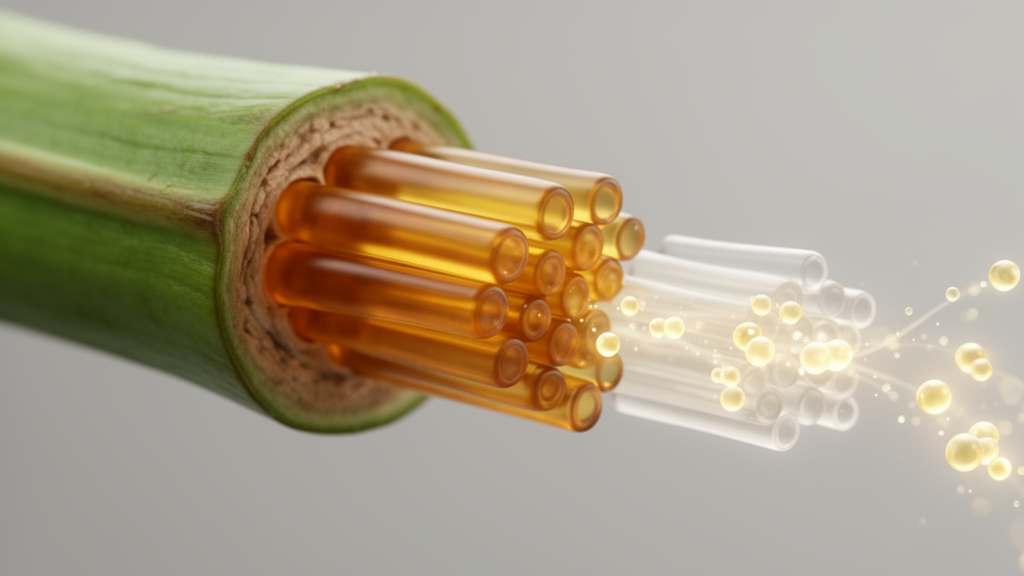
In a discovery that reshapes how scientists view the inner plumbing of plants, researchers have assembled evidence that the sugar-transport capacity of ferns has declined through geological time. By examining the microscopic conducting cells of living species and exceptionally preserved fossils, a team has shown that the cells responsible for carrying sugars through fern stems and leaves have become progressively smaller over evolutionary history. The finding, published in Nature Plants, suggests that the most diverse group of modern ferns—the ones thriving in the shaded understories of angiosperm forests—may have traded transport capacity for survival in a changing world.
Phloem is the sugar-transporting tissue in vascular plants, and its conducting cells, called sieve elements, are among the most important yet least evolutionarily characterized tissues in the plant kingdom. To fill this gap, the researchers carried out a histological investigation of sieve elements in 26 extant fern species spanning 21 families, collectively producing a dataset of roughly 18,000 measurements. The sampling strategy covered disparate morphology, growth form and vascular architecture, from the semi-aquatic Ceratopteris richardii to the giant-leaved eusporangiate fern Angiopteris evecta, whose petiole alone yielded more than 1,200 individual cell measurements. Mature leaves were collected in summer 2022, 2023 and 2024 from the Institute of Molecular Plant Sciences at the University of Edinburgh and the Royal Botanic Garden Edinburgh, with thin sections stained and imaged to reveal the phloem in fine detail.
The results revealed striking diversity in fern phloem. Sieve element radius varied extensively between species, from the smallest at 1.9 micrometres in the floating water fern Salvinia auriculata to the largest at 13.5 micrometres in Angiopteris evecta. Statistical testing confirmed that between-species variation was roughly tenfold higher than within-species variation, suggesting that major differences in sieve element radius between species potentially lead to different phloem conductivity. The team then set out to determine what factors underpin this diversity.
Using phylogenetic generalized least squares analysis to account for evolutionary relatedness among species, the researchers found significant correlations between sieve element radius and both vascular architecture and leaf morphology. Leaf area emerged as the strongest single predictor, explaining 69.9 percent of the variance in sieve element radius. Vascular bundle radius and leaf length were also strong predictors, each accounting for more than half of the variation when analysed individually. When the team combined leaf and vascular traits in pairwise models, the best combinations—either leaf length or leaf area paired with vascular circularity—explained approximately 75 percent of the variation, leaving roughly a quarter unexplained by scaling relationships alone. Not every species fit the pattern neatly: despite the staghorn fern Platycerium bifurcatum having much larger leaves than adder’s-tongue Ophioglossum vulgatum, its sieve element radius was much smaller.
The phylogenetic signal in the data proved equally important. Closely related species possessed similar sieve element radii, as quantified by Blomberg’s K of 1.34 and Pagel’s λ of 1.10, both indicating a strong phylogenetic signal. This pattern held even when species had very different ecologies. For example, the semi-aquatic Ceratopteris richardii might be expected to share sieve element characteristics with aquatic water ferns, but instead its sieve element radius more closely resembled that of its terrestrial relative Adiantum aleuticum. The researchers suggest that closely related species share similar vascular and leaf traits despite differences in habitat, and that shared evolutionary history accounts for much of the diversity in sieve element radius among ferns.
Ancestral state reconstruction based on the living species revealed a shift towards smaller sieve element radii deeper in the fern phylogeny. The predicted common ancestor of all living ferns had a sieve element radius of 5.5 micrometres, as did the common ancestor of circinatophytes. The common ancestor of leptosporangiates was predicted at 5.2 micrometres. In contrast, the common ancestors of more recently derived groups—the Polypodiales at 4.0 micrometres and the eupolypod ferns at 3.4 micrometres—showed progressively smaller predicted radii. Non-osmundaceous leptosporangiate ferns, which constitute more than 97 percent of extant fern diversity, consistently showed smaller sieve element radii compared to eusporangiate species such as Angiopteris evecta. This helps explain why the tree fern Dicksonia antarctica, with its large leaves, has a small sieve element radius more similar to close relatives than to the distantly related giant-leaved Angiopteris.
To test whether this pattern reflected a genuine evolutionary trend rather than an artefact of studying only living species, the researchers turned to the fossil record. They collected 1,332 measurements of sieve element radii from eight extinct species, including the Carboniferous taxon Stauropteris burntislandica, whose petiole cross-sections preserve cellular detail in museum collections. Three complementary approaches all pointed in the same direction. Side-by-side comparisons between extinct and extant members of the Equisetales, Osmundales and Marattiales showed that sieve element radius in extinct species was significantly larger than in their living relatives. Bulk comparisons between extinct leptosporangiate genera such as Botryopteris, Anachoropteris, Ankyropteris and Tempskya and all extant leptosporangiates again showed that fossils possessed larger sieve element radii in general. Even broad comparisons between all extant and extinct ferns, and between extant ferns and early fernlike plants with poorly constrained taxonomic assignment, preserved the same signal of significantly larger conducting cells in fossils.
The magnitude of the decline varied across lineages. The decrease in sieve element radius was most dramatic in leptosporangiate ferns, at 3.5 times, compared with 2.6 times in Equisetales, 1.7 times in Osmundales and 1.3 times in Marattiales. This pattern is consistent with the shift towards smaller sieve element radii predicted from the living species data alone. The team also accounted for potential biases: because they could not control the sampling location along fossil petioles, many fossil measurements likely came from positions other than the point of maximum sieve element radius, yet extinct radii were still larger. Removing distinctively large cells present in a few fossil species did not change the conclusions, and measurements corrected for shrinkage from the cellulose acetate peel technique did not alter the outcome.
The functional consequences follow directly from the physics of sap transport. Sieve elements function as approximately circular cylindrical vessels, and the average speed of sugar transport scales with the square of the radius, meaning that doubling the radius produces a fourfold increase in conductivity. The average sieve element radius of extinct ferns was 12.3 micrometres, compared with 4.2 micrometres in extant ferns—a roughly fourfold decrease that translates into a predicted 16-fold decrease in phloem conductivity. In specific comparisons between extinct and extant members of the Equisetales, Osmundales and Marattiales, average differences suggest a decrease in conductivity of around four times. Even focusing solely on living species, the predicted decrease from the common ancestor of all living ferns to the common ancestor of eupolypods implies a more than twofold reduction in conductivity through fern evolution.
The researchers also tested whether smaller cells might have been compensated by greater numbers. In extant species, they identified a positive correlation between sieve element radius and sieve element number, indicating that species with larger cells usually also have more of them. Fossils with large sieve element radii showed no significant difference in cell number compared with extant species. This suggests a double penalty on phloem transport capacity in non-osmundaceous leptosporangiate ferns, with a simultaneous decrease in both cell radius and cell number leading to a net reduction in total conducting area. The majority of extant fern diversity radiated into angiosperm-dominated ecosystems, and the new niches and lower light levels in the understory of angiosperm forests may have favoured slower flow rates. Alternatively, having small sieve elements might be beneficial when responding to wounding and pathogen attack. No experimental measurements of comparative phloem transport rates in ferns currently exist, but the researchers note that new techniques now offer approaches better suited for broad-scale evolutionary quantification of phloem flow. Combined with recent work showing that food-conducting cells of Devonian lycophyte fossils were also significantly larger than those of extant species, the findings point towards a general trend of decreasing phloem cell size during vascular plant evolution, providing a major step forward in understanding how the plant kingdom’s sugar highways have changed over deep time.
Subject of Research: Evolutionary decline in fern phloem sieve element size and conductivity through geological time
Article Title: Fern phloem evolution records a trend of decreasing conductivity through geological time
Article References: Fu, Z., Cruz, R., Jensen, K. H., & Hetherington, A. J. (2026). Fern phloem evolution records a trend of decreasing conductivity through geological time. Nature Plants. https://doi.org/10.1038/s41477-026-02440-3
Image Credits: AI Generated
DOI: 10.1038/s41477-026-02440-3
Keywords: ferns, phloem, sieve elements, plant evolution, fossil record, conductivity, phylogenetics, leptosporangiate ferns, polypod ferns, sap transport, paleobotany, Nature Plants
Cite Scienmag News
Violet Maxwell. (October 26, 2026). Fern sieve cells shrank over geological time, cutting sugar-transport capacity. Scienmag. https://scienmag.com/fern-sieve-cells-shrank-over-geological-time-cutting-sugar-transport-capacity/
Violet Maxwell. "Fern sieve cells shrank over geological time, cutting sugar-transport capacity." Scienmag, 26 October 2026, https://scienmag.com/fern-sieve-cells-shrank-over-geological-time-cutting-sugar-transport-capacity/. Accessed 26 October 2026.
Violet Maxwell. "Fern sieve cells shrank over geological time, cutting sugar-transport capacity." Scienmag. October 26, 2026. https://scienmag.com/fern-sieve-cells-shrank-over-geological-time-cutting-sugar-transport-capacity/


