


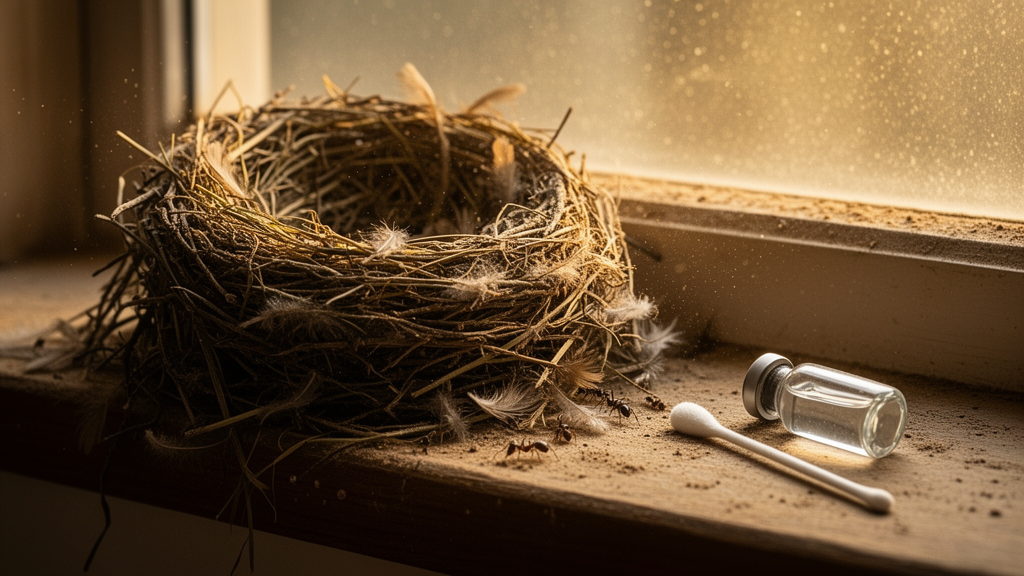
A bird nest looks like a quiet bundle of twigs, grass and feathers, but a new study shows it is also a dense archive of genetic traces left by dozens of other species. By applying DNA metabarcoding to nest dust, fragments of arthropod remains and feathers collected from 20 nests of six bird species at the University of Guelph Arboretum in Ontario, Canada, researchers detected 103 distinct taxa, 82 of which could be assigned to species level. That is more than four times the 24 taxa recovered from four nests processed in traditional emergence traps, which rely on live arthropods crawling out of collected nests. Because the emergence-trap comparison rested on only four nests while metabarcoding covered all 20, the two figures illustrate the reach of each method rather than a like-for-like comparison of identical nests.
The study, conducted on nests from American Robin, Black-Capped Chickadee, Eastern Bluebird, Eastern Phoebe, House Wren and Tree Swallow, is the first to use metabarcoding to characterise the invertebrate community of bird nests. Nests were collected after fledglings had left or at the end of the breeding period, between June and October 2019, with three additional abandoned nests gathered in Guelph in July 2018. Because researchers deliberately limit disturbance to nesting birds, access to nests is usually only possible after the breeding season, and many resident invertebrates are immature stages that are difficult to identify below family level. Earlier studies therefore reared arthropods to adulthood in rearing chambers or emergence traps, an approach limited to taxa still present in the nest at the end of the breeding season.
The team compared two strategies. Four nests were placed in emergence traps combined with Berlese-Tullgren funnels for two to three weeks, allowing live arthropods to emerge for subsequent DNA barcoding. The nests were then frozen, thawed, and sieved through 5 mm and 2 mm meshes. Remains too large to pass the sieves were hand-picked as arthropod fragments, material passing the 2 mm sieve was retained as dust, and all feathers found in a nest were collected separately. Each nest thus yielded up to four sample types: ground arthropod remains, dust and feathers, with dust processed through two different DNA extraction protocols.
Laboratory work followed a two-step PCR protocol amplifying a fragment of the cytochrome oxidase I (COI) gene, the standard barcode region for animals. Sequencing on an Illumina MiSeq produced more than 27 million reads, but only a small fraction survived stringent quality filtering: after demultiplexing, merging, denoising, removal of chimeras and contaminant sequences detected in negative controls, 352,692 reads belonging to 103 taxa remained for analysis. The researchers note that only 1.3 percent of all reads were ultimately used for taxonomic assignment, a low yield they attribute to the dominance of plant and microbial DNA in dust, the degraded state of DNA that accumulated over the breeding season, and potential inhibition from plant material, clay and traces of bird feces.
Sample type mattered greatly. Ground arthropod remains yielded the highest total number of taxa at 67, and nest dust extracted with the DNeasy PowerSoil kit produced significantly more detections per nest than dust processed with the standard DNeasy kit followed by a commercial inhibitor removal step. A Poisson regression comparing the four sample types found significantly fewer taxa detected from DNeasy-extracted dust than from ground arthropods, PowerSoil-extracted dust or feathers. On average, ground arthropod samples produced 5.90 taxa per nest and PowerSoil-processed dust 6.25 taxa per nest, making these the two most informative approaches. Detections from dust were possible for all but one of the 19 nests with usable dust data.
The two extraction methods also differed in consistency. Subsamples of the same nest processed with the DNeasy and PowerClean approach shared 75.5 percent of their detections on average, whereas PowerSoil subsamples overlapped by only 47.31 percent, likely because the DNeasy protocol creates one large mixed lysate while PowerSoil processes only small amounts of dry material per extraction. The authors suggest processing several subsamples per nest when only small quantities of dust are available. Feathers, found in nine of the 20 nests, yielded DNA-based detections of birds, insects and earthworms in six cases, with three to twelve taxa per sample, but the researchers caution that feather sampling alone would miss most arthropod taxa, and not all bird species incorporate feathers into their nests.
Among the species recovered were several well-known nest associates. The most abundant arthropod reads, 20.9 percent, were assigned to Protocalliphora, bird blowflies that lay their eggs in nests and parasitize nestlings, detected in seven nests. The moth genus Niditinea, whose larvae feed on nest material and dried animal matter, and the flea genus Ceratophyllus, several species of which are associated with birds, each appeared in ten nests. Only five taxa were detected by both emergence trapping and metabarcoding, underscoring how differently the two methods sample the nest community. Emergence traps capture only organisms alive at collection, while environmental DNA captures living and dead organisms and fragments, effectively integrating a longer time window, provided the DNA traces withstand environmental conditions.
The metabarcoding data also revealed the nests’ broader ecological context. Twenty-five bird species, all occurring in the study region, were detected, mostly through feathers incorporated as nest material or left by visitors. The nesting species itself was detected in every nest except one Black-Capped Chickadee nest, accounting for 32 to 71 percent of avian reads. House Wren nests contained the greatest variety, with 18 of the 25 bird species, which the authors link to the wrens’ nest-destroying behaviour of carrying material from other nests back to their own. An American Robin nest showed a large proportion of reads matching Eastern Phoebe, a species known to reuse robin nests, suggesting either a visit or previous use of the nest.
Functional assignments shed light on what the detected organisms were doing. Of the 103 taxa, 73 percent could be assigned a reason for occurring in the nest, and the arthropods were primarily food for the nesting birds or species feeding within the nest. Of the taxa detected via metabarcoding in the four emergence-trap nests, 52.5 percent were classified as bird food or ambiguously as feeding in the nest or bird food, categories that would rarely appear in emergence-trap catches. By consumer type, herbivores, predators and decomposers dominated, suggesting a potential chain of interactions within a single nest: herbivores feeding on nest material, predators feeding on herbivores, and decomposers processing the remains. Detections of Arachnida and Collembola in the emergence traps indicated that these groups use nests for foraging activities.
The authors conclude that metabarcoding of arthropod remains and nest dust eDNA is a viable alternative to emergence traps for surveying bird nest communities, capturing a broader taxonomic range and not being restricted to live organisms. They identify ground arthropod remains and nest dust extracted with the PowerSoil kit as the most promising approaches for scaling up to large-scale studies of functional diversity in nests and differences between bird species. The study also carries clear limitations: the unbalanced number of nests per bird species prevented formal comparison of community composition between host species, the emergence-trap comparison rested on only four nests, and the low proportion of usable reads shows that nest materials remain a challenging substrate for molecular analysis.
Subject of Research: DNA metabarcoding of arthropod communities in bird nests compared with emergence trapping
Article Title: Unravelling bird nest arthropod community structure using metabarcoding
Article References: Levesque-Beaudin, V., Steinke, D., Böcker, M., & Thalinger, B. (2023). Unravelling bird nest arthropod community structure using metabarcoding. Metabarcoding and Metagenomics, 7, Article e103279. https://doi.org/10.3897/mbmg.7.103279
Image Credits: AI Generated
Keywords: DNA metabarcoding, bird nests, environmental DNA, arthropods, emergence traps, COI barcode, nest dust, Protocalliphora, eDNA extraction, ornithology, biodiversity, Guelph
Cite Scienmag News
Gavin Prescott. (October 26, 2026). DNA in dust reveals hidden arthropod world inside bird nests. Scienmag. https://scienmag.com/dna-in-dust-reveals-hidden-arthropod-world-inside-bird-nests/
Gavin Prescott. "DNA in dust reveals hidden arthropod world inside bird nests." Scienmag, 26 October 2026, https://scienmag.com/dna-in-dust-reveals-hidden-arthropod-world-inside-bird-nests/. Accessed 26 October 2026.
Gavin Prescott. "DNA in dust reveals hidden arthropod world inside bird nests." Scienmag. October 26, 2026. https://scienmag.com/dna-in-dust-reveals-hidden-arthropod-world-inside-bird-nests/


