


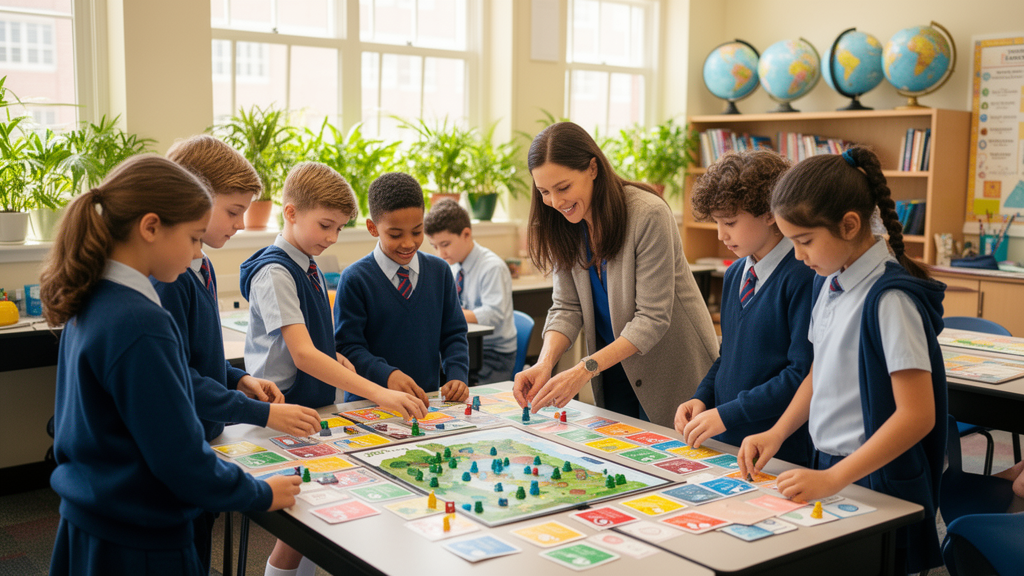
When fifth-graders in a Chinese public school spent their science club sessions cracking acid-base codes as junior agents, racing cardboard structures against time pressure, and hunting a missing fingerprint for clues, something measurable happened to their scientific literacy. A two-month study of 240 fifth-grade students at a public primary school in Shanwei, Guangdong Province, found that students taught with a systematically gamified science curriculum outperformed peers receiving conventional instruction on a posttest of scientific literacy, even after their pretest scores were statistically taken into account. The study, published in Frontiers in Education on 26 October 2026, went further than a simple before-and-after comparison: using structural equation modeling, the researchers traced how the benefit traveled through two psychological channels, learning motivation and classroom engagement, and discovered that the two mediators worked in sequence rather than independently.
The intervention was built on the Theory of Gamified Learning, developed by Landers, which holds that game attributes do not directly improve learning outcomes. Instead, they alter learners’ psychological states, which reshape learning behaviors and ultimately influence performance. That premise shaped the study’s central question: does gamified teaching enhance primary school students’ scientific literacy, and what internal transmission mechanisms operate through learning motivation and classroom engagement? To answer it, the team designed an eight-session gamified protocol drawing on Toda’s taxonomy of 21 expert-validated game elements spanning five dimensions: performance, ecological, social, personal, and fictional. Every one of the 21 elements appeared in the course, from points, levels, and progression to rarity, economy, imposed choice, time pressure, social pressure, competition, cooperation, puzzles, novelty, narrative, and storytelling.
The dosage was substantial. Each of the eight weekly sessions lasted 50 minutes, and across the whole intervention, gamified elements were active for 280 of the 400 total instructional minutes, or 70 percent of class time, averaging 35 minutes per session. The most intensive sessions, including Cracking the Acid-Base Code, Variation Survivor, and Vanishing Fingerprints, reached 40 minutes of gamified activity. Crucially, the elements were not sprinkled on as a superficial layer. Each was deliberately mapped to the four domains of China’s Compulsory Education Science Curriculum Standards (2022 Edition): scientific concepts, scientific thinking, inquiry practice, and attitudes and responsibility. A rainbow layered challenge targeted the physical property of density, an electric car session taught gear ratio, a purification puzzle trained experimental analysis, and the fingerprint mystery developed safety awareness about protecting personal information.
The design was a cluster-randomized pretest-posttest control-group trial. Six intact fifth-grade classes with generally comparable overall performance, initially comprising 269 students, were randomly assigned at the class level: three classes received the gamified model and three received traditional teaching. Twenty-nine students were excluded because of incomplete data across assessment sessions, leaving a final complete-case sample of 240 students, 120 in each group. The proportion of incomplete cases did not differ significantly between groups. Randomization at the class level rather than the individual level was a practical concession to the school’s requirement to keep administrative classes intact, and the authors acknowledge that it limits the strength of causal inference.
The results were striking. In the control group, mean scientific literacy scores rose from 55.833 at pretest to 60.838 at posttest, a gain of about five points. In the experimental group, scores climbed from 53.758 to 66.921, a gain of more than 13 points, despite the gamified classes starting slightly lower. A mixed-design repeated-measures ANOVA confirmed that the pretest-to-posttest change differed significantly between groups, with a large time-by-group interaction effect. An ANCOVA adjusting for pretest scores reinforced the finding: the adjusted posttest mean was 67.362 for the gamified group versus 60.396 for the control group, and the adjusted group effect remained highly significant. The researchers note that the small baseline imbalance and the possibility of regression to the mean cannot be entirely excluded, but the converging statistical evidence makes a purely baseline-driven explanation unlikely.
The heart of the study lay in the mediation analysis. The team constructed a path model with instructional condition as the independent variable, learning motivation and classroom engagement as mediators, pretest scientific literacy as a control, and posttest scientific literacy as the outcome. The model fit the data well. Gamified teaching had a significant positive direct effect on posttest scientific literacy, with a standardized coefficient of 0.381, and a total standardized effect of 0.451 when indirect pathways were included. Group membership also significantly predicted both learning motivation and classroom engagement, and learning motivation in turn significantly predicted classroom engagement. Together, the variables in the model explained 40.7 percent of the variance in posttest scientific literacy scores.
Bootstrap mediation testing with 2,000 bias-corrected resamples revealed a differentiated picture. The indirect pathway through classroom engagement alone was statistically significant, with a 95 percent confidence interval of 0.015 to 0.095 that excluded zero. The sequential chain pathway, from gamified teaching through learning motivation and then classroom engagement to scientific literacy, was also significant, though small in magnitude at 0.007. But the indirect effect through learning motivation alone, estimated at 0.020 with a confidence interval of −0.001 to 0.042, included zero and was not statistically significant. In other words, motivation mattered only when it was translated into active classroom behavior. The authors suggest that having higher motivation and effectively deploying it during learning activities are distinct things, echoing meta-analytic evidence that gamification’s motivational effects are modest and do not always improve learning outcomes unless accompanied by behavioral change.
Why did motivation alone fail to carry the effect? The researchers offer three plausible interpretations. First, measurement inadequacy: learning motivation was operationalized as a study-specific composite indicator formed by averaging the mean scores of a Scientific Career Aspiration Scale and a Creative Self-Efficacy Scale, which captures only a limited slice of students’ motivational states. Second, insufficient dosage: eight sessions over two months may have been too brief to establish a stable motivational pathway independent of behavioral translation. Third, and considered most plausible, a genuine pattern in which the motivational boost from gamified teaching needs to be converted into sustained classroom participation to become educationally consequential. Consistent with this, instructional condition explained only 2.2 percent of the variance in the motivation composite, a modest association in line with meta-analytic estimates of gamification’s average motivational effects.
The study also probed whether the gamified elements, including challenging features such as time pressure and imposed choice, induced frustration or negative affect. Across the post-intervention sample, scores on items assessing boredom, anxiety, and disengagement fell below the scale midpoint, indicating that students generally did not experience high levels of frustration, while items assessing positive affect yielded high scores. Course records contained no documented negative emotions such as students feeling difficulties or giving up. The authors interpret this as evidence that the challenging game mechanics were perceived as motivating rather than discouraging, though these self-report indicators come with the usual caveats of questionnaire data.
The findings carry practical weight for teachers designing gamified science lessons. The five dimensions of game elements appeared to work in concert: performance elements provided immediate feedback and reinforced effort, ecological elements introduced meaningful constraints that deepened cognitive engagement, social elements fostered emotional engagement through peer interaction, personal elements stimulated curiosity and problem-solving, and fictional elements created immersive contexts that activated initial motivation. The authors recommend a two-phase sequence in which extrinsic game elements first attract attention and engagement, and collaborative inquiry tasks, peer discussion, and reflective activities then channel that initial motivation into sustained behavioral and cognitive participation, with external incentives gradually faded as intrinsic interest develops. They also flag anticipated implementation challenges, including students becoming overly focused on competition or rewards, increased noise and off-task behavior, and curriculum time pressure, and suggest clear behavioral expectations, debriefing phases connecting game experiences to learning objectives, and alternative pathways such as individual progress tracking instead of public leaderboards.
The limitations deserve equal attention. Motivation and engagement were measured simultaneously at post-intervention, so the assumed temporal ordering of motivation before engagement is grounded in theoretical rationale rather than empirically verified, and reciprocal or reverse models cannot be ruled out. The classroom engagement scale’s confirmatory factor analysis showed suboptimal fit, which is why engagement was represented by its overall composite score in the path analysis. The intervention was brief, no delayed posttests assessed long-term retention, and the sample came from a single public school in a third-tier city, so the findings should be interpreted as contextually bound rather than universally generalizable. The authors are careful to frame their results as evidence of statistical pathways rather than definitive proof of a temporal causal mechanism. Even so, the study offers a theoretically grounded and practically actionable framework for gamified science instruction, anchored in the sequential pathway from gamified teaching through motivation and engagement to learning outcomes, and it required no specialized equipment beyond basic multimedia projection and printed worksheets, making it feasible for most public primary schools.
Subject of Research: Gamified teaching and scientific literacy in primary school students
Article Title: The influence mechanism of gamified teaching on primary school students' scientific literacy: an empirical analysis based on structural equation modeling
Article References: Li, Y., Gu, Y., He, W., Zheng, L., & Liu, W. (2026). The influence mechanism of gamified teaching on primary school students' scientific literacy: an empirical analysis based on structural equation modeling. Frontiers in Education, 11, 1899547. https://doi.org/10.3389/feduc.2026.1899547
Image Credits: AI Generated
DOI: 10.3389/feduc.2026.1899547
Keywords: gamified teaching, scientific literacy, primary science education, classroom engagement, learning motivation, structural equation modeling, STEM education, chain mediation, educational intervention, fifth-grade students, China, game elements
Cite Scienmag News
Cora Reilly. (October 26, 2026). Gamified Science Lessons Boost Scientific Literacy by Fueling Classroom Engagement. Scienmag. https://scienmag.com/gamified-science-lessons-boost-scientific-literacy-by-fueling-classroom-engagement/
Cora Reilly. "Gamified Science Lessons Boost Scientific Literacy by Fueling Classroom Engagement." Scienmag, 26 October 2026, https://scienmag.com/gamified-science-lessons-boost-scientific-literacy-by-fueling-classroom-engagement/. Accessed 26 October 2026.
Cora Reilly. "Gamified Science Lessons Boost Scientific Literacy by Fueling Classroom Engagement." Scienmag. October 26, 2026. https://scienmag.com/gamified-science-lessons-boost-scientific-literacy-by-fueling-classroom-engagement/


