

Monday, October 26, 2026
Science
No Result
View All Result
  • Login
  • HOME
  • SCIENCE NEWS
  • CONTACT US
  • HOME
  • SCIENCE NEWS
  • CONTACT US
No Result
View All Result
Scienmag
No Result
View All Result
Home Science News Medicine

Low Vitamin D After Bariatric Surgery Tracks With Fat-Infiltrated Muscle

October 26, 2026
in Medicine
Ophelia Keating
By Ophelia Keating Scienmag Editorial Profile - Health Services Research
Reading Time: 3 mins read
0
Low Vitamin D After Bariatric Surgery Tracks With Fat-Infiltrated Muscle

Low Vitamin D After Bariatric Surgery Tracks With Fat-Infiltrated Muscle

65
SHARES
587
VIEWS
Share on FacebookShare on Twitter
ADVERTISEMENT

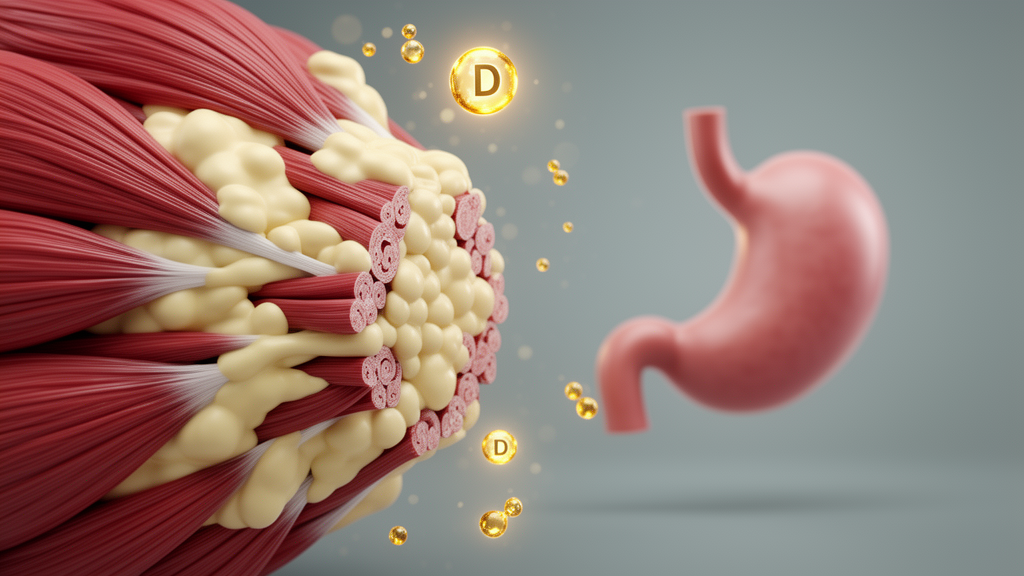
Most patients remain vitamin D deficient a year after bariatric surgery, and those with the lowest blood levels of the nutrient also carry more fat inside their spinal muscles and around their abdominal organs, according to a prospective cohort study published in BMC Medical Imaging. The research team measured serum 25-hydroxyvitamin D, the standard marker of vitamin D status, before surgery and again one year after the operation. Average levels rose from 11.92 to 21.24 nanograms per millilitre, a statistically significant increase.

Yet the improvement was not enough for most patients: 72.6 percent still fell below the threshold for vitamin D deficiency at the one-year mark. At baseline and at one year, they measured anthropometric values, biochemical markers and QCT-derived body composition variables, including fat infiltration within the erector spinae muscles that run along the spine, fat fraction in the psoas major muscle, and volumes of visceral adipose tissue, the fat stored deep inside the abdomen around internal organs. When patients were split into postoperatively deficient and normal vitamin D groups, clear differences emerged.

The deficient group had significantly higher erector spinae muscle fat, a higher erector spinae muscle fat fraction, a higher psoas major muscle fat fraction, and greater visceral adipose tissue volume and visceral adipose tissue index, all differences reaching statistical significance. In other words, patients whose vitamin D remained low carried more fat inside the muscles that stabilize the trunk and more fat around their abdominal organs. Correlation analysis reinforced the pattern.

Postoperative 25-hydroxyvitamin D levels were negatively correlated with erector spinae muscle fat, erector spinae muscle fat fraction, psoas major muscle fat fraction, visceral adipose tissue and the visceral adipose tissue index, with all associations remaining significant after adjustment for the false discovery rate. Lower vitamin D went hand in hand with greater fat deposition in both muscle and visceral compartments. Two further analyses tempered the interpretation.

When the researchers examined whether changes in vitamin D levels tracked with changes in body composition over the year, no such correlations remained significant. And preoperative vitamin D levels did not predict postoperative body composition parameters at all. The picture is therefore cross-sectional: at the one-year time point, patients with higher vitamin D had less muscle fat infiltration and less visceral fat, but the study cannot establish that raising vitamin D caused those differences, nor that preoperative status sets the trajectory.

A sensitivity analysis restricted to patients who underwent sleeve gastrectomy alone produced similar cross-sectional findings, indicating that the associations were not driven by a mixture of operation types. The authors conclude that vitamin D deficiency was prevalent after surgery and that higher postoperative 25-hydroxyvitamin D was associated with lower muscle fat infiltration and visceral adiposity. On that basis, they recommend monitoring both postoperative vitamin D levels and body composition to optimize long-term clinical outcomes.

Subject of Research: Associations of postoperative vitamin D with body composition changes after bariatric surgery: a prospective cohort study

Article Title: Associations of postoperative vitamin D with body composition changes after bariatric surgery: a prospective cohort study

Article References: Guan, W., Yuan, X., Hao, Z., Zhu, W., Yin, H., Li, J., Zhang, T., Li, W., Yu, F., Zhang, P., Wang, Z., & Zhang, P. (2026). Associations of postoperative vitamin D with body composition changes after bariatric surgery: a prospective cohort study. BMC Medical Imaging. https://doi.org/10.1186/s12880-026-02985-x

Image Credits: AI Generated

DOI: 10.1186/s12880-026-02985-x

Keywords: Associations, postoperative, vitamin, body, composition, changes, bariatric, surgery, prospective, cohort, scientific research

Cite Scienmag News

Ophelia Keating. (October 26, 2026). Low Vitamin D After Bariatric Surgery Tracks With Fat-Infiltrated Muscle. Scienmag. https://scienmag.com/low-vitamin-d-after-bariatric-surgery-tracks-with-fat-infiltrated-muscle/

Ophelia Keating. "Low Vitamin D After Bariatric Surgery Tracks With Fat-Infiltrated Muscle." Scienmag, 26 October 2026, https://scienmag.com/low-vitamin-d-after-bariatric-surgery-tracks-with-fat-infiltrated-muscle/. Accessed 26 October 2026.

Ophelia Keating. "Low Vitamin D After Bariatric Surgery Tracks With Fat-Infiltrated Muscle." Scienmag. October 26, 2026. https://scienmag.com/low-vitamin-d-after-bariatric-surgery-tracks-with-fat-infiltrated-muscle/


Tags: association between muscle fat and vitamin Dassociationsbariatricbodychangescohortcompositionfat distribution and nutrient deficienciesfat infiltration in spinal musclesimpact of obesity on vitamin Dlong-term outcomes of bariatric surgerymuscle fat infiltrationmuscle health post-bariatric surgerypost-surgical body compositionpostoperativeprospectiveScientific Researchserum 25-hydroxyvitamin D levelssurgeryvisceral adipose tissuevitaminVitamin D deficiency after bariatric surgeryvitamin D status monitoring
Share26Tweet16
Previous Post

Troponin Kinetics and Emerging Biomarkers May Help Untangle Myocarditis, Heart Attacks, and Sepsis-Related Heart Injury

Next Post

Softening Hard Masks: New Correction Method Tames Overconfident AI Labels

Related Posts

Troponin Kinetics and Emerging Biomarkers May Help Untangle Myocarditis, Heart Attacks, and Sepsis-Related Heart Injury
Medicine

Troponin Kinetics and Emerging Biomarkers May Help Untangle Myocarditis, Heart Attacks, and Sepsis-Related Heart Injury

October 26, 2026
Bioengineering strategies expand the promise of prenatal therapy
Medicine

Bioengineering strategies expand the promise of prenatal therapy

October 26, 2026
Rhinovirus and Influenza Lead Pediatric Respiratory Pathogen Detections in Single-Center Surveillance
Medicine

Rhinovirus and Influenza Lead Pediatric Respiratory Pathogen Detections in Single-Center Surveillance

October 26, 2026
AI Chatbots Could Reshape Cannabis Use Support, But Safety Questions Loom
Medicine

AI Chatbots Could Reshape Cannabis Use Support, But Safety Questions Loom

October 26, 2026
Rapid Steroid Dosing Does Not Increase Fracture Risk in Elderly Asthmatics
Medicine

Rapid Steroid Dosing Does Not Increase Fracture Risk in Elderly Asthmatics

October 26, 2026
Cryptic amplifier hosts: the overlooked bridge species in bat virus spillover
Medicine

Cryptic amplifier hosts: the overlooked bridge species in bat virus spillover

October 26, 2026
Next Post
Softening Hard Masks: New Correction Method Tames Overconfident AI Labels

Softening Hard Masks: New Correction Method Tames Overconfident AI Labels

  • Mothers who receive childcare support from maternal grandparents show more optimized

    Mothers who receive childcare support from maternal grandparents show more parental warmth, finds NTU Singapore study

    27656 shares
    Share 11059 Tweet 6912
  • University of Seville Breaks 120-Year-Old Mystery, Revises a Key Einstein Concept

    1061 shares
    Share 424 Tweet 265
  • Bee body mass, pathogens and local climate influence heat tolerance

    682 shares
    Share 273 Tweet 171
  • Researchers record first-ever images and data of a shark experiencing a boat strike

    546 shares
    Share 218 Tweet 137
  • Groundbreaking Clinical Trial Reveals Lubiprostone Enhances Kidney Function

    531 shares
    Share 212 Tweet 133
Science

Embark on a thrilling journey of discovery with Scienmag.com—your ultimate source for cutting-edge breakthroughs. Immerse yourself in a world where curiosity knows no limits and tomorrow’s possibilities become today’s reality!

RECENT NEWS

  • Softening Hard Masks: New Correction Method Tames Overconfident AI Labels
  • Low Vitamin D After Bariatric Surgery Tracks With Fat-Infiltrated Muscle
  • Troponin Kinetics and Emerging Biomarkers May Help Untangle Myocarditis, Heart Attacks, and Sepsis-Related Heart Injury
  • Gamified Science Lessons Boost Scientific Literacy by Fueling Classroom Engagement

Categories

  • Agriculture
  • Anthropology
  • Archaeology
  • Athmospheric
  • Biology
  • Biotechnology
  • Blog
  • Bussines
  • Cancer
  • Chemistry
  • Climate
  • Earth Science
  • Editorial Policy
  • Marine
  • Mathematics
  • Medicine
  • Pediatry
  • Policy
  • Psychology & Psychiatry
  • Science Education
  • Science News
  • Social Science
  • Space
  • Technology and Engineering

Subscribe to Blog via Email

Enter your email address to subscribe to this blog and receive notifications of new posts by email.

Join 5,151 other subscribers

© 2025 Scienmag - Science Magazine

Welcome Back!

Login to your account below

Forgotten Password?

Retrieve your password

Please enter your username or email address to reset your password.

Log In
No Result
View All Result
  • HOME
  • SCIENCE NEWS
  • CONTACT US

© 2025 Scienmag - Science Magazine

Discover more from Science

Subscribe now to keep reading and get access to the full archive.

Continue reading