


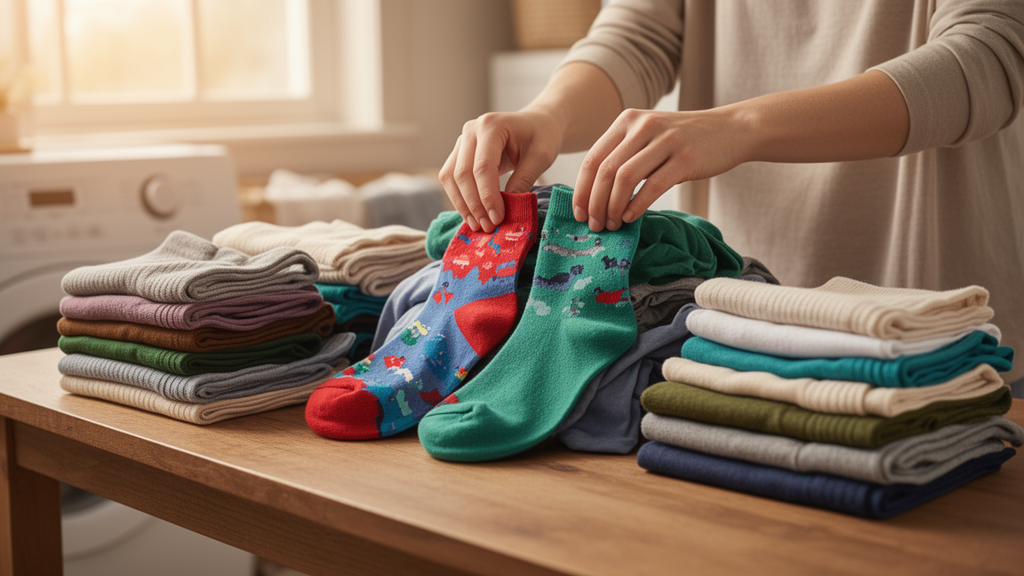
A lost sock is usually treated as a minor domestic nuisance, but a new study argues that it is better understood as a service failure. When one member of a pair disappears during laundering, the surviving sock can become stranded wear-capacity: a functional garment that cannot be worn without violating the wearer’s matching preferences. Published in Humanities and Social Sciences Communications, the research formalizes sock ownership as a sequential decision problem under uncertainty, in which socks wear out and vanish stochastically while public exposure imposes a person-specific penalty for wearing non-matching socks.
The framework treats each day as a decision point. A person owns a stock of socks that degrades and disappears randomly, and must choose what to wear under uncertainty about future losses. Strict matching, the default behavior for most owners, ties usable capacity to the availability of identical pairs. The study’s central finding is that this apparent frugality is partly an illusion: strict matching can look resource-efficient largely because it generates many sockless days, in which demand for sock service goes unmet rather than served from the existing stock.
To connect the model to real behavior, the author conducted an in-person study estimating two person-level parameters: mismatch sensitivity, the discomfort associated with visibly non-matching socks, and diversity preference, the tolerance for mixing different socks. Linking this behavioral heterogeneity to interpretable mixing policies allowed the analysis to test pairing strategies that range from rigid matching to controlled tolerance for mismatch, rather than treating sock choice as purely idiosyncratic.
The evaluation combined an exact benchmark on small, tractable instances with simulation-based comparison of pairing policies across stochastic loss regimes. Across those regimes, controlled tolerance for mismatch sustained daily sock service and reduced stranded wear-capacity compared with strict matching. In practical terms, deliberately pairing orphan socks can convert garments that would otherwise sit idle into usable wear-capacity, at the cost of accepting some visible mismatching on days when the alternative is going sockless despite owning functional socks.
The study also probes the environmental dimension, but with an explicit caveat. The ecological-cost term in the analysis is treated as a proportional embodied-cost proxy rather than an independent life-cycle assessment measure. The author therefore frames the environmental interpretation as suggestive and mechanism-based: fewer sockless days and less stranded capacity plausibly mean fewer replacement purchases, but the results are not a direct estimate of environmental savings. The claim is about the mechanism by which mismatch tolerance could reduce waste, not a quantified footprint reduction.
The paper positions the findings as establishing both the feasibility and the limitations of matching non-matching socks as a simple strategy for preserving service from garments people already own. Because the mismatch penalty is person-specific, the optimal policy is not universal: wearers with high mismatch sensitivity will rationally accept more sockless days, while those with greater diversity preference can extract substantially more service from the same stock. The broader implication is that a household item produced and replaced at massive scale may hold untapped utility, and that a small behavioral change, tolerating the occasional odd pair, can be modeled and measured like any other decision problem under uncertainty.
Subject of Research: Decision modeling and simulation of whether pairing non-matching socks preserves daily sock service under stochastic loss
Article Title: Service preservation from matching non-matching socks under stochastic loss
Article References: Lazebnik, T. (2026). Service preservation from matching non-matching socks under stochastic loss. Humanities and Social Sciences Communications. https://doi.org/10.1057/s41599-026-09321-2
Image Credits: AI Generated
DOI: 10.1057/s41599-026-09321-2
Keywords: socks, decision theory, stochastic loss, behavioral study, simulation, sustainability, operations research, consumer behavior, Service, preservation, matching, non-matching
Cite Scienmag News
Courtney Benton. (October 26, 2026). Pairing Odd Socks Preserves Daily Sock Service, Model Shows. Scienmag. https://scienmag.com/pairing-odd-socks-preserves-daily-sock-service-model-shows/
Courtney Benton. "Pairing Odd Socks Preserves Daily Sock Service, Model Shows." Scienmag, 26 October 2026, https://scienmag.com/pairing-odd-socks-preserves-daily-sock-service-model-shows/. Accessed 26 October 2026.
Courtney Benton. "Pairing Odd Socks Preserves Daily Sock Service, Model Shows." Scienmag. October 26, 2026. https://scienmag.com/pairing-odd-socks-preserves-daily-sock-service-model-shows/


