


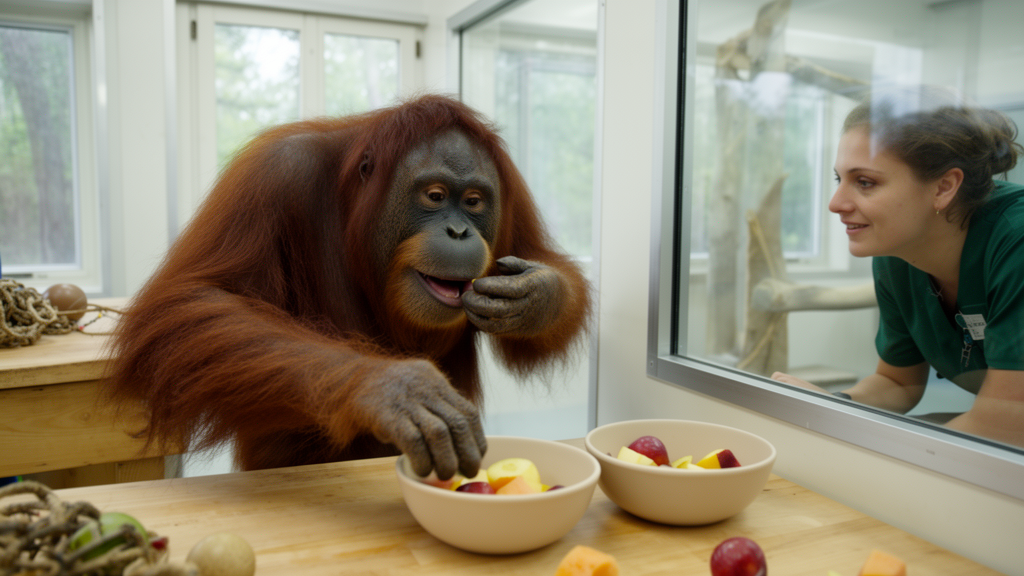
Orangutans preferred a material they had searched while hearing orangutan laughter over an equally rewarded material searched while hearing a control sound in a five-day experiment led by Indiana University Bloomington researchers. The animals encountered pairs of materials, including wood chips, paper towels and yarn, that concealed a food reward. By the final choice, both materials had hidden food during earlier trials, but the orangutans showed a measurable bias toward the location associated with laughter. The result indicates that the play vocalization influenced how the animals valued the associated reward, rather than merely determining where food was present.
The experimental study was conducted from Erica Cartmill’s laboratory at Indiana University and led by postdoctoral researcher Daan Laméris, who designed the study. Most of the orangutan research took place at ZOO Planckendael in Mechelen, Belgium. The task unfolded over five consecutive days. On days one and three, food was always hidden under one material and never under the other. On days two and four, the previously unrewarded material appeared alongside a new material that now covered the reward. On day five, the researchers returned the two materials that had hidden food and observed which one the orangutans chose.
During the learning trials, researchers played the sound of orangutan laughter while the animals searched in one rewarded material and a control sound while they searched in the other. The final test was therefore designed to separate the influence of the accompanying sound from a simple material preference: because both options had previously concealed food, neither had an advantage based on the training schedule alone. The orangutans favored the material they had searched while hearing laughter, providing experimental evidence of an affective bias in reward choice. The supplied research account does not report the number of orangutans, statistical effect sizes or the extent of variation among individual animals, so the scale and consistency of the effect cannot be assessed from the available information.
Laméris and Cartmill interpreted the behavior as evidence that hearing laughter placed orangutans in a more positive mood and caused them to assign greater value to the associated reward. Cartmill said the study showed that the value of laughter and the contribution of mood could be measured, adding that positive moods can make memories more positive and valuable. Laméris described the result as surprising because orangutans are the least social of the great ape species. “Even among relatively non-social animals, laughter is important,” he said. The finding offers an animal analogue to the established human observation that positive moods can enhance learning and make experiences more memorable, although the experiment does not establish that the underlying mechanisms are identical in humans and orangutans.
Cartmill used a familiar-food analogy to explain the proposed association: someone might prefer a relative’s pancakes not because they are objectively the best pancakes, but because eating them at a loved one’s home creates a positive association. In the experiment, the food reward did not differ between the two final options, but the material searched with laughter acquired greater value through its accompanying sound. Published in the peer-reviewed journal Biology Letters under the title “Play vocalizations induce affective bias in reward learning and memory in orangutans,” the study links a play vocalization to a change in orangutan reward choice. Cartmill said the broader project aimed to examine the moments that shape animals’ lives, including friendships, memories and positive emotions, rather than focusing only on fear, grief, competition and survival. The controlled design supports a causal interpretation of the sound’s effect within the task, while the limited experimental setting and missing details about sample size and individual variation constrain conclusions beyond this reward-learning task.
Subject of Research: Experimental effects of orangutan laughter on reward learning and valuation
Article Title: Hearing laughter may cause orangutans to value rewards more
Article References: Hearing laughter may cause orangutans to value rewards more. Original publication (Bibliographic details unavailable.)
Image Credits: AI Generated
DOI: Not provided
Keywords: orangutans, laughter, reward learning, animal cognition, affective bias, reward valuation, great apes, vocal communication, positive emotion, experimental study, Hearing, cause
Cite Scienmag News
Courtney Benton. (October 26, 2026). Laughter biased orangutans’ reward choices in five-day experiment. Scienmag. https://scienmag.com/laughter-biased-orangutans-reward-choices-in-five-day-experiment/
Courtney Benton. "Laughter biased orangutans’ reward choices in five-day experiment." Scienmag, 26 October 2026, https://scienmag.com/laughter-biased-orangutans-reward-choices-in-five-day-experiment/. Accessed 26 October 2026.
Courtney Benton. "Laughter biased orangutans’ reward choices in five-day experiment." Scienmag. October 26, 2026. https://scienmag.com/laughter-biased-orangutans-reward-choices-in-five-day-experiment/


