


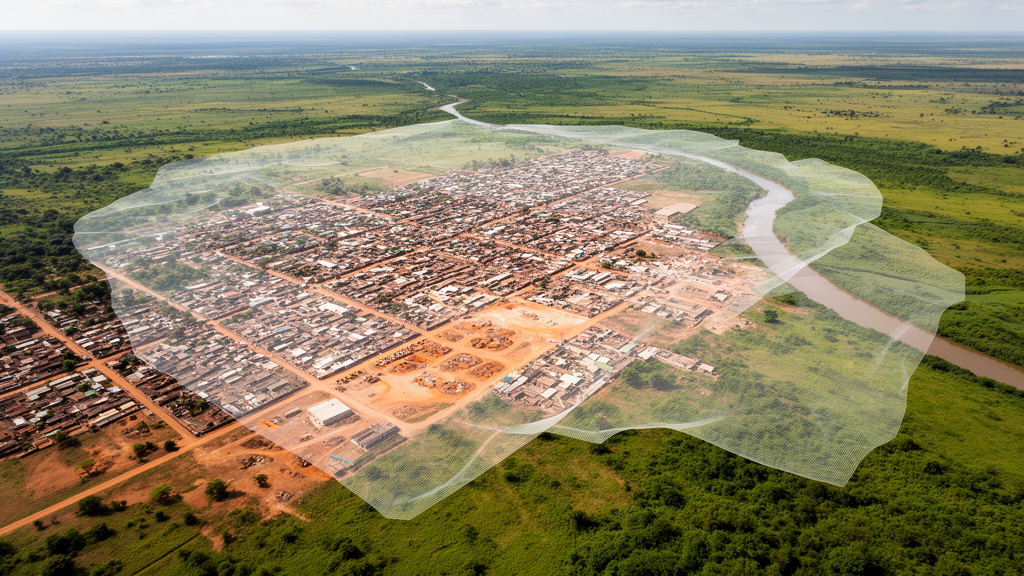
A machine-learning and satellite-imaging analysis found that Gambella Town, Ethiopia, experienced substantial urban expansion between 2005 and 2025, with built-up land rising from 93 hectares, or 2.0% of the mapped area, to 1,956 hectares, or 41.3%. The study combined Random Forest classification of Landsat imagery with GIS-based spatial analysis to track six land-use and land-cover classes: agricultural land, bush with grass, built-up area, bare land, forest land and water bodies. The classifier achieved overall accuracies of 90% for 2005, 90% for 2015 and 89% for 2025.
The mapped area also showed a pronounced shift in the composition of surrounding land. Agricultural land increased from 634 hectares, representing 13.4% of the study area, to 1,750 hectares, or 36.9%. Bush with grass declined from 3,375 hectares, or 71.1%, to 652 hectares, or 13.7% over the same period. The authors identified conversion of bush, grass and other open areas into built-up land as a major feature of Gambella’s physical growth. Their analysis also emphasizes the distinction between urban expansion, measured here through the increase in built-up land, and urban sprawl, which describes the spatial pattern and form of outward development.
Socio-economic information collected from 277 respondents pointed to population growth, rural-to-urban migration, housing demand, employment opportunities and infrastructure development as major drivers of the transformation. These survey responses provide context for the satellite-observed changes, but the reported results do not quantify the independent contribution of each factor or establish that any single driver caused a specific mapped conversion. Overall, the study documents rapid physical expansion, vegetation loss and increasing pressure on urban services in Gambella Town, providing evidence to inform land management and sustainable urban planning.
Integrating supervised machine learning with multi-temporal remote sensing allowed the researchers to produce consistent land-cover maps for three observation years and compare changes across two decades. The relatively stable classification accuracies indicate that the approach identified the major land-cover classes with comparable performance in each image set. The resulting maps show that Gambella’s expanding built-up footprint coincided with a contraction of the dominant bush-and-grass class and a rise in agricultural land. Together, the spatial analysis and respondent evidence portray a town undergoing rapid land transformation, while the study’s definition of sprawl cautions against treating every increase in built-up area as a direct measure of outward spatial form.
Subject of Research: Remote-sensing and machine-learning analysis of urban expansion and land-use change in Gambella Town, Ethiopia
Article Title: Integrating machine learning and geospatial technologies for spatio-temporal analysis of urban expansion and land use transformation in Gambella Town, Ethiopia
Article References: Dararo, K. F., Jal Dup, G., Chemeda, W. M., & Karuppannan, S. (2026). Integrating machine learning and geospatial technologies for spatio-temporal analysis of urban expansion and land use transformation in Gambella Town, Ethiopia. PLOS One, 21(10), e0360419. https://doi.org/10.1371/journal.pone.0360419
Image Credits: AI Generated
DOI: 10.1371/journal.pone.0360419
Keywords: urban expansion, Random Forest, remote sensing, Landsat imagery, land-use change, Gambella, Ethiopia, geospatial analysis, urban sprawl, GIS, Integrating, machine
Cite Scienmag News
Teresa Odom. (October 26, 2026). Machine learning maps rapid urban expansion in Gambella. Scienmag. https://scienmag.com/machine-learning-maps-rapid-urban-expansion-in-gambella/
Teresa Odom. "Machine learning maps rapid urban expansion in Gambella." Scienmag, 26 October 2026, https://scienmag.com/machine-learning-maps-rapid-urban-expansion-in-gambella/. Accessed 26 October 2026.
Teresa Odom. "Machine learning maps rapid urban expansion in Gambella." Scienmag. October 26, 2026. https://scienmag.com/machine-learning-maps-rapid-urban-expansion-in-gambella/


