


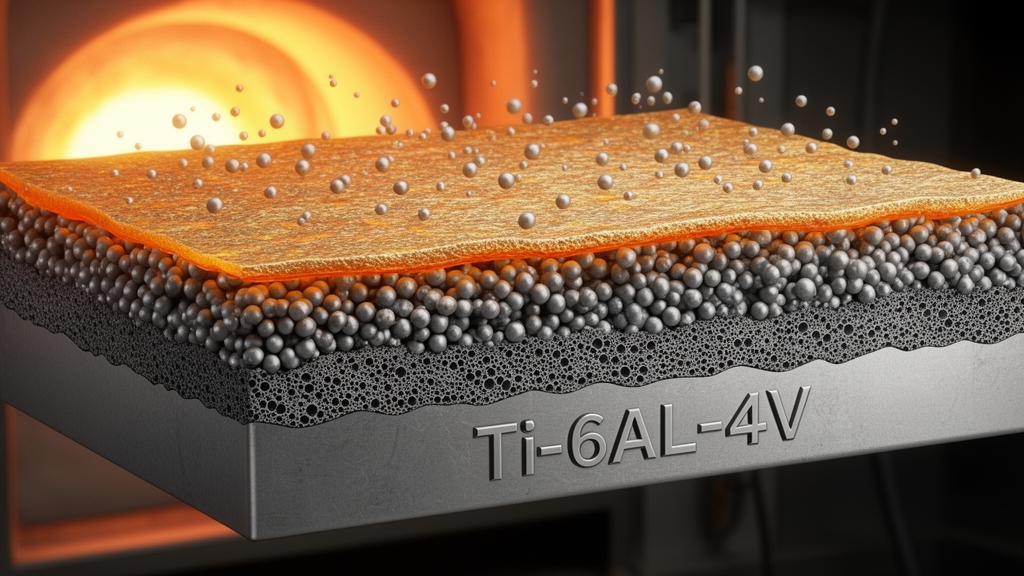
TC4 titanium alloy exposed to air at 700 °C undergoes a shift from rapid early oxidation to slower mass gain as an oxide scale thickens, according to a study combining isothermal oxidation experiments with first-principles calculations. Microscopy, elemental analysis, X-ray diffraction and electronic-structure modeling indicate that the transition is associated with aluminum redistribution within the scale, including the formation of alumina-containing regions that may provide stronger protection than the initially dominant titanium dioxide.
The experimental component measured how the alloy’s mass changed during isothermal oxidation in air at 700 °C. Mass gain increased throughout the exposure, but the apparent oxidation rate gradually declined. The researchers interpreted this behavior as evidence that transport resistance rose as the oxide scale developed. In other words, continued oxidation was not eliminated; instead, the alloy’s growing oxide layer became less permeable to the processes responsible for additional mass gain. The result is a laboratory observation of oxidation kinetics and a proposed explanation for the rate transition, rather than a direct demonstration of long-term service performance.
Characterization showed that the scale was composed mainly of crystalline TiO2 with the P42/mnm structure, alongside a smaller quantity of Al2O3 with the R-3c structure. Scanning electron microscopy and energy-dispersive spectroscopy, supported by semi-quantitative X-ray diffraction, indicated progressive thickening and later-stage aluminum enrichment in the oxide-scale region. The sequence described by the authors is Ti-preferential oxidation followed by Al redistribution and the development of aluminum-enriched or Al2O3-containing regions. This progression provides a physical basis for the observed decline in the apparent oxidation rate, although the source does not establish how the alloy would perform under fluctuating temperatures, mechanical loading, chemically different atmospheres or substantially longer exposures.
First-principles calculations examined how aluminum incorporation changes the electronic structure and bonding of α-Ti surfaces. The calculations indicated that Ti oxidation initially dominates and forms TiO2, after which aluminum becomes enriched at the oxidized surface and forms more stable Al2O3. Analysis of electronic structure and charge distribution showed that the Al–O bond is more ionic than the corresponding Ti–O bonding environment. The authors also describe Al2O3 as denser and more structurally stable than TiO2, suggesting stronger intrinsic protective characteristics. Together, the calculations and experiments support a possible mechanism in which alumina-containing regions increasingly impede oxidation once they develop, but the proposed transition should be distinguished from a directly measured improvement in engineering durability.
The combined approach offers a detailed picture of an alloying element that initially remains subordinate to titanium but later influences the protective nature of the oxide scale. TiO2 dominates the early crystalline products, while aluminum redistribution introduces a more chemically stable oxide into the scale during later stages. That sequence helps reconcile two observations from the same experiment: total mass continued to rise, showing that oxidation persisted, while the rate of increase slowed as the developing layer raised resistance to further transport. The study therefore presents a mechanistic account of oxidation-rate transition in TC4 at one temperature in air, with its strongest support coming from the agreement among kinetic measurements, scale characterization and atomistic calculations. Whether that mechanism can be used to predict service life, prevent oxidation under other environmental conditions or translate directly into component design remains untested by the reported research.
Subject of Research: Oxidation mechanisms and oxide-scale evolution in TC4 titanium alloy at 700 °C in air
Article Title: Oxidation behavior and mechanistic analysis of TC4 titanium alloy at 700 °C in air: an experimental and first-principles study
Article References: Xue, L., Feng, Y., Meng, Q., Deng, L., Xia, J., Zhang, J., Hou, J., Chen, W., & Cui, G. (2026). Oxidation behavior and mechanistic analysis of TC4 titanium alloy at 700 °C in air: an experimental and first-principles study. Journal of Materials Science, 61(41), 31928-31945. https://doi.org/10.1007/s10853-026-13619-6
Image Credits: AI Generated
DOI: 10.1007/s10853-026-13619-6
Keywords: TC4 titanium, high-temperature oxidation, oxide scale, aluminum enrichment, TiO2, Al2O3, first-principles calculations, oxidation kinetics, electron microscopy, surface chemistry, Oxidation, behavior
Cite Scienmag News
Denise Maddox. (October 26, 2026). TC4 titanium oxidation shifts toward Al-rich scale at 700 °C. Scienmag. https://scienmag.com/tc4-titanium-oxidation-shifts-toward-al-rich-scale-at-700-c/
Denise Maddox. "TC4 titanium oxidation shifts toward Al-rich scale at 700 °C." Scienmag, 26 October 2026, https://scienmag.com/tc4-titanium-oxidation-shifts-toward-al-rich-scale-at-700-c/. Accessed 26 October 2026.
Denise Maddox. "TC4 titanium oxidation shifts toward Al-rich scale at 700 °C." Scienmag. October 26, 2026. https://scienmag.com/tc4-titanium-oxidation-shifts-toward-al-rich-scale-at-700-c/


