


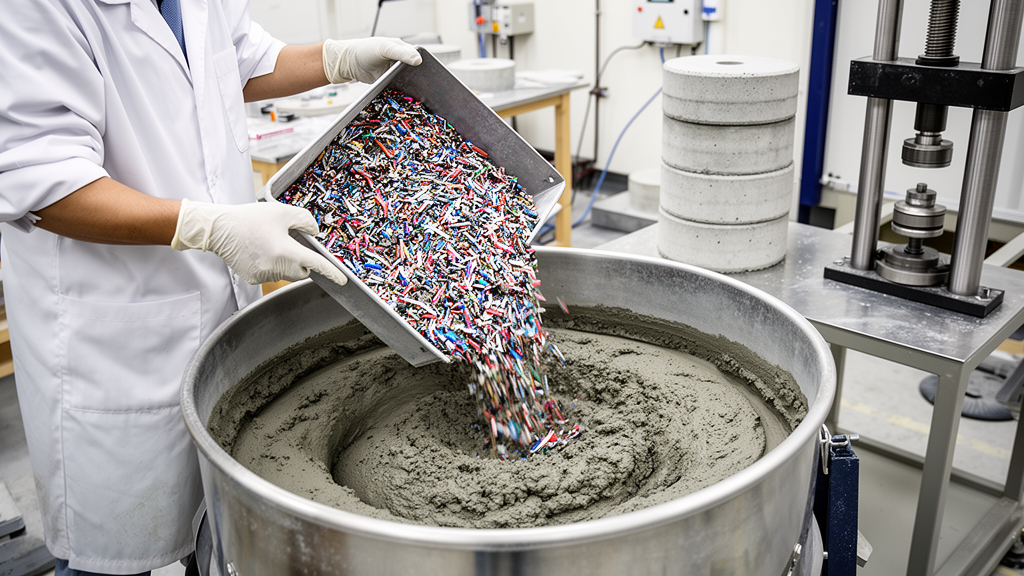
Concrete made with finely ground post-consumer plastic powder in place of river sand loses compressive strength steadily as the plastic fraction rises, but a calibrated finite element model can reproduce the measured response with remarkable precision, according to a combined experimental and numerical investigation. In the study, five concrete mixtures were prepared with waste plastic powder replacing natural river sand at mass-based levels of 0, 10, 20, 30, and 40 percent, all held at a constant water-to-cement ratio of 0.45. At 28 days, the mean compressive strength fell from 26.90 megapascals for the control mixture to 23.51, 21.50, 20.55, and 19.67 megapascals for the 10, 20, 30, and 40 percent replacements, corresponding to reductions of approximately 12.6, 20.1, 23.6, and 26.9 percent. The researchers then built a three-dimensional ABAQUS model using the Concrete Damaged Plasticity framework and, after systematic calibration, brought its predicted peak stresses to within 0.40 to 0.85 percent of the laboratory values.
The work addresses two environmental pressures at once. Rapid infrastructure development has substantially increased demand for natural river sand as fine aggregate in concrete, and excessive, poorly regulated extraction depletes natural resources while disrupting riverine ecosystems. Meanwhile, the world faces a pollution crisis from plastic waste, with millions of tons of synthetic plastics discarded every year; these materials do not decay and can pollute the lithosphere for hundreds of years in landfills. Using waste plastic powder as a partial sand replacement offers a route to tackle both problems in a single material substitution. The researchers note that a fine powdered form of post-consumer plastic may distribute particles more evenly through the cementitious matrix than coarse plastic flakes and could act as a micro-filler that reduces void propagation, although the present study did not perform direct microscopic characterization to confirm such mechanisms.
The experimental program used Portland Composite Cement conforming to BDS EN 197-1 (CEM II/B-M) as the binder, locally available river sand as fine aggregate, and crushed stone chips with a 20-millimeter maximum nominal size as coarse aggregate. The waste plastic powder was collected from post-consumer plastic waste containers sourced from the market, then prepared by washing, sun-drying for roughly two to three hours, and mechanical grinding. The processed material appeared as a light-colored granular fraction with non-uniform particle size and shape. Sieve analysis showed cumulative passing percentages of 0.0, 1.4, 4.0, 19.8, 98.6, and 100.0 percent at sieve sizes of 0.075, 0.15, 0.30, 0.60, 1.18, and 2.36 millimeters respectively, meaning about 78.8 percent of the material was held between the 0.60 and 1.18 millimeter sieves. The researchers emphasize this was not a uniformly fine powder but a finely ground granular plastic fraction.
Mix proportions for the control mixture were 1.00:1.49:2.41:0.45 by mass, representing cement, fine aggregate, coarse aggregate, and a water-to-cement ratio of 0.45. Per cubic meter, the control contained 198 kilograms of water, 441 kilograms of cement, 657 kilograms of fine aggregate, and 1063 kilograms of coarse aggregate. In the modified mixes, natural sand was replaced with an equal mass of waste plastic powder: 65.7 kilograms per cubic meter at 10 percent, 131.4 at 20 percent, 197.1 at 30 percent, and 262.8 at 40 percent, with cement, coarse aggregate, and water held constant. Cement, sand, and powder were dry-mixed uniformly in a mechanical laboratory mixer before water was slowly added. The replacement levels were chosen to represent low, moderate, and high plastic contents and to allow comparison with earlier studies of plastic or PET as partial sand replacement.
Specimens were cast in standard cylindrical steel molds with a nominal diameter of 100 millimeters and a height of 200 millimeters. Fresh concrete was poured in two layers, each tamped with 25 strokes of a standard 3/8-inch tamping rod. After 24 hours at room temperature, specimens were demolded and immediately placed in a clean water curing tank. Three homogeneous replicate specimens were tested for compressive strength and three for splitting tensile strength at each replacement level and each curing age of 7, 14, and 28 days, giving 45 specimens per test and 90 in total. Compressive crushing strength was obtained with a calibrated digital compression testing machine under continuous axial load until failure, while splitting tensile strength was measured with a digital universal testing machine applying a diametric compressive line load until splitting occurred.
Workability declined consistently with increasing plastic content. Slump, measured immediately after mixing with no extra water or chemical admixture added to compensate, dropped from 5.1 inches for the control to 4.9, 4.7, 4.6, and 4.5 inches for the 10, 20, 30, and 40 percent mixtures, an overall reduction of 11.8 percent at the highest replacement. The researchers attribute this trend to the hydrophobic nature of polymer particles and their often-irregular shapes, which add internal friction to the mix and alter particle packing, citing prior reports on PET-modified concrete. They caution, however, that particle-size distribution effects, morphology, and fresh-concrete air content were not measured in this study, so these mechanisms stand as literature-supported explanations rather than direct experimental evidence from the present work.
Hardened concrete results showed the same directional pattern. Compressive strength rose with curing age for every mixture but fell with increasing plastic replacement at every age. At 7 days, means ranged from 23.483 megapascals for the control to 13.759 for the 40 percent mix; at 14 days, from 24.829 to 17.431; and at 28 days, from 26.912 to 19.671. Splitting tensile strength followed a parallel course: the 28-day control reached 3.12 megapascals, while the 10, 20, 30, and 40 percent mixtures measured 2.92, 2.68, 2.65, and 2.47 megapascals respectively. The 10 percent mixture showed the least reduction and the highest mechanical strength retention among the plastic-modified mixes, though the authors stress this is not identified as a universal optimum or strength-enhancing replacement level. Qualitatively, fracture surfaces became visually more irregular with higher plastic content, with more granular particles of varying color and discontinuous-looking matrix regions, particularly at 30 and 40 percent.
To capture the nonlinear damage behavior that laboratory peak-load tests cannot fully represent, the team constructed full constitutive relations analytically. Compressive stress-strain curves were derived from the Modified Kent and Park model, using the measured 28-day peak strength as input, an assumed peak strain of 0.002 following Eurocode 2, and a descending branch calibrated so unconfined normal-strength concrete retains 85 percent of peak capacity at an ultimate strain of 0.0035, with residual stress capped at 0.2 times peak strength as a numerical regularization. Tensile softening followed the Cornelissen exponential law with constants c1 of 3.0 and c2 of 6.93. These relations fed a three-dimensional Concrete Damaged Plasticity model in ABAQUS/Standard, with cylinders discretized using 8-node linear brick elements with reduced integration. A sequential calibration procedure varied the dilation angle first, then the viscosity parameter, then mesh size, benchmarking each stage against the experimental 28-day strength and the 0.002 reference peak strain.
The calibration converged on a dilation angle of 40 degrees, which produced the lowest peak-stress error of 6.40 percent among tested values; a viscosity parameter of 0.001, which reduced the error to 1.44 percent; and a 10-millimeter mesh, which achieved the final error of 0.82 percent for the control mix. Numerical contours showed maximum von Mises stress falling from 3.13 by 10 to the first megapascals to 2.34 by 10 to the first as replacement rose from 0 to 40 percent, while the compressive damage index reached 0.50 in all models, suggesting a stable core-crushing mechanism and mid-height diagonal shear band formation regardless of plastic content. Tensile damage expanded along specimen outer edges at higher replacement levels, consistent with enhanced lateral bulging under compression producing vertical cracking. Simulated maximum load fell from about 216.14 kilonewtons for the control to 189.21, 173.33, 165.82, and 158.77 kilonewtons for the 10 through 40 percent mixes, with similar initial stiffness but divergent peak and post-peak responses.
The final quantitative comparison showed numerical peak stresses of 26.67, 23.35, 21.39, 20.46, and 19.59 megapascals for the 0 through 40 percent mixes against experimental values of 26.90, 23.51, 21.50, 20.55, and 19.67, with errors of 0.85, 0.67, 0.51, 0.43, and 0.40 percent. Numerical peak strains of 0.00175 to 0.00182 fell below the analytical reference of about 0.002, a gap the authors attribute to testing-machine compliance, loading-system deformation, and specimen-platen interaction absent from the idealized model, along with the non-associated flow rule’s influence near peak stress. The researchers are explicit that these results represent calibration and reproduction of the measured response, not independent predictive validation, since the same experimental dataset defined the constitutive inputs and calibrated parameters. The study also lacks direct microstructural characterization, particle-density and water-absorption measurements, durability testing, independently measured stress-strain curves, and an external validation dataset. Future work, the authors conclude, should target these gaps to clarify dominant material mechanisms, assess long-term performance, and test whether the framework can predict behavior for mixtures it has never seen.
Subject of Research: Use of waste plastic powder as a partial fine-aggregate replacement in concrete, combining experimental testing with calibrated finite element modeling
Article Title: Experimental and numerical results of concrete prepared with waste plastic powder as fine aggregate
Article References: Alam, M. R., Rahman, M. M., Jubaer, M. M., & Patwary, A. H. (2026). Experimental and numerical results of concrete prepared with waste plastic powder as fine aggregate. Results in Engineering, 32, Article 113504. https://doi.org/10.1016/j.rineng.2026.113504
Image Credits: AI Generated
DOI: 10.1016/j.rineng.2026.113504
Keywords: waste plastic powder, concrete, fine aggregate, river sand replacement, compressive strength, splitting tensile strength, slump, Concrete Damaged Plasticity, ABAQUS, finite element analysis, Kent and Park model, Cornelissen softening law
Cite Scienmag News
Denise Maddox. (October 26, 2026). Ground Waste Plastic Replaces River Sand in Concrete, With Measured Strength Trade-Offs. Scienmag. https://scienmag.com/ground-waste-plastic-replaces-river-sand-in-concrete-with-measured-strength-trade-offs/
Denise Maddox. "Ground Waste Plastic Replaces River Sand in Concrete, With Measured Strength Trade-Offs." Scienmag, 26 October 2026, https://scienmag.com/ground-waste-plastic-replaces-river-sand-in-concrete-with-measured-strength-trade-offs/. Accessed 26 October 2026.
Denise Maddox. "Ground Waste Plastic Replaces River Sand in Concrete, With Measured Strength Trade-Offs." Scienmag. October 26, 2026. https://scienmag.com/ground-waste-plastic-replaces-river-sand-in-concrete-with-measured-strength-trade-offs/


