

Sunday, October 25, 2026
Science
No Result
View All Result
  • Login
  • HOME
  • SCIENCE NEWS
  • CONTACT US
  • HOME
  • SCIENCE NEWS
  • CONTACT US
No Result
View All Result
Scienmag
No Result
View All Result
Home Science News Medicine

Expert analysis of LLM hantavirus outbreak responses finds 11.1% potentially misleading

October 25, 2026
in Medicine
Kristina Jarvis
By Kristina Jarvis Scienmag Editorial Profile - Infectious Disease Medicine
Reading Time: 3 mins read
0
Expert analysis of LLM hantavirus outbreak responses finds 11.1% potentially misleading

Expert analysis of LLM hantavirus outbreak responses finds 11.1% potentially misleading

65
SHARES
587
VIEWS
Share on FacebookShare on Twitter
ADVERTISEMENT

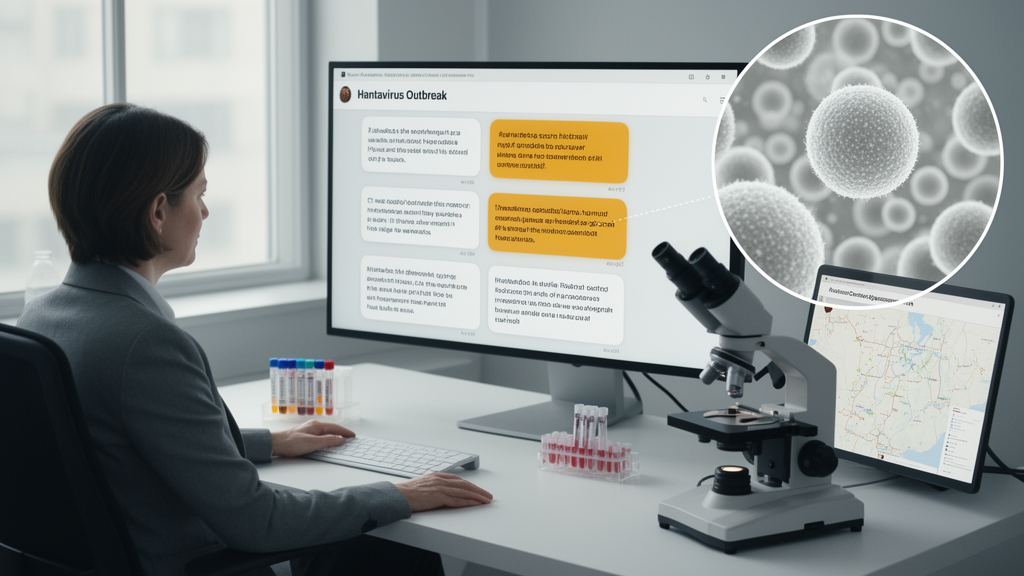
An expert-rated analysis of 900 responses generated by three publicly accessible large language models found that 63.1% were completely correct and sufficient, while 11.1% were partially correct or potentially misleading about hantavirus risk communication during the 2026 Andes virus outbreak. The comparative, cross-sectional study assessed outputs from ChatGPT, Gemini and Claude rather than patient outcomes, disease transmission or the models’ effects in a clinical setting. Across the evaluated dataset, no response was rated completely incorrect or overtly harmful, but the findings indicate that model-generated outbreak information still requires scrutiny before public use.

The researchers submitted 150 predefined hantavirus-related questions to the non-Pro, publicly accessible versions of the three models. The questions covered three areas: information based on official health-authority or guideline material, expert and clinical-practice issues, and frequently asked public questions. Each question was submitted twice, using either a standard zero-shot prompt or a prompt directed toward public-health risk communication. The two prompt formats generated 900 responses altogether, providing a dataset for comparing model outputs and assessing whether specialized risk-communication framing changed the expert-rated distribution of answers.

Three independent experts evaluated the responses with a predefined rubric addressing accuracy, completeness, consistency, safety and actionability. Ratings were summarized descriptively, while inter-rater reliability was assessed with percentage agreement and Fleiss’ kappa. Of the 900 responses, 568 were classified as completely correct and sufficient. A further 232, or 25.8%, were rated mostly correct but incomplete, and 100, or 11.1%, were considered partially correct or potentially misleading. Thus, 88.9% received one of the two higher ratings, even though nearly one in nine answers fell into the category that allowed potentially misleading information.

ChatGPT had the numerically highest proportion of completely correct responses, with 198 of 300 answers, or 66.0%, and the lowest proportion in the potentially misleading category, with 28 of 300, or 9.3%. Gemini and Claude had completely correct rates of 62.7% and 60.7%, respectively. The investigators interpreted these model-level differences descriptively and did not present them as evidence that one system was superior. The aggregate distribution of categorical ratings also did not change with the public-health risk communication prompt compared with the standard zero-shot prompt, indicating no measured change in the overall rating pattern under the two tested formats.

The study supports a qualified role for publicly accessible language models in infectious-disease and outbreak-related communication, but its results do not establish that the systems can serve as stand-alone sources of clinically complex or rapidly changing guidance. The analysis was confined to 150 predefined questions, three public model systems, two prompt formats and an expert scoring framework, and its results were reported descriptively rather than through statistical claims of model superiority. The researchers concluded that these tools may support risk communication when their outputs are grounded in official information and subjected to expert oversight. During a hantavirus outbreak, that distinction remains important because a majority of correct or mostly correct answers does not eliminate the possibility of incomplete or potentially misleading content in individual responses.

Subject of Research: Expert comparison of large language model responses to hantavirus risk-communication questions during the 2026 Andes virus outbreak

Article Title: Large language models for hantavirus-related infectious disease risk communication during the 2026 Andes virus outbreak: an expert-rated comparative content analysis

Article References: Polat, A. O., Tunç Karaman, S., & Basat, O. (2026). Large language models for hantavirus-related infectious disease risk communication during the 2026 Andes virus outbreak: an expert-rated comparative content analysis. BMC Infectious Diseases. https://doi.org/10.1186/s12879-026-14386-0

Image Credits: AI Generated

DOI: 10.1186/s12879-026-14386-0

Keywords: large language models, hantavirus, Andes virus, outbreak communication, public health, ChatGPT, Gemini, Claude, content analysis, risk communication, Large, language

Cite Scienmag News

Kristina Jarvis. (October 25, 2026). Expert analysis of LLM hantavirus outbreak responses finds 11.1% potentially misleading. Scienmag. https://scienmag.com/expert-analysis-of-llm-hantavirus-outbreak-responses-finds-11-1-potentially-misleading/


Kristina Jarvis. "Expert analysis of LLM hantavirus outbreak responses finds 11.1% potentially misleading." Scienmag, 25 October 2026, https://scienmag.com/expert-analysis-of-llm-hantavirus-outbreak-responses-finds-11-1-potentially-misleading/. Accessed 25 October 2026.

Kristina Jarvis. "Expert analysis of LLM hantavirus outbreak responses finds 11.1% potentially misleading." Scienmag. October 25, 2026. https://scienmag.com/expert-analysis-of-llm-hantavirus-outbreak-responses-finds-11-1-potentially-misleading/

Tags: AI safety and reliability in public healthand Claude in outbreak infoAndes virusassessment of LLMs in epidemic responseChatGPTChatGPT and health risk responsesClaudecomparative study of ChatGPTcontent analysisevaluation of AI-generated health informationexpert review of AI health responsesGeminihantavirusHantavirus outbreak communicationlanguagelargelarge language modelslarge language models in health misinformationmisinformation potential in AI health modelsmodel accuracy in disease outbreak scenariosoutbreak communicationPublic healthpublic health risk communication AI analysisrisk communication
Share26Tweet16
Previous Post

Printed liquid-metal electrodes track motion and heart signals

Next Post

Updated childhood bed-wetting guidance favors diagnosis, monitoring and tailored treatment

Related Posts

Kurarinol A inhibits activated stellate cells through MyD88 in preclinical study
Medicine

Kurarinol A inhibits activated stellate cells through MyD88 in preclinical study

October 25, 2026
Low-dose prednisolone eases long-COVID symptoms modestly, but B vitamins fail in phase 3 trial
Medicine

Low-dose prednisolone eases long-COVID symptoms modestly, but B vitamins fail in phase 3 trial

October 25, 2026
Photodynamic therapy shows promising HPV results in real-world CIN1 cohort
Medicine

Photodynamic therapy shows promising HPV results in real-world CIN1 cohort

October 25, 2026
Competing-risk analysis of tuberculosis outcomes in Liangshan
Medicine

Competing-risk analysis of tuberculosis outcomes in Liangshan

October 25, 2026
Thermally provoked itch in atopic dermatitis: current evidence, knowledge gaps, and digital approaches to nocturnal scratching
Medicine

Thermally provoked itch in atopic dermatitis: current evidence, knowledge gaps, and digital approaches to nocturnal scratching

October 25, 2026
Circadian control of tryptophan metabolism links immunity, brain function and metabolism
Medicine

Circadian control of tryptophan metabolism links immunity, brain function and metabolism

October 25, 2026
Next Post
Updated childhood bed-wetting guidance favors diagnosis, monitoring and tailored treatment

Updated childhood bed-wetting guidance favors diagnosis, monitoring and tailored treatment

  • Mothers who receive childcare support from maternal grandparents show more optimized

    Mothers who receive childcare support from maternal grandparents show more parental warmth, finds NTU Singapore study

    27656 shares
    Share 11059 Tweet 6912
  • University of Seville Breaks 120-Year-Old Mystery, Revises a Key Einstein Concept

    1061 shares
    Share 424 Tweet 265
  • Bee body mass, pathogens and local climate influence heat tolerance

    682 shares
    Share 273 Tweet 171
  • Researchers record first-ever images and data of a shark experiencing a boat strike

    546 shares
    Share 218 Tweet 137
  • Groundbreaking Clinical Trial Reveals Lubiprostone Enhances Kidney Function

    531 shares
    Share 212 Tweet 133
Science

Embark on a thrilling journey of discovery with Scienmag.com—your ultimate source for cutting-edge breakthroughs. Immerse yourself in a world where curiosity knows no limits and tomorrow’s possibilities become today’s reality!

RECENT NEWS

  • Kurarinol A inhibits activated stellate cells through MyD88 in preclinical study
  • Updated childhood bed-wetting guidance favors diagnosis, monitoring and tailored treatment
  • Expert analysis of LLM hantavirus outbreak responses finds 11.1% potentially misleading
  • Printed liquid-metal electrodes track motion and heart signals

Categories

  • Agriculture
  • Anthropology
  • Archaeology
  • Athmospheric
  • Biology
  • Biotechnology
  • Blog
  • Bussines
  • Cancer
  • Chemistry
  • Climate
  • Earth Science
  • Editorial Policy
  • Marine
  • Mathematics
  • Medicine
  • Pediatry
  • Policy
  • Psychology & Psychiatry
  • Science Education
  • Science News
  • Social Science
  • Space
  • Technology and Engineering

Subscribe to Blog via Email

Enter your email address to subscribe to this blog and receive notifications of new posts by email.

Join 5,151 other subscribers

© 2025 Scienmag - Science Magazine

Welcome Back!

Login to your account below

Forgotten Password?

Retrieve your password

Please enter your username or email address to reset your password.

Log In
No Result
View All Result
  • HOME
  • SCIENCE NEWS
  • CONTACT US

© 2025 Scienmag - Science Magazine

Discover more from Science

Subscribe now to keep reading and get access to the full archive.

Continue reading