


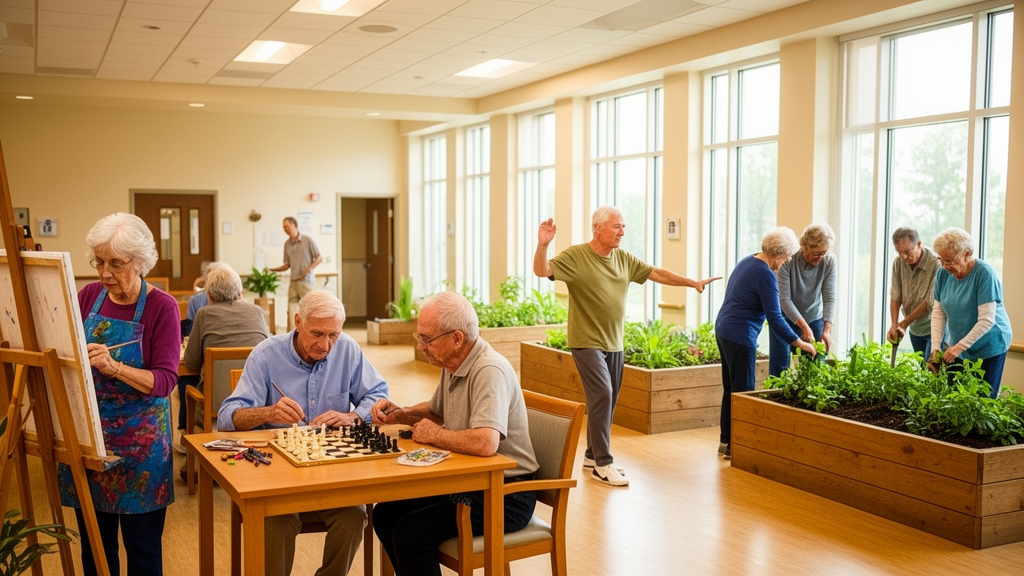
For decades, the popular story of ageing has been simple: as the years accumulate, life contracts. Activities fall away, the world shrinks, and the home becomes the final boundary of engagement. A new longitudinal study from France suggests that this narrative is far too tidy. By tracking thousands of adults aged 50 and older across nearly a decade, researchers found that everyday participation in later life follows several distinct configurations, each with its own stability and its own pattern of change. Crucially, the shift towards more home-centred activity was not the universal destination of ageing, but one trajectory among several, shaped by functional health, retirement and changing household circumstances in very different ways.
The study drew on the French sample of the Survey of Health, Ageing and Retirement in Europe, known as SHARE, a longitudinal survey following adults aged 50 years and older. The researchers analysed data from wave 5 in 2013 through wave 9, collected in 2021 and 2022. At the starting point, 4,505 participants living in France contributed the information needed to construct an occupational engagement profile. Their mean age was 67.6 years and 57.4 percent were women. To preserve comparability during the pandemic period, the analysis was restricted to interviews conducted in person using computer-assisted personal interviewing, a decision that may itself have selected for participants with more stable survey participation. In total, 1,814 participants had profiles at all five waves and contributed to complete-sequence analyses.
Rather than examining volunteering, leisure, family care or social participation in isolation, the researchers asked how these domains combine at the population level. Using indicators of social, domestic, family, productive, community, cultural, leisure and physical activities, organised through the International Classification of Functioning, Disability and Health, they applied a clustering technique called Partitioning Around Medoids with Gower dissimilarity, which accommodates the mixture of ordinal, binary and categorical variables that SHARE provides. Each domain received an equal total weight so that no single activity measured by more questionnaire items could dominate the solution. Five profiles emerged as the best compromise between statistical quality and empirical differentiation, balancing explained variance against cohesion across clustering diagnostics.
The largest configuration, Home-centred engagement, accounted for 73.2 percent of the baseline sample. It was dominated by individual and home-based activities such as reading and cognitive games, with limited community participation, volunteering, education, help to others or childcare. Participants in this profile were older, less educated and showed less favourable health characteristics, including more chronic conditions, poorer self-rated health and more frequent limitations in activities of daily living. The four smaller profiles painted a more outward-facing picture. Family-oriented engagement, at 9.8 percent, centred on frequent contact with parents and help within the household. Community engagement, at 3.8 percent, combined family contact with extra-household help and volunteering. Diversified engagement, at 7.6 percent, spanned the broadest range of measured domains, from club participation and education to political activities and moderate physical exercise. Social engagement, at 5.6 percent, sustained cultural and volunteering activities with less family orientation.
What happened over time was strikingly asymmetrical. Among participants initially in Home-centred engagement, 57.3 percent remained in that configuration at the end of follow-up. For the other four profiles, the equivalent figures ranged from just 7.0 to 17.5 percent. Transitions were predominantly directed towards Home-centred engagement, whereas movements out of it and direct jumps between highly contrasted configurations were less frequent. Among the 1,814 participants with complete sequences, 33.8 percent remained in the same profile across all five waves, with full-sequence stability concentrated in Home-centred engagement at 50.8 percent. Population-averaged regression models confirmed the pattern: compared with Home-centred engagement, originating from any other profile was associated with a substantially higher probability of change, adding between 35.5 and 47.1 percentage points to the likelihood of shifting configuration between consecutive waves.
The health analyses revealed a technical distinction with real consequences. When deterioration in self-rated health and increases in limitations of basic self-care activities and instrumental activities of daily living were modelled separately, all three were associated with a higher probability of Home-centred engagement. But when the three health dimensions were included simultaneously, self-rated health was no longer statistically significant, while increases in instrumental activity limitations remained strongly associated with the home-centred configuration, adding 20.8 percentage points to its probability. This pattern makes sense given what these measures capture: instrumental activities concern complex tasks required for independent living, such as managing transport, shopping and household administration, and are generally affected earlier in functional decline than basic self-care. The association suggests that the practical conditions under which complex everyday activities remain practicable may matter more than perceived health alone.
Not every life-course change pointed in the same direction. Retirement, defined as a transition from employment to retirement between consecutive waves, was associated with a lower probability of Home-centred engagement, reducing it by 12.76 percentage points, and with higher probabilities of Community engagement, up 8.17 percentage points, and, more modestly, Diversified engagement, up 3.97 percentage points. This finding aligns with recent SHARE-based evidence associating the transition to retirement with greater volunteering and community-oriented engagement, particularly among individuals with more favourable health, educational and financial resources. Leaving employment, in other words, coincided with a different distribution of activity configurations rather than a retreat into the home, though the study measured these changes over the same intervals and cannot establish that retirement itself generated new participation opportunities.
Changes in household size told yet another story, consistent with the life-course principle of linked lives, in which individual trajectories unfold within relationships and shared living arrangements. Both increases and decreases in the number of people sharing a household were associated with a higher probability of Home-centred engagement, up 7.21 percentage points for decreases and 38.45 percentage points for increases. An increase was additionally associated with Family-oriented engagement, up 9.80 percentage points. The researchers emphasise that household-size change does not identify the biographical event involved: bereavement, separation, a child leaving or another person arriving may entail very different relational, economic and practical circumstances. Increased economic difficulties, measured through a composite deprivation score, were not statistically significantly associated with membership in any profile, though a comparable measure was available for only a subset of wave intervals.
The authors caution against reading these results as a natural taxonomy of older adults. The five profiles are analytical constructions, and the profiles capture observable activity patterns but not the meaning, identity, belonging or biographical significance that occupational science emphasises. The same observed configuration may represent very different situations: a home-centred pattern may reflect preference, adaptation, constraint or combinations of these processes, and the data cannot determine which. The study draws on the French concept of déprise, which describes ageing not as uniform loss but as a selective reorganisation of activities and investments in relation to changing capacities, constraints and priorities. Some transitions towards Home-centred engagement may be compatible with such reorientation, but treating the home as synonymous with reduced engagement would be too restrictive, since similar observable configurations may have different significance under different circumstances.
Several limitations qualify the findings. Requiring wave 5 participation and consecutive observations, together with reduced in-person follow-up during the pandemic waves, may have selected participants with more stable survey participation. Inverse probability weighting produced broadly similar results but cannot eliminate selection related to unmeasured characteristics. Missing data were not imputed, and the SHARE indicators incompletely represent domestic, informal and relational activities. Because health, life-course and profile changes were measured over the same wave intervals, the findings describe concurrent associations rather than temporal ordering, and most changes were examined in separate models rather than as mutually adjusted effects. For population health, the implication is not to identify a desirable profile but to understand the conditions under which different forms of engagement remain possible, and where modifiable barriers to participation may arise beyond the home.
Subject of Research: Longitudinal change in occupational engagement configurations in later life: evidence from SHARE France
Article Title: Longitudinal change in occupational engagement configurations in later life: evidence from SHARE France
Article References: Sahraoui, M., Cambois, E., Canouï-Poitrine, F., Laurent, M., & Hagege, M. (2026). Longitudinal change in occupational engagement configurations in later life: evidence from SHARE France. SSM – Population Health, Article 101990. https://doi.org/10.1016/j.ssmph.2026.101990
Image Credits: AI Generated
DOI: 10.1016/j.ssmph.2026.101990
Keywords: Longitudinal, change, occupational, engagement, configurations, later, life, evidence, SHARE, France, scientific research
Cite Scienmag News
Beatrice Stafford. (October 25, 2026). Later-Life Activities Follow Differentiated Paths Rather Than a Single Narrowing Pattern. Scienmag. https://scienmag.com/later-life-activities-follow-differentiated-paths-rather-than-a-single-narrowing-pattern/
Beatrice Stafford. "Later-Life Activities Follow Differentiated Paths Rather Than a Single Narrowing Pattern." Scienmag, 25 October 2026, https://scienmag.com/later-life-activities-follow-differentiated-paths-rather-than-a-single-narrowing-pattern/. Accessed 25 October 2026.
Beatrice Stafford. "Later-Life Activities Follow Differentiated Paths Rather Than a Single Narrowing Pattern." Scienmag. October 25, 2026. https://scienmag.com/later-life-activities-follow-differentiated-paths-rather-than-a-single-narrowing-pattern/


