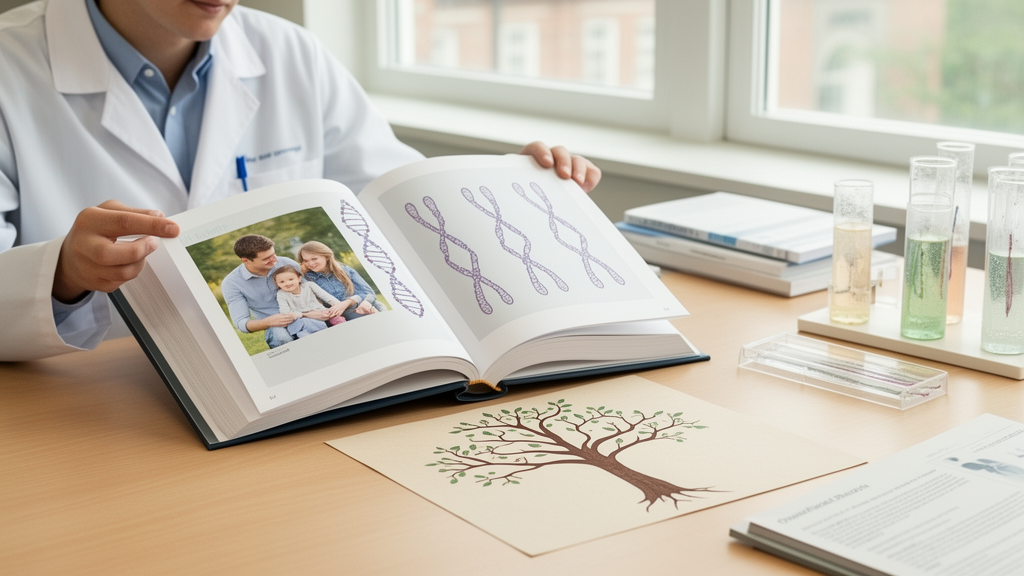
Twin studies have placed the heritability of schizophrenia at roughly 80% for decades, yet fewer than half of identical twins receive the same diagnosis. Those established but difficult-to-reconcile figures form the scientific backdrop for “Why My Sister? A Scientist’s Search for Meaning Amid Her Family’s Struggle with Schizophrenia,” a new book by psychiatric geneticist Consuelo Walss-Bass of UTHealth Houston.
The book interweaves the history of her family in Mexico and the United States with an account of the laboratory methods being used to investigate why genetic vulnerability does not determine which sibling develops schizophrenia. For Walss-Bass, the question is both personal and professional. Her mother, Eugenia, lived with schizophrenia across four decades and two countries, and her illness was untreated during much of that period.
Of Eugenia’s five children, one received the same diagnosis. The number of affected siblings was close to what the statistics predict, but nothing visible within the family predicted which child would be affected. Neither birth order nor differences in each child’s exposure to the mother’s illness explained the outcome, and the youngest child, a boy born long after the others, was spared.
The narrative opens in December 1976, when Eugenia landed in Mexico City from Ohio with three small children and no husband beside her. Her American visa was due to expire before Christmas, although she did not yet know that it would not be renewed. Months later, with money running out and her immigration status unresolved, she was living in a three-bedroom house in Puebla with her children, her disabled father and her mother.
She subsequently moved the family to her husband’s hometown of Torreón, where voices came and went during the ensuing years. A fourth child, Patricia, called Paty, would be born and called “the pretty one.” Paty later painted flowers, and the flowers slowly stopped looking like flowers.
By the time Walss-Bass wrote the book, Paty was 50, living above her sister’s garage, taking her medication and shopping at a store where the cashiers knew her name. She dressed for church on Sundays and drew with Walss-Bass on Saturdays. Against the social exclusion described in the book, Walss-Bass repeatedly returns to a plain statement: “Paty is doing well.” The family account therefore does not present schizophrenia only through illness or diagnosis, but also through the continuing life and relationships of a person receiving treatment.
The book separates that personal history from the research carried out by Walss-Bass’s laboratory. She directs the UTHealth Houston Psychiatric Genetics Program and founded and directs the UTHealth Houston Brain Collection for Research in Psychiatric Disorders. Since 2014, the collection has received more than 175 donations and supports transcriptomic profiling and epigenetic clock analysis of post-mortem tissue.
A second research line begins with donor skin biopsies. Walss-Bass’s group generates induced pluripotent stem cells from those cells and differentiates them into neurons and into three-dimensional cortical organoids, each smaller than a pea and each carrying the donor’s genome. Working from cells of affected sibling pairs in Costa Rica, the group was the first to demonstrate specific signaling alterations in neurons derived from people with schizophrenia, identifying convergent abnormalities in PI3K/GSK3 signaling.
Drawing organoid lines from families with multiple affected members concentrates genetic signal that is diffuse across unrelated cases, an approach intended to make biological differences associated with affected sibling pairs easier to investigate. Interleaved with the family narrative, the scientific passages trace positive and negative symptoms to Eugen Bleuler’s 1911 paper and examine FKBP5 variants that modulate the cortisol stress response. Depending on the variant, these genetic differences can buffer a person against early adversity or sensitize the person to it.
A further section surveys the current state of stem-cell modeling. The two registers—the third-person family history and the technical account—can be read together or separately. Neither is presented as a complete explanation, and the book does not portray the cell models or the family case as evidence that a cure is already available.
That restraint also informs the discussion of treatment. Clozapine, the medication that fully stabilized Walss-Bass’s sister, was discovered 50 years ago and remains the only option for treatment-resistant schizophrenia. It was withdrawn in 1976 after being incorrectly linked to eight deaths in Finland, reapproved in 1989 under a weekly blood-monitoring requirement, and released from that requirement by the U.S. Food and Drug Administration in 2025.
As the book went to press, Texas had not implemented the change. The monitoring burden had prompted many clinicians to decline to prescribe the drug. Two antipsychotics with novel mechanisms, Cobenfy and Caplyta, reached the market in the preceding two years, marking the first new mechanisms in decades to target something other than dopamine.
According to Walss-Bass, stigma is the antagonist of the book rather than schizophrenia itself. Her older brother Rudy, a lawyer in Torreón, said the societal weight of mental illness is crushing because people with cancer or diabetes receive empathy while a person with mental illness becomes “the crazy one,” and that this treatment extends to those around them. The account also examines the author’s changing relationship with her mother.
Writing, she said, gradually displaced a lifetime of anger toward her mother with empathy, compassion and admiration for what her mother had endured. “Why My Sister?” is scheduled for publication on September 15, 2026, by Allele Books in English, Spanish, Portuguese, French, German and Italian, with each edition prepared as a full literary translation for its market. A Japanese edition is planned for later in 2026, while Chinese-language rights remain open.
Its central contribution is not a new clinical trial or a claim of immediate therapeutic benefit, but an unusually direct juxtaposition of one multigenerational family history and the established tools of psychiatric genetics. Walss-Bass does not present stem-cell work as a cure; she presents it as a method by which a cure might become findable.
Subject of Research: Schizophrenia heritability, familial risk and stem-cell models of affected sibling pairs
Article Title: Why her sister and not her: inside the gap that schizophrenia genetics has not closed
Article References: Why her sister and not her: inside the gap that schizophrenia genetics has not closed. Original publication (Bibliographic details unavailable.)
Image Credits: AI Generated
DOI: Not provided
Keywords: schizophrenia, psychiatric genetics, heritability, identical twins, stem cell models, cortical organoids, PI3K/GSK3 signaling, FKBP5, family history, mental-health stigma, cerebral organoids, treatment-resistant schizophrenia
Cite Scienmag News
Juliet Wilcox. (October 25, 2026). Schizophrenia Genetics Book Examines Unequal Risk in One Family. Scienmag. https://scienmag.com/schizophrenia-genetics-book-examines-unequal-risk-in-one-family/
Juliet Wilcox. "Schizophrenia Genetics Book Examines Unequal Risk in One Family." Scienmag, 25 October 2026, https://scienmag.com/schizophrenia-genetics-book-examines-unequal-risk-in-one-family/. Accessed 25 October 2026.
Juliet Wilcox. "Schizophrenia Genetics Book Examines Unequal Risk in One Family." Scienmag. October 25, 2026. https://scienmag.com/schizophrenia-genetics-book-examines-unequal-risk-in-one-family/