


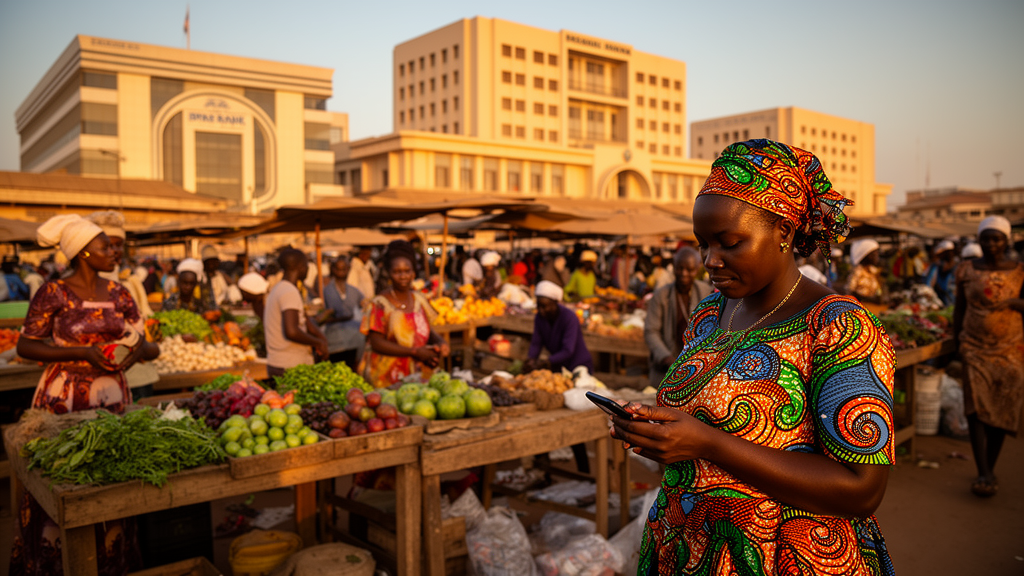
A panel study of 32 Sub-Saharan African countries reports that financial inclusion is positively and statistically significantly associated with welfare, and that institutional quality shows a positive and significant relationship with well-being as well. The open access research, published in Discover Sustainability by Haymanot Bassie Mognhod and Belete Animaw Beyene, uses data for the years 2011, 2014, 2017, and 2021 to examine how access to financial services, governance structures, and macroeconomic conditions relate to human welfare in the region.
Methodologically, the authors constructed two composite measures using principal component analysis. The first is a multidimensional financial inclusion index combining three dimensions: access, usage, and quality of financial services. The second is a composite institutional quality index. To estimate the relationships with welfare, the study employed the Feasible Generalized Least Squares (FGLS) estimator, which accounts for serial correlation and heteroskedasticity commonly present in panel data. The results were cross-checked with two additional techniques, Panel-Corrected Standard Errors and the Driscoll–Kraay estimator, to confirm robustness.
The headline result is that the composite financial inclusion index displays a positive and statistically significant association with welfare across the sampled countries. When the index is broken into its components, a more nuanced picture emerges. The access dimension, reflecting the availability of financial services, and the usage dimension, reflecting how actively people engage with those services, both show strong, positive, and statistically significant relationships with welfare. The quality dimension, by contrast, is positive but statistically insignificant, a pattern the authors interpret as pointing to latent structural market frictions that may prevent improvements in service quality from translating into measurable welfare gains.
Institutional quality itself also shows a positive and statistically significant relationship with welfare. According to the study, this suggests that stronger governance structures enhance the welfare gains derived from financial systems. The authors state that strengthening financial inclusion alongside institutional reforms is essential for achieving inclusive and sustainable welfare improvements in Sub-Saharan Africa.
Two control variables add further texture to the results. Rapid population growth is found to constrain welfare improvements, while final consumption expenditure contributes positively. These estimates indicate that demographic pressure can offset gains from financial deepening, whereas spending supports well-being in the model. The authors frame financial inclusion as a critical driver of sustainable development, improving access to financial services and enhancing human well-being, and they state that the findings provide policy insights for governments seeking to accelerate progress toward the Sustainable Development Goals through inclusive financial sector development. As an accepted research article shared ahead of final production, the version is citable and carries a permanent DOI, with a final Version of Record to follow. The study’s scope is limited to the 32 sampled countries and the four survey years analyzed, and the reported relationships are statistical associations estimated from panel data rather than established causal effects.
Subject of Research: The association between financial inclusion, institutional quality, and welfare in Sub-Saharan Africa
Article Title: Financial inclusion, institutional quality, and welfare in Sub-Saharan Africa
Article References: Mognhod, H. B., & Beyene, B. A. (2026). Financial inclusion, institutional quality, and welfare in Sub-Saharan Africa. Discover Sustainability. https://doi.org/10.1007/s43621-026-05092-7
Image Credits: AI Generated
DOI: 10.1007/s43621-026-05092-7
Keywords: financial inclusion, Sub-Saharan Africa, institutional quality, welfare, FGLS estimator, panel data, sustainable development, Discover Sustainability, financial access, governance, Financial, inclusion
Cite Scienmag News
Violet Maxwell. (October 25, 2026). Financial Inclusion and Institutional Quality Linked to Welfare in Sub-Saharan Africa. Scienmag. https://scienmag.com/financial-inclusion-and-institutional-quality-linked-to-welfare-in-sub-saharan-africa/
Violet Maxwell. "Financial Inclusion and Institutional Quality Linked to Welfare in Sub-Saharan Africa." Scienmag, 25 October 2026, https://scienmag.com/financial-inclusion-and-institutional-quality-linked-to-welfare-in-sub-saharan-africa/. Accessed 25 October 2026.
Violet Maxwell. "Financial Inclusion and Institutional Quality Linked to Welfare in Sub-Saharan Africa." Scienmag. October 25, 2026. https://scienmag.com/financial-inclusion-and-institutional-quality-linked-to-welfare-in-sub-saharan-africa/


