

Sunday, October 25, 2026
Science
No Result
View All Result
  • Login
  • HOME
  • SCIENCE NEWS
  • CONTACT US
  • HOME
  • SCIENCE NEWS
  • CONTACT US
No Result
View All Result
Scienmag
No Result
View All Result
Home Science News Agriculture

Sodium silicate improves salt-stressed tomato growth and ion balance in plant study

October 25, 2026
in Agriculture
Alan Morgan
By Alan Morgan Scienmag Editorial Profile - Precision Agriculture
Reading Time: 2 mins read
0
Sodium silicate improves salt-stressed tomato growth and ion balance in plant study

Sodium silicate improves salt-stressed tomato growth and ion balance in plant study

65
SHARES
587
VIEWS
Share on FacebookShare on Twitter
ADVERTISEMENT

Sodium silicate improved growth, photosynthetic pigment content, antioxidant defenses, and ionic balance in tomato plants exposed to salt stress, according to a plant study testing plants under 75 and 150 millimolar sodium chloride concentrations. The researchers identified 2 millimolar sodium silicate as the most effective concentration among those evaluated. Salinity substantially reduced plant growth, pigment content, and essential mineral uptake while increasing malondialdehyde, hydrogen peroxide, hydroxyl radicals, and electrolyte leakage, measurements that together documented increased oxidative stress and impaired cellular stability.

The study investigated whether exogenous silicon supplied as sodium silicate could lessen the physiological and biochemical effects of salt stress in tomato, Solanum lycopersicum L. The research compared responses to the two tested sodium chloride conditions and assessed the effects of sodium silicate at several concentrations. The supplied results do not report the plant developmental stage, treatment duration, sample size, growth setting, or other methodological details, so the full experimental scope and the precision of the estimates cannot be assessed from the available evidence.

Relative to salt-stressed plants that did not receive silicon, sodium silicate—especially at 2 millimolar—significantly improved growth performance and photosynthetic pigment content. It also increased the activity of superoxide dismutase, catalase, ascorbate peroxidase, glutathione reductase, and peroxidase. The treatment raised levels of ascorbate and glutathione, compounds the study associated with antioxidant defense. These changes accompanied lower concentrations of malondialdehyde, hydrogen peroxide, and hydroxyl radicals, as well as reduced electrolyte leakage. The reported pattern indicates that silicon strengthened antioxidant capacity and cellular redox balance while stabilizing membranes, although the results do not provide numerical effect sizes or statistical uncertainty.

Silicon treatment also altered mineral status by decreasing sodium ion concentration and increasing the absorption of nitrogen, phosphorus, potassium, and silicon. In conjunction with the improvements in growth, photosynthesis-related pigments, and antioxidant activity, these results support the study’s conclusion that sodium silicate alleviated salt-induced impairment through coordinated physiological, biochemical, and ionic regulation. The findings concern plant-level responses to controlled salt exposure and do not establish effects on tomato yield, fruit quality, soils, climates, cultivars, or commercial production systems. The authors proposed exogenous sodium silicate, particularly the 2 millimolar concentration, as a potential sustainable strategy for tomato cultivation under salt-affected conditions, but the reported study does not demonstrate those wider agricultural outcomes.

Subject of Research: Effects of sodium silicate on salinity stress responses in tomato plants

Article Title: Silicon enhances salinity tolerance in tomato (Solanum lycopersicum L.) through physiological, biochemical, and ionic regulation

Article References: Badawy, I., Mohamed, H. I., Fouda, H., Elnosary, M. E., & Sofy, M. R. (2026). Silicon enhances salinity tolerance in tomato (Solanum lycopersicum L.) through physiological, biochemical, and ionic regulation. BMC Plant Biology, 26(1), Article 1559. https://doi.org/10.1186/s12870-026-09859-y

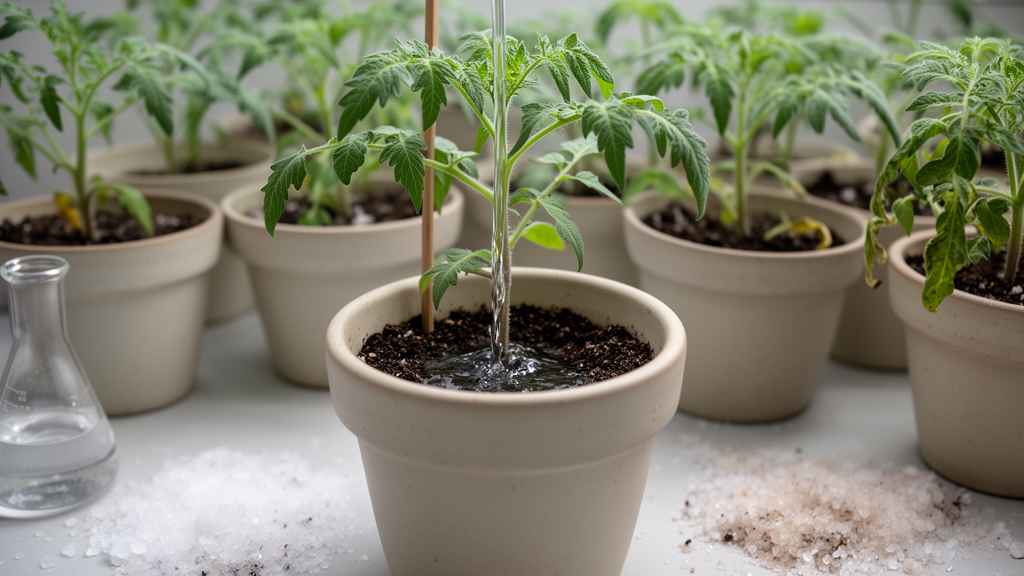
Image Credits: AI Generated

DOI: 10.1186/s12870-026-09859-y

Keywords: tomato, salinity stress, sodium silicate, silicon, plant growth, photosynthetic pigments, antioxidant enzymes, ionic balance, sodium chloride, plant mineral uptake, enhances, salinity

Cite Scienmag News

Alan Morgan. (October 25, 2026). Sodium silicate improves salt-stressed tomato growth and ion balance in plant study. Scienmag. https://scienmag.com/sodium-silicate-improves-salt-stressed-tomato-growth-and-ion-balance-in-plant-study/


Alan Morgan. "Sodium silicate improves salt-stressed tomato growth and ion balance in plant study." Scienmag, 25 October 2026, https://scienmag.com/sodium-silicate-improves-salt-stressed-tomato-growth-and-ion-balance-in-plant-study/. Accessed 25 October 2026.

Alan Morgan. "Sodium silicate improves salt-stressed tomato growth and ion balance in plant study." Scienmag. October 25, 2026. https://scienmag.com/sodium-silicate-improves-salt-stressed-tomato-growth-and-ion-balance-in-plant-study/

Tags: antioxidant enzymesbiochemical mechanisms of salt stress in tomatoeffects of sodium silicate on plant ion balance under salt stressenhancesinfluence of sodium silicate on photosynthetic pigment content in stressed plantsionic balanceionic regulation in tomato plants exposedoptimal sodium silicate concentration for salt stress alleviationoxidative stress markers in salt-stressed tomatophotosynthetic pigmentsplant antioxidant enzyme response to salinityplant growthplant growth improvement under saline conditions with sodium silicateplant mineral uptakerole of silicon in enhancing plant salt tolerancesalinitysalinity stressSalt stress mitigation in tomato plants using sodium silicatesiliconsodium chloridesodium silicatetomato
Share26Tweet16
Previous Post

Children in social care show sharply higher healthcare use across Welsh groups

Next Post

Research report: Prognostic significance of folate receptor alpha expression in endometrial serous carcinoma: implications for patient stratification and targeted therapy

Related Posts

Natural Farming Shows Promise for Climate-Resilient Soils, but Evidence Gaps Remain
Agriculture

Natural Farming Shows Promise for Climate-Resilient Soils, but Evidence Gaps Remain

October 25, 2026
Pulsed Drip Irrigation and Moderate Nitrogen Boost Photosynthesis in Sugarcane
Agriculture

Pulsed Drip Irrigation and Moderate Nitrogen Boost Photosynthesis in Sugarcane

October 25, 2026
Southeastern Tibetan Plateau forest survey finds asynchronous soil nutrient changes
Agriculture

Southeastern Tibetan Plateau forest survey finds asynchronous soil nutrient changes

October 25, 2026
Micelle Quercetin Fails to Boost Growth in Growing-Finishing Pigs but Shifts Serum Bile Acids
Agriculture

Micelle Quercetin Fails to Boost Growth in Growing-Finishing Pigs but Shifts Serum Bile Acids

October 25, 2026
Minimum tillage boosts soya bean yields, but compost can backfire
Agriculture

Minimum tillage boosts soya bean yields, but compost can backfire

October 25, 2026
Seed Priming Emerges as a Low-Cost Route to Climate-Resilient Crops
Agriculture

Seed Priming Emerges as a Low-Cost Route to Climate-Resilient Crops

October 25, 2026
Next Post
Research report: Prognostic significance of folate receptor alpha expression in endometrial serous carcinoma: implications for patient stratification and targeted therapy

Research report: Prognostic significance of folate receptor alpha expression in endometrial serous carcinoma: implications for patient stratification and targeted therapy

  • Mothers who receive childcare support from maternal grandparents show more optimized

    Mothers who receive childcare support from maternal grandparents show more parental warmth, finds NTU Singapore study

    27656 shares
    Share 11059 Tweet 6912
  • University of Seville Breaks 120-Year-Old Mystery, Revises a Key Einstein Concept

    1061 shares
    Share 424 Tweet 265
  • Bee body mass, pathogens and local climate influence heat tolerance

    682 shares
    Share 273 Tweet 171
  • Researchers record first-ever images and data of a shark experiencing a boat strike

    546 shares
    Share 218 Tweet 137
  • Groundbreaking Clinical Trial Reveals Lubiprostone Enhances Kidney Function

    531 shares
    Share 212 Tweet 133
Science

Embark on a thrilling journey of discovery with Scienmag.com—your ultimate source for cutting-edge breakthroughs. Immerse yourself in a world where curiosity knows no limits and tomorrow’s possibilities become today’s reality!

RECENT NEWS

  • Research report: Prognostic significance of folate receptor alpha expression in endometrial serous carcinoma: implications for patient stratification and targeted therapy
  • Sodium silicate improves salt-stressed tomato growth and ion balance in plant study
  • Children in social care show sharply higher healthcare use across Welsh groups
  • Probing the sensitivity of dark energy dynamics to equation of state parametrization flexibility

Categories

  • Agriculture
  • Anthropology
  • Archaeology
  • Athmospheric
  • Biology
  • Biotechnology
  • Blog
  • Bussines
  • Cancer
  • Chemistry
  • Climate
  • Earth Science
  • Editorial Policy
  • Marine
  • Mathematics
  • Medicine
  • Pediatry
  • Policy
  • Psychology & Psychiatry
  • Science Education
  • Science News
  • Social Science
  • Space
  • Technology and Engineering

Subscribe to Blog via Email

Enter your email address to subscribe to this blog and receive notifications of new posts by email.

Join 5,151 other subscribers

© 2025 Scienmag - Science Magazine

Welcome Back!

Login to your account below

Forgotten Password?

Retrieve your password

Please enter your username or email address to reset your password.

Log In
No Result
View All Result
  • HOME
  • SCIENCE NEWS
  • CONTACT US

© 2025 Scienmag - Science Magazine

Discover more from Science

Subscribe now to keep reading and get access to the full archive.

Continue reading