


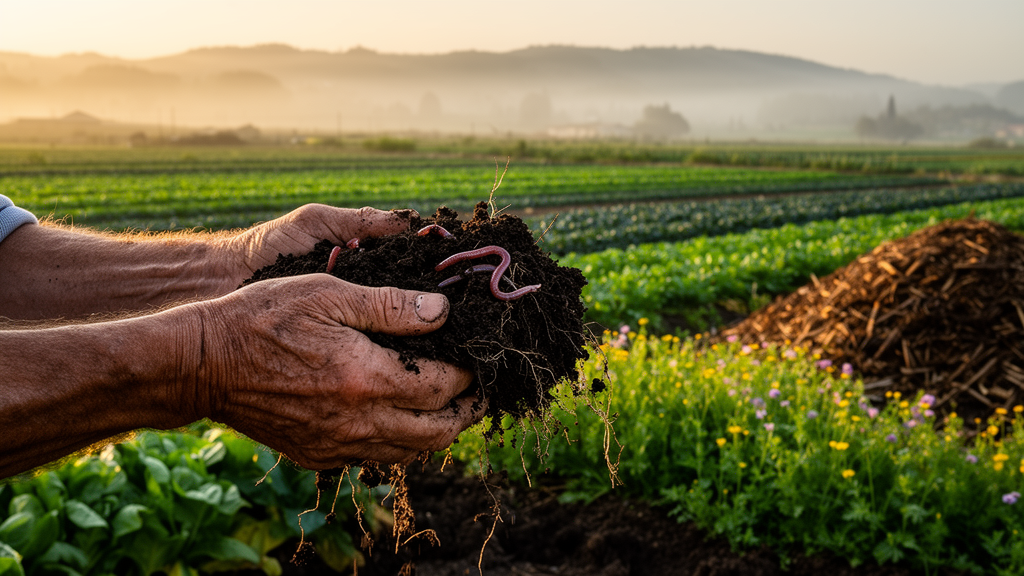
Natural farming, a low-external-input agroecological approach built around farm-made biological formulations, mulching and crop diversification, can improve a range of soil physical, chemical and biological properties, according to a critical review published in Discover Soil. The synthesis, however, cautions that many reported benefits come from studies in which natural farming formulations were applied alongside farmyard manure, vermicompost, microbial inoculants or reduced mineral fertilizer, making it impossible to credit natural farming alone. Direct, long-term evidence that these practices actually buffer crops against drought, heat and erratic rainfall remains scarce, and the review sets out the research agenda needed to test that claim rigorously.
The review traces the roots of natural farming in India, where it evolved from traditional and Vedic agricultural knowledge and gained modern prominence through Subhash Palekar’s Zero Budget Natural Farming. The system rests on four pillars: Beejamrit, a seed treatment based on desi cow dung, cow urine and other local ingredients intended to strengthen germination and protect against seed- and soil-borne disease; Jeevamrit, a fermented microbial inoculant applied to soil or foliage to stimulate nutrient availability; Acchadana, or mulching, in soil, live and dead forms to conserve moisture and build humus; and intercropping with legumes for biological nitrogen fixation. Policy momentum has been substantial: the Union Cabinet approved the National Mission on Natural Farming on 25 November 2024 as a standalone centrally sponsored scheme with an outlay of ₹2,481 crore, and government-reported data indicate that 18,786 clusters covering roughly 8.80 lakh hectares had been formed and 18.19 lakh farmers enrolled as of 5 March 2026, figures the review notes reflect programme coverage rather than independently verified adoption.
The urgency behind this interest is grounded in the poor state of Indian soils. An analysis of more than 200,000 soil samples collected between 2011 and 2017 found average deficiencies of 36.5 percent for zinc, 23.4 percent for boron, 12.8 percent for iron, 11.0 percent for molybdenum, 7.1 percent for manganese and 4.2 percent for copper. In terms of macronutrients, an estimated 59 percent of Indian soils are low in available nitrogen and 36 percent medium, while 49 percent are low in available phosphorus and 45 percent medium, and 9 percent low in available potassium with 39 percent medium. Alkaline conditions in parts of Punjab and Haryana have been associated with reduced iron and zinc availability, and imbalanced fertilization, erosion and leaching compound these losses. Natural farming formulations may influence micronutrient availability indirectly, through organic matter, rhizosphere processes and microbial activity that complex, chelate and solubilize iron, zinc, manganese and copper, but the review stresses that enhanced microbial activity does not guarantee adequate long-term nutrient supply in inherently deficient soils.
The biological credentials of the fermented formulations themselves are well documented. Jeevamrit has been reported to contain more than 6.33 × 10⁸ bacteria, 0.51 × 10⁵ fungi and 3 × 10⁵ actinomycetes per millilitre, with acid phosphatase, alkaline phosphatase and dehydrogenase activities of 6.72, 13.34 and 2.77 micrograms per millilitre respectively. Screening of bacterial isolates from Panchgavya, Jeevamrit and farmyard manure found 67.78 percent phosphorus solubilizers, 60.37 percent nitrogen fixers, 62.37 percent siderophore producers and high proportions of antagonists against Pythium and Colletotrichum pathogens, with Bacillus and Pseudomonas the most effective plant-growth promoters. The review, however, draws a sharp line between microbial counts in a bottle and microbial change in a field: high counts in formulations demonstrate their biological character but do not prove that soil communities shift after application.
Field evidence on soil properties is more mixed in attribution. In a two-year trial, natural farming alone improved certain biological indicators, while the combination of farmyard manure at 10 tonnes per hectare with 10 percent Jeevamrit applied at 15-day intervals produced stronger physical results, including a bulk density of 1.43 megagrams per cubic metre, mean weight diameter of 1.12 millimetres, hydraulic conductivity of 8.13 centimetres per hour and water capacity of 14.2 mcm/m. Because manure was part of that treatment, Jeevamrit cannot be identified as the sole contributor. Other studies report that fresh Jeevamrit outperformed stored material in improving aeration and water retention, and that combinations of vermicompost or farmyard manure with Jeevamrit raised soil organic carbon, cation exchange capacity and available nutrients in French beans, okra and pea, with pea yields reaching 14.78 tonnes per hectare, 20.5 percent above recommended fertilizer and manure application. A broccoli study combining 90 percent of recommended nitrogen with Jeevamrit achieved soil organic carbon of 20.93 grams per kilogram and available nitrogen, phosphorus and potassium of 375.13, 48.46 and 260.53 kilograms per hectare, but the review classifies such treatments as integrated nutrient management rather than natural farming.
Some headline numbers demand careful reading. One study attributed to Zero Budget Natural Farming reported a 46 percent increase in soil organic carbon and rises of 439 percent in available phosphorus and 142 percent in available potassium between 2017 and 2019, yet the review notes that such changes depend on baseline soil condition, prior management and study duration. It also warns that increased organic carbon concentration is not synonymous with carbon sequestration, which requires monitoring carbon stocks over time with consistent bulk density and sampling depth methods, alongside attention to permanence and greenhouse-gas emissions. Microorganisms, the review emphasizes, mobilize existing nutrients rather than creating new ones, so long-term nutrient budgets balancing inputs, mineralization, crop uptake and removal are essential, particularly for phosphorus, potassium, sulfur and micronutrients.
Biological and integrated assessments offer some of the strongest system-level signals. In Japanese paddy fields under natural farming, soil microbial communities showed higher resource utilization and ecosystem complexity, along with greater saprotrophic fungal diversity and predicted diversity of carbon- and nitrogen-cycling bacteria. Metagenomic analysis of Zero Budget Natural Farming soils found increased abundance of Bacillus, Pseudomonas and Rhizobium, though the review cautions that abundance does not imply active function. A soil quality index rose from 0.68 under conventional management to 0.90 with farmyard manure plus 10 percent Jeevamrit, accompanied by a maize-equivalent yield 8.65 percent higher, while a principal-component analysis comparing natural and conventional farms in the north-western Himalayas produced mean indices of 0.617 and 0.540 respectively, with microbial biomass carbon, DTPA-extractable zinc, available phosphorus, sand percentage and electrical conductivity as key indicators accounting for 84.7 percent of variation across five components.
The climate-resilience case is framed as plausible mechanism rather than demonstrated outcome. The review proposes causal chains such as mulching reducing evaporation and moderating soil temperature, thereby improving water availability and potentially buffering drought, and organic inputs raising organic carbon and aggregation, thereby increasing infiltration and retention and potentially resisting runoff and erosion. Improved aggregation, porosity and plant-available water could help capture rain and reduce losses during heavy rainfall, while mulch stabilizes temperature around roots during heat and dry spells. But the literature mostly reports changes in soil-health indicators rather than measured plant or soil responses to droughts, heat waves or extreme rainfall, so these pathways are treated as potential sources of resilience, not proof of it. Evidence that microbial communities under natural farming resist and recover from climatic shocks is likewise sparse.
Yield and economic trade-offs complicate the picture further. Crop responses to natural farming are not uniformly positive, varying with crop species, initial soil fertility, agro-climate, transition duration and the supplementary inputs used, and some studies report little advantage or reductions relative to conventional or integrated systems. Practical constraints include the labour, knowledge and timely ingredient availability required to prepare and repeatedly apply farm-derived formulations, and unequal access to biomass and organic resources, although reduced purchases of synthetic inputs may lower costs. The review also distinguishes natural farming from organic farming, integrated nutrient management, regenerative agriculture and agroecology, which share principles but are not synonymous, and notes that botanical pest formulations such as Neemastra, Brahmastra and Agniastra have demonstrated antifeedant, insecticidal and nematicidal effects, including against the root-knot nematode Meloidogyne incognita under experimental conditions, but their long-term effects on soil organisms remain largely unstudied.
The review’s conclusions are measured: natural farming has genuine potential to support soil functions relevant to climate resilience, but the magnitude and persistence of its benefits require context-specific evaluation. Its research priorities include long-term, multi-location comparisons with conventional, organic and integrated systems under defined protocols, full nutrient budgeting, soil carbon stock assessment, greenhouse-gas measurements, standardization of formulations whose microbial and chemical properties vary with ingredients, fermentation and storage, and evaluation of yield stability, labour demands and economic performance during the transition period. With India’s net-zero commitment for 2070 and the new national mission in place, the stakes are high, and the review argues that policy support should be matched by rigorous, system-level field evidence before natural farming is credited with delivering climate-resilient soils at scale.
Subject of Research: Effects of natural farming practices on soil health and climate resilience
Article Title: Natural farming as a pathway to climate-resilient soils
Article References: Sharma, R., & Sharma, A. (2026). Natural farming as a pathway to climate-resilient soils. Discover Soil, 3(1), Article 199. https://doi.org/10.1007/s44378-026-00357-z
Image Credits: AI Generated
DOI: 10.1007/s44378-026-00357-z
Keywords: natural farming, soil health, Jeevamrit, Beejamrit, soil organic carbon, climate resilience, Zero Budget Natural Farming, mulching, soil microbiology, nutrient management, India, agroecology
Cite Scienmag News
Alan Morgan. (October 25, 2026). Natural Farming Shows Promise for Climate-Resilient Soils, but Evidence Gaps Remain. Scienmag. https://scienmag.com/natural-farming-shows-promise-for-climate-resilient-soils-but-evidence-gaps-remain/
Alan Morgan. "Natural Farming Shows Promise for Climate-Resilient Soils, but Evidence Gaps Remain." Scienmag, 25 October 2026, https://scienmag.com/natural-farming-shows-promise-for-climate-resilient-soils-but-evidence-gaps-remain/. Accessed 25 October 2026.
Alan Morgan. "Natural Farming Shows Promise for Climate-Resilient Soils, but Evidence Gaps Remain." Scienmag. October 25, 2026. https://scienmag.com/natural-farming-shows-promise-for-climate-resilient-soils-but-evidence-gaps-remain/


