


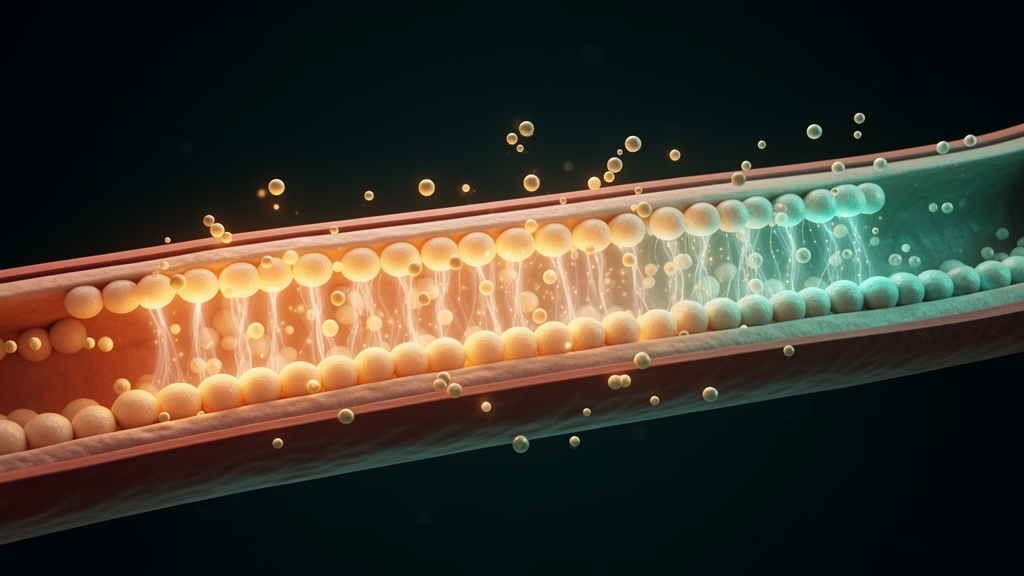
Obesity now affects more than 878 million adults worldwide, and one of its most consequential injuries happens inside the blood vessel wall, long before a heart attack or stroke announces itself. A new pre-clinical study reports that the anti-inflammatory cytokine interleukin-35 can reverse a hallmark of this hidden damage: the loss of endothelium-dependent vasodilation, the ability of arteries to relax in response to chemical signals from their own lining. Working in obese mice and in human endothelial cells exposed to lipotoxic stress, the researchers traced the protective effect to a specific intracellular route, the STAT3-MAPK/ERK-eNOS signaling axis, which restores the activating phosphorylation of the enzyme that makes nitric oxide. The findings, published as a mechanistic characterization of IL-35 vascular biology, position this regulatory T cell-derived cytokine as a candidate therapeutic target for the metabolic vascular injury that current weight- and lipid-focused drugs leave largely untouched.
The scale of the problem is difficult to overstate. In 2022, an estimated 504 million women and 374 million men were living with obesity, a state that markedly elevates susceptibility to type 2 diabetes, hypertension, atherosclerosis, non-alcoholic fatty liver disease, sleep apnea, osteoporosis and multiple cancers. Endothelial dysfunction triggered by obesity is a central pathological driver of these disorders. The endothelium is the thin monolayer of cells lining every vessel, and it sustains vascular homeostasis mainly through endothelial nitric oxide synthase, the rate-limiting enzyme for endothelial nitric oxide production. Nitric oxide mediates vasodilation, inhibits platelet aggregation and adhesion, restrains overgrowth of vascular smooth muscle, and exerts anti-inflammatory and anti-oxidant actions that maintain the integrity of the vessel lining. When hyperlipidaemia, hyperglycemia and inflammation push eNOS activity and nitric oxide bioavailability downward, the result is vasoconstriction, oxidative stress, aberrant proliferation, coagulation dysregulation and adhesion-molecule upregulation, a cascade that accelerates cardiometabolic disease.
What makes the new work potentially significant is its answer to a residual-risk problem. Existing anti-obesity and lipid-lowering agents, including liraglutide, orlistat and statins, confer endothelial benefits that are largely secondary to improved weight, glucose and lipid profiles. Their vascular protection is indirect and metabolism-dependent, and many patients continue to exhibit chronic inflammation and endothelial dysfunction even under optimal metabolic control. Obesity-associated chronic low-grade inflammation drives endothelial injury and cardiovascular complications independently of body weight and metabolic indices, leaving a clinical need for therapies that directly target the vascular inflammatory microenvironment and eNOS function. IL-35, an anti-inflammatory member of the IL-12 cytokine family predominantly secreted by regulatory T cells, has attracted attention precisely because circulating levels fall in obesity, likely owing to functional exhaustion of adipose tissue Tregs under chronic inflammatory pressure. Prior pre-clinical studies had shown IL-35 protects against atherosclerosis, pulmonary hypertension, ischemic vascular injury and autoimmune inflammation, but whether it could reverse obesity-induced impairment of vasodilation, and which signaling cascades mediate such protection, remained open questions.
The experimental design combined a diet-induced obesity model with mechanistic cell work. Thirty male C57BL/6J mice were divided into control, high-fat diet, and high-fat diet plus IL-35 groups. The high-fat diet contained 60 percent fat, and by week 8 the diet-fed mice showed more than a 1.2-fold higher body weight and elevated blood glucose compared with controls, confirming successful model establishment. During a subsequent four-week intervention period, the treatment group received weekly intraperitoneal injections of recombinant mouse IL-35 at 0.5 micrograms per gram of body weight, while control animals received equal volumes of phosphate-buffered saline. Investigators performing the vascular ring assays, Western blotting, immunofluorescence imaging and data quantification were blinded to group allocation, and the study followed NIH and ARRIVE animal welfare guidelines.
The functional readout came from isolated aortic rings tested in a multi-channel microvascular tension system. Rings were pre-contracted with norepinephrine, then exposed to cumulative concentrations of acetylcholine to assess endothelium-dependent relaxation, and, after washing, to sodium nitroprusside to assess endothelium-independent relaxation. Compared with controls, aortas from high-fat diet mice showed significantly reduced endothelium-dependent vasodilation in response to acetylcholine, with a decrease in maximum relaxation. IL-35 treatment markedly improved this vasodilatory function. Endothelium-independent vasodilation was also reduced in the diet-fed mice, but IL-35 produced only a non-significant trend of improvement there. The authors attribute this differential effect largely to anatomy: the endothelial monolayer forms a functional diffusion barrier between the bloodstream and the vascular media, so circulating IL-35 delivered intraperitoneally preferentially acts on endothelial cells directly exposed to the blood while having limited ability to reach the underlying smooth muscle, whose cytokine environment is normally maintained by paracrine secretion from perivascular adipose tissue and the adventitia.
Behind the functional rescue lay a precise molecular restoration. Western blotting of aortic tissue showed that phosphorylation of eNOS at serine 1177, a critical activating modification that increases enzymatic activity by several- to ten-fold, was significantly reduced in obese mice and restored by IL-35 treatment, while total eNOS protein levels showed no significant differences across groups. The same pattern appeared in human umbilical vein endothelial cells injured with 100 micromolar palmitic acid, a saturated fatty acid accounting for roughly 38 percent of circulating saturated fatty acids in obesity, whose lipotoxic injury recapitulates key features of diet-induced endothelial dysfunction. A nitric oxide fluorescence assay using DAF-FM DA confirmed that the reduction in nitric oxide production induced by palmitate was significantly reversed by IL-35. The cytokine also selectively lowered serum triglycerides in the obese mice without altering total cholesterol, LDL-C or HDL-C, a lipid effect the authors link to downregulation of PPARγ and C/EBPα rather than to cholesterol metabolism.
The subunit biology added an intriguing wrinkle. IL-35 is a heterodimer composed of EBI3 and IL-12A, and immunofluorescence colocalization with the endothelial marker CD31 revealed that EBI3 fluorescence in aortic endothelial cells was notably reduced in obese mice and elevated by IL-35 supplementation, a trend confirmed by Western blotting. In contrast, IL-12A expression showed no significant differences across the three groups by either assay, and the same divergent pattern held in palmitate-treated cells, where exogenous IL-35 upregulated EBI3 without touching IL-12A. Serum IL-35 concentrations measured by ELISA were significantly lower in the obese group. The authors note that non-parallel regulation of the two subunits is commonly observed in diverse pathological states, and that free EBI3 has been identified as an independent immunosuppressive cytokine acting through the gp130/IL-27Rα receptor axis and downstream STAT3 activation. Because the study did not include EBI3 or IL-12A genetic deletion experiments, how subunit imbalance shapes IL-35 biology in obese endothelial injury remains unresolved, and the inference that endothelial cells can assemble and secrete the heterodimer is indirect, grounded on subunit detection rather than direct measurement of assembled IL-35.
To identify the upstream mechanism of eNOS Ser1177 phosphorylation, the team coupled immunoprecipitation mass spectrometry with protein interaction network analysis. Volcano plot analysis of the eNOS interactome in palmitate-injured cells with or without IL-35 revealed that the interaction with ERK1, encoded by MAPK3, showed a significant increase in the IL-35-treated group, with a fold change above 1.5 and p below 0.05, and STRING analysis of the top 20 differentially bound proteins confirmed that ERK1 was the only direct eNOS interactor among the candidates. Rescue experiments then pinned the pathway down. Palmitate significantly reduced phosphorylation of cRAF, MEK, ERK and eNOS; IL-35 markedly elevated all of these, and the Raf inhibitor sorafenib at 5 micromolar effectively reversed the IL-35-induced phosphorylation and blunted the cytokine-induced nitric oxide release. An ERK-specific inhibitor at 0.5 micromolar produced the same reversal of p-ERK, p-eNOS Ser1177 and nitric oxide production, corroborating the pivotal role of the MAPK/ERK cascade.
STAT3 completed the axis. IL-35 is known to promote phosphorylation of STAT1, STAT3 and STAT4, and because STAT3 can activate the MAPK/ERK pathway, the researchers hypothesized IL-35 triggers MAPK/ERK activation via STAT3. Silencing STAT3 with validated siRNA in palmitate-injured cells significantly decreased p-STAT3, total STAT3, p-eNOS Ser1177, total eNOS, and phosphorylation of cRAF, MEK and ERK, and it attenuated the IL-35-induced nitric oxide release. Notably, STAT3 silencing also reduced total eNOS abundance, and since functional STAT3 binding sites have been identified in the eNOS promoter, the authors postulate that STAT3 sustains basal eNOS expression transcriptionally, a dual regulation of both protein amount and activating phosphorylation that may underpin the robust protection of the eNOS-nitric oxide axis. The direction of regulation is non-canonical: the classical paradigm positions MAPKs as upstream kinases that phosphorylate STAT proteins, yet accumulating evidence from other cellular contexts supports a reverse relationship, suggesting STAT3 and MAPK/ERK form a mutually regulated feedback loop. IL-35 also regulates MAPK signaling in a context-dependent manner, suppressing excessive MAPK activation in inflammation-dominant models such as LPS-induced sepsis while restoring a chronically repressed Raf-MEK-ERK cascade under obesity-associated lipotoxic stress, highlighting the functional plasticity of the cytokine in endothelial homeostasis.
The authors are candid about limitations. Most mechanistic experiments were performed in vitro, and whether the regulatory circuitry is fully recapitulated in the complex in vivo pathological microenvironment remains unclear. All in vivo work was conducted exclusively in male mice, and sex differences are known to affect obesity-related vascular injury, so generalizability across sexes requires validation in female models. Mouse and human vascular physiology and immune regulation differ fundamentally, demanding confirmation in primary human arterial endothelial cells or clinical samples. The study used only exogenous IL-35 and lacked loss-of-function validation via gene knockout or neutralizing antibodies, small sample sizes in some experiments may have inflated effect sizes, and the high cost and instability of recombinant IL-35 constrain clinical translation, motivating the search for small-molecule compounds that induce endogenous IL-35 expression. Within those bounds, the study demonstrates that IL-35 ameliorates obesity-associated impairment of endothelium-dependent vasodilation by activating the STAT3-MAPK/ERK-eNOS axis, enhancing eNOS Ser1177 phosphorylation and nitric oxide production, and it establishes IL-35 as a promising therapeutic target for obesity-related cardiovascular and metabolic complications.
Subject of Research: Pre-clinical study shows IL-35 reverses obesity-impaired endothelium-dependent vasodilation in mice and palmitate-injured human endothelial cells by activating the STAT3-MAPK/ERK-eNOS axis, restoring eNOS Ser1177 phosphorylation and nitric oxide production.
Article Title: Interleukin‐35 Ameliorates Obesity‐Associated Impairment of Endothelium‐Dependent Vasodilation via the STAT3‐MAPK/ERK‐eNOS Signaling Axis
Article References: Li, K., Feng, J., Gong, R., Liu, Y., & Wu, Y. (2026). Interleukin‐35 Ameliorates Obesity‐Associated Impairment of Endothelium‐Dependent Vasodilation via the STAT3‐MAPK/ERK‐eNOS Signaling Axis. Immunity, Inflammation and Disease, 14(10), Article e70564. https://doi.org/10.1002/iid3.70564
Image Credits: AI Generated
DOI: 10.1002/iid3.70564
Keywords: obesity, interleukin-35, endothelial dysfunction, eNOS, nitric oxide, STAT3, MAPK/ERK, vasodilation, cardiometabolic disease, cytokine, Interleukin, Ameliorates
Cite Scienmag News
Daisy Hatcher. (October 25, 2026). IL-35 Cytokine Restores Obesity-Damaged Vessels via STAT3-MAPK/ERK-eNOS Axis. Scienmag. https://scienmag.com/il-35-cytokine-restores-obesity-damaged-vessels-via-stat3-mapk-erk-enos-axis/
Daisy Hatcher. "IL-35 Cytokine Restores Obesity-Damaged Vessels via STAT3-MAPK/ERK-eNOS Axis." Scienmag, 25 October 2026, https://scienmag.com/il-35-cytokine-restores-obesity-damaged-vessels-via-stat3-mapk-erk-enos-axis/. Accessed 25 October 2026.
Daisy Hatcher. "IL-35 Cytokine Restores Obesity-Damaged Vessels via STAT3-MAPK/ERK-eNOS Axis." Scienmag. October 25, 2026. https://scienmag.com/il-35-cytokine-restores-obesity-damaged-vessels-via-stat3-mapk-erk-enos-axis/


