


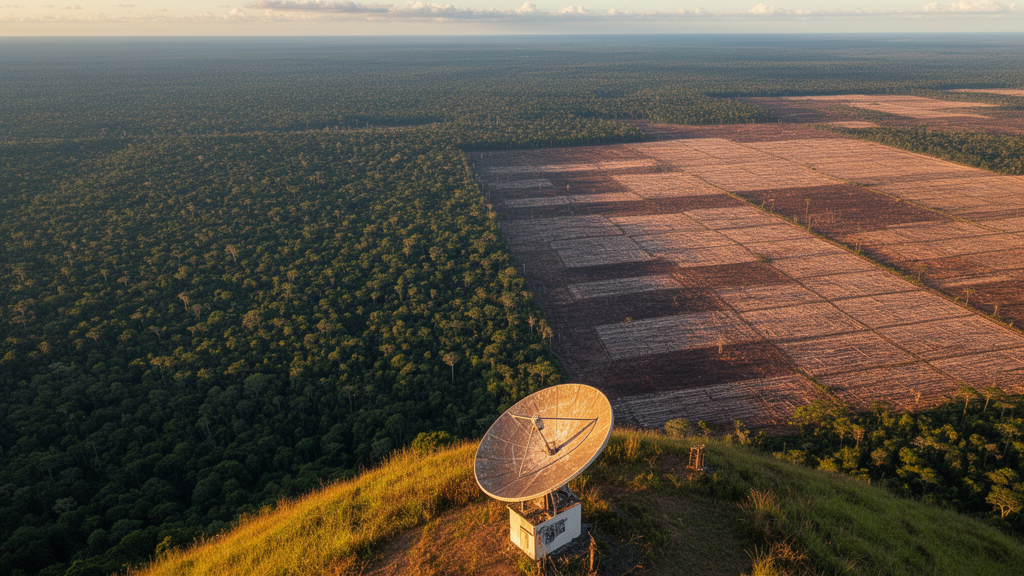
Every presidential election in Brazil since 1990 has left a measurable fingerprint on the country’s forests and savannas, according to a University of Cambridge-led analysis that tracked native vegetation across more than three decades and seven presidencies. Using land-cover maps built from satellite imagery, researchers charted habitat loss in Brazil’s three largest biomes — the Amazon, the Cerrado, and the Atlantic Forest — and found that the winner of each national vote directly shaped the pace at which these globally vital ecosystems were cleared or recovered. The study, published in Environmental Research Communications, documents a rollercoaster of loss rates that swung from a peak of 3.62 million hectares of native vegetation vanishing annually under Itamar Franco in the 1990s to a low of just 1.21 million hectares a year under Michel Temer roughly a decade ago. The scale of that swing, nearly a threefold difference between consecutive eras of governance, underscores how strongly environmental outcomes in Brazil have tracked the priorities of whoever occupied the presidential office.
The most recent transition illustrates the pattern with striking clarity. In the Amazon, the average annual area of native vegetation lost during the first three years of Luiz Inácio ‘Lula’ da Silva’s current presidency was around 994,000 hectares, compared with 1.4 million hectares a year under his predecessor, Jair Bolsonaro — a reduction of roughly 29 percent. Yet in the Cerrado, the vast tropical savannas of central Brazil, the trend moved in the opposite direction. Annual habitat losses there averaged around 1.28 million hectares between 2023 and 2025, an increase of about 50 percent compared with the 854,000 hectares per year recorded under Bolsonaro, during whose presidency savanna loss had already been accelerating. The Cerrado is a vital source of water that feeds many of Brazil’s rivers, and it has seen major expansion of commercial farming of crops such as soybean, partly because US-China trade tensions during Donald Trump’s first term pushed China to pivot toward Brazilian soybean supplies.
The researchers suggest that weaker legal protections in the Cerrado, combined with efforts to curb deforestation in the Amazon, may have pushed agricultural expansion across biome boundaries. They warn that the withdrawal of major soy traders from a moratorium on growing soy on recently deforested land could have devastating consequences for Brazil’s natural habitats. The findings complicate any simple narrative of national progress: while Amazon deforestation slowed under Lula’s return, the overall loss of native vegetation across the country’s three major biomes declined by only around 2 percent, largely because of increasing vegetation loss in the Cerrado. Displacement of pressure from one ecosystem to another, the authors note, means that headline deforestation figures for the Amazon alone can mask a more troubling picture of where Brazil’s habitat conversion is actually heading.
The Atlantic Forest tells a different story altogether. Stretching along Brazil’s eastern coastline, this biome has been highly fragmented by centuries of farming and urbanisation, yet the satellite record shows it experienced periods of genuine recovery rather than simply a slowdown in loss. During Lula’s first two terms, the Atlantic Forest gained an average of around 18,000 hectares of native vegetation a year, and under Dilma Rousseff that figure rose to nearly 30,000 hectares annually. Since Rousseff left office, the Atlantic Forest has returned to net vegetation losses, although at a much smaller scale than the losses recorded in the Amazon or the Cerrado. It remains the only one of Brazil’s three major biomes to have experienced periods of net vegetation gain in the last thirty-five years, a distinction the study highlights as evidence that regeneration is possible when conditions allow.
“Brazilian presidents have dictated the fate of the country’s forests and savannas for over three decades,” said study lead author Dr Vinicius Tonetti, a Brazilian conservation biologist at the University of Cambridge’s Department of Zoology. “We see that presidential terms characterised by strong environmental laws, satellite monitoring, and zero-deforestation agreements are clearly linked to major reductions in habitat loss. Brazil’s recent history shows just how much environmental policy matters and comes from the top.” Tonetti added that the findings also reveal an uncomfortable asymmetry in the current administration’s record. “While deforestation in the Amazon has slowed under Lula, the loss of natural habitats across the Cerrado has remained high. Protecting one ecosystem while losing another is not a sustainable solution,” he said.
Technically, the analysis relied on land-cover maps from the MapBiomas project, derived from decades of satellite data, to track changes across the Amazon, Cerrado and Atlantic Forest between 1990 and 2025. An important methodological note shapes how the numbers should be read: the study measured the net change in vegetation cover rather than the total area cleared. Regeneration in some areas can offset losses elsewhere, which is why the Atlantic Forest could post net gains during certain presidencies even as clearing continued in patches. This net accounting means the figures capture the balance between destruction and regrowth, offering a more conservative picture of landscape change than gross deforestation tallies alone would provide, and allowing direct comparison across seven presidencies and three ecologically distinct biomes.
The historical trajectory the maps reveal is dramatic. The largest average annual net loss of native vegetation across all three biomes combined occurred during the presidency of Itamar Franco, between 1993 and 1994, when approximately 3.62 million hectares disappeared each year. Fernando Henrique Cardoso’s administration, from 1995 to 2002, recorded average annual losses of around 3.30 million hectares. Lula’s first two terms, between 2003 and 2010, marked a major turning point, with the loss of natural habitat falling by some 35 percent to an annual average of around 2.44 million hectares. In the Amazon alone, habitat loss was around 20 percent lower under Lula than under Cardoso, with a significant slowdown in the rate of deforestation. “During Lula’s first two terms, agricultural production expanded while stronger monitoring and enforcement resulted in more habitat preservation,” said Tonetti. “Economic development and environmental protection do not have to come at the expense of each other.”
The decline continued, then reversed. Under Lula’s successor Dilma Rousseff, overall habitat loss almost halved again — a further 46 percent reduction — to about 1.31 million hectares a year, before reaching just 1.21 million hectares a year on average during Michel Temer’s time in office, the historic low of the entire record. Under Bolsonaro, however, major cuts to environment agencies, weakened enforcement, reduced environmental fines, and efforts to loosen environmental regulations coincided with a sharp rise in the loss of native vegetation across ecosystems, which climbed to 2.36 million hectares per year on average — an increase of 95 percent, nearly doubling from the low reached under Temer. The study presents these figures as coincident with policy changes rather than proving causation in a controlled sense, but the consistency of the pattern across seven administrations and three decades is difficult to dismiss.
The single largest gap in vegetation loss between presidents for any of the biomes was recorded in the Amazon, which lost an average of 1.95 million hectares a year under Fernando Henrique Cardoso but just 614,158 hectares a year under Dilma Rousseff. The difference between those two administrations amounts to an area of forest the size of Montenegro spared annually, a comparison the researchers use to convey the sheer scale of what presidential policy choices have meant for the world’s largest rainforest. That the same biome could absorb losses at vastly different rates under different governments, while agricultural production continued to grow, is central to the study’s argument that enforcement and monitoring — not economic inevitability — have been the decisive variables in Brazil’s environmental record.
Looking ahead, the researchers see warning signs. The collapse of the soy moratorium in the Amazon and new laws restricting Indigenous land claims are part of a trend that Tonetti says may escalate under a new president; for example, Flávio Bolsonaro has pledged to overhaul the environmental licensing system if elected. “Brazil has shown the world that deforestation can be dramatically reduced when there is the political will to act. But that progress is fragile. Recent changes to environmental legislation and the weakening of commitments to deforestation-free soy could undermine years of conservation gains,” Tonetti said. “As the nation once again elects a president, the voters of Brazil need to understand just how much is at stake for some of the world’s most precious forests and ecosystems.” The study’s satellite record, spanning seven presidencies and thirty-five years, stands as a quantitative reminder that in Brazil, the fate of the forest has repeatedly been decided at the ballot box.
Subject of Research: Satellite-based analysis linking Brazilian presidential terms to native vegetation loss and recovery in the Amazon, Cerrado and Atlantic Forest from 1990 to 2025
Article Title: Brazil's presidential elections linked to decades of fluctuating environmental destruction – study
Article References: Brazil's presidential elections linked to decades of fluctuating environmental destruction – study. Original publication (Bibliographic details unavailable.)
Image Credits: AI Generated
DOI: Not provided
Keywords: Brazil, deforestation, Amazon, Cerrado, Atlantic Forest, satellite imagery, MapBiomas, environmental policy, habitat loss, soybean farming, presidential elections, conservation
Cite Scienmag News
Drew Townsend. (October 25, 2026). Brazil’s presidents steered three decades of forest loss, satellite maps reveal. Scienmag. https://scienmag.com/brazils-presidents-steered-three-decades-of-forest-loss-satellite-maps-reveal/
Drew Townsend. "Brazil’s presidents steered three decades of forest loss, satellite maps reveal." Scienmag, 25 October 2026, https://scienmag.com/brazils-presidents-steered-three-decades-of-forest-loss-satellite-maps-reveal/. Accessed 25 October 2026.
Drew Townsend. "Brazil’s presidents steered three decades of forest loss, satellite maps reveal." Scienmag. October 25, 2026. https://scienmag.com/brazils-presidents-steered-three-decades-of-forest-loss-satellite-maps-reveal/


