


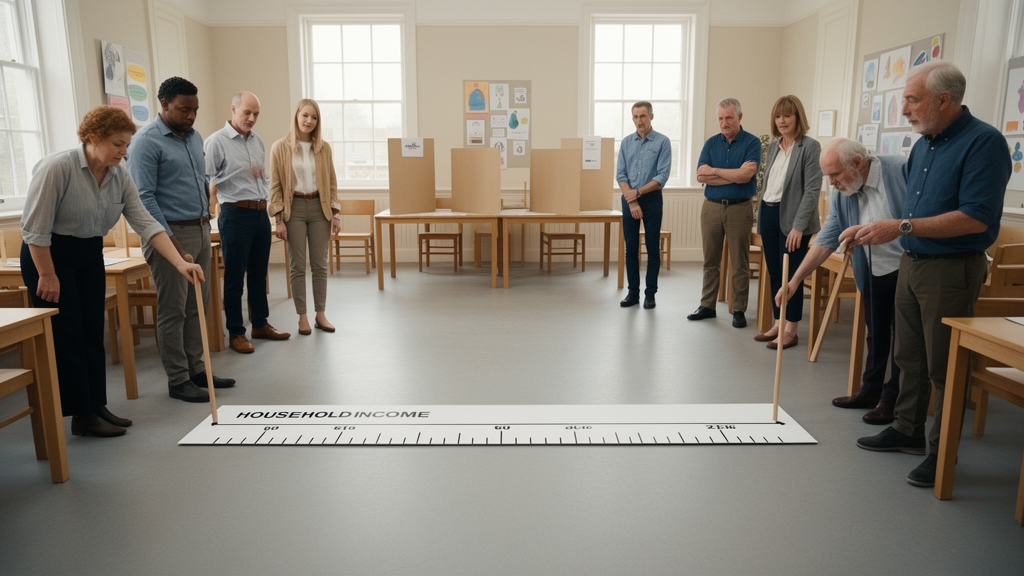
A survey of 2,642 participants in the 2022 British Social Attitudes Survey found that political ideology was associated with judgments about whether particular living conditions should be called poverty. The divide was widest for circumstances involving exclusion from ordinary living standards and narrowest for severe material hardship. The results suggest that arguments about how much poverty exists in Britain can begin with disagreement about what the term means: respondents can assess the same kind of material circumstance differently according to their political outlook.
The peer-reviewed study, published in Research in Social Stratification and Mobility and led by Dr Joanna Syrda of the University of Bath School of Management, examined how respondents drew boundaries around poverty. Participants considered three scenarios. The first described someone who had enough for essential needs but not for things most people take for granted. The second involved having enough to eat and live but not enough for other necessities. The third described someone who did not have enough to eat and live without going into debt.
Each scenario represented a different conception of poverty. The first concerned a socially comparative boundary: whether a person should be considered poor because they lacked access to goods and living conditions that most others could take for granted. The second concerned a minimum standard of living, with basic food and shelter available but other necessities lacking. The third represented absolute deprivation, combining inadequate subsistence with the need to incur debt. The study therefore tested judgments across circumstances of different breadth and severity rather than asking about one fixed income threshold.
Responses depended markedly on which scenario was presented. About 41% of participants classified the first, socially comparative circumstance as poverty. The proportion rose to 68% for the minimum-standard scenario and reached 80% for the severe circumstance in which someone lacked enough to eat and live without going into debt. These results show that the label of poverty was more readily applied when respondents considered a minimum standard of living or severe deprivation than when the question centered on exclusion from what most people regarded as ordinary.
Ideological differences were strongest for the broadest and most contested definition of poverty and weakest when respondents considered severe hardship. People with more right-leaning or welfare-sceptical political views were consistently less likely to classify the specified material circumstances as poverty. Those with more left-leaning or welfare-sympathetic views were more likely to do so. The association was most pronounced when deciding whether deprivation relative to ordinary social living standards should count as poverty, and least pronounced for the scenario involving inability to afford basic subsistence and debt.
The findings also show that respondents’ judgments were connected to broader political values independently of the specific political party for which they voted. Left-right political orientation and support for or skepticism toward welfare were related to the poverty boundaries people adopted. The results therefore did not reduce differences to party choice alone. At the same time, the study reports an observational association: it does not demonstrate that political ideology caused any individual respondent to classify a particular circumstance in a particular way.
People’s definitions were closely linked to their view of the scale of poverty in Britain. Left-leaning and welfare-sympathetic participants favored broader definitions and were significantly more likely to say that there was a lot of poverty in the country. They were also more likely to believe that poverty had increased and would continue to increase. Right-leaning and welfare-sceptical participants tended to adopt narrower definitions and perceived less poverty. The results show that conclusions about prevalence and trends can vary systematically when groups apply different boundaries to the same national setting.
Dr Syrda said that statistics can show how many people fall below a specified threshold but cannot determine where that threshold should be drawn. The survey findings illustrate the importance of that distinction through the “poverty boundary judgments” described in the paper. People begin with different assumptions about whether poverty should refer to relative living standards, a minimum standard of living or absolute deprivation. Those assumptions are associated not only with whether particular scenarios qualify as poverty, but also with assessments of how widespread and how changing the problem is.
The research suggests a practical implication for public discussion. Researchers, policymakers and journalists can make the definition under discussion explicit by identifying whether it is based on relative living standards, a minimum standard of living or absolute deprivation. Syrda said that making assumptions visible may not eliminate disagreement, but it can clarify what is actually being debated. The study does not establish one universally correct poverty definition or propose a replacement for existing measures. Instead, it shows why the meaning of the term should be stated when people compare statistics, trends or policy arguments about poverty.
The study is best understood as a survey-based snapshot of definitional judgments rather than a time series or a direct measure of material living conditions. Its three scenarios represent different concepts and degrees of deprivation, accounting for the rise from 41% to 68% and 80% in the share classifying each as poverty. The ideological pattern adds another layer: political values were more strongly associated with judgments at the broader relative-poverty boundary than at the severe-deprivation boundary. Taken together, the results provide evidence that disagreement about poverty in Britain can reflect both differing assessments of social conditions and differing decisions about where poverty begins. They do not establish that ideology accounts for every disagreement, nor do they show that a single definition would resolve competing views about poverty, its prevalence or its future direction.
Subject of Research: Political ideology and public judgments of poverty boundaries in Britain
Article Title: Why Britons disagree about poverty: they draw the line differently
Article References: Why Britons disagree about poverty: they draw the line differently. Original publication (Bibliographic details unavailable.)
Image Credits: AI Generated
DOI: Not provided
Keywords: poverty definitions, political ideology, British Social Attitudes Survey, social inequality, welfare attitudes, relative poverty, absolute deprivation, living standards, public opinion, Britons, disagree, poverty
Cite Scienmag News
Courtney Benton. (October 25, 2026). Political Ideology Shapes Where Britons Draw the Poverty Line. Scienmag. https://scienmag.com/political-ideology-shapes-where-britons-draw-the-poverty-line/
Courtney Benton. "Political Ideology Shapes Where Britons Draw the Poverty Line." Scienmag, 25 October 2026, https://scienmag.com/political-ideology-shapes-where-britons-draw-the-poverty-line/. Accessed 25 October 2026.
Courtney Benton. "Political Ideology Shapes Where Britons Draw the Poverty Line." Scienmag. October 25, 2026. https://scienmag.com/political-ideology-shapes-where-britons-draw-the-poverty-line/


