


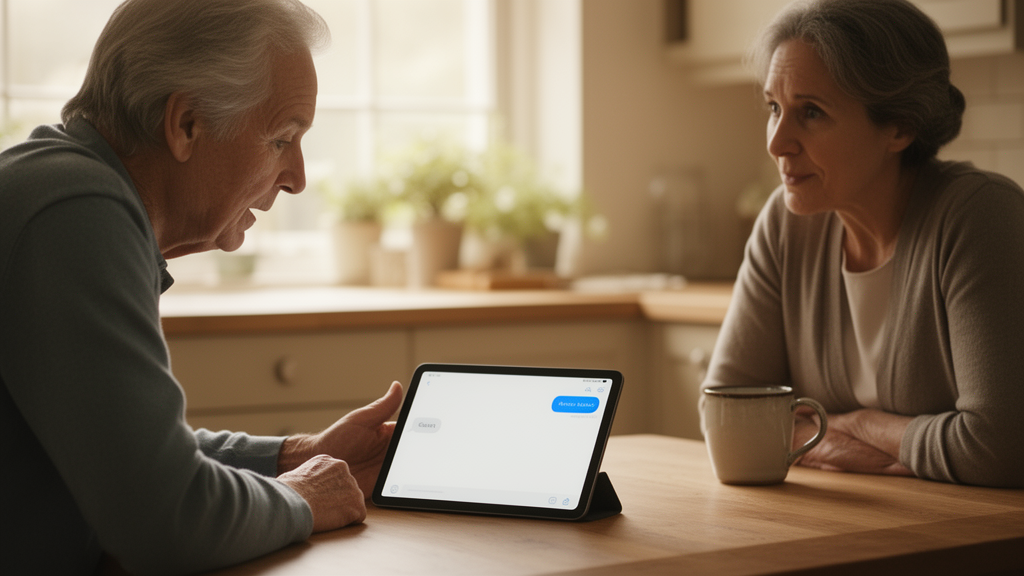
Perceived human likeness showed a different association: after the closeness of the interaction was accounted for, participants who regarded the chatbot as more human-like reported a lower intention to use it. The findings suggest that the quality of a conversation may matter more to adoption than making an artificial companion convincingly resemble a person. The study involved 140 community-dwelling adults aged 60 to 89 who were invited to interact with Ami Chat, a social chatbot developed by the research team.
Participants completed a single session in a controlled setting and then reported their attitudes and intention to use a social chatbot in daily life. Ami Chat was designed specifically for older adults and for the Singapore context. Powered by a large language model, it speaks and listens instead of requiring typed responses, while enlarged buttons and simple gestures simplify navigation.
Its cartoon avatar depicts a warm-hearted Singaporean woman, and the system responds in short, colloquial phrases. The study assessed first impressions rather than long-term companionship, and intention to use was treated as a proxy for adoption rather than evidence that users would continue using the system or experience better well-being. Researchers extended the Senior Technology Acceptance Model, which links technology adoption to factors such as perceived ease of use and health, with three socio-relational measures.
Anthropomorphism captured how human-like the chatbot seemed, authenticity represented how genuine and responsive it felt, and artificial intelligence social interaction intensity, abbreviated AISI, measured how closely an exchange resembled conversation with a friend. The established technology-acceptance factors explained 26% of the variation in participants’ intention to use the chatbot, while the three added measures accounted for a further 27%. Confidence and support in using the system, perceived authenticity, and interactions that felt reciprocal and close were associated with stronger adoption intentions.
These were statistical associations within the study, not proof that any single feature caused greater use. Health-related responses followed another pattern, which the researchers did not attribute to a causal effect. Older adults who rated their health less positively expressed a stronger intention to use the chatbot.
The team linked this pattern mainly with difficulty concentrating and lower life satisfaction. The researchers suggested that people who were less satisfied with their quality of life might have been more motivated to explore technologies offering conversation or support. They also drew a distinction between social engagement and human likeness, observing that participants could want a chatbot that interacts effectively without one that pretends to be a person.
The results do not show that Ami Chat reduced loneliness or that chatbot use improved participants’ health, emotional well-being or quality of life. The findings offer design guidance for developers of companion chatbots, but the team emphasized the need for further testing. It recommends that systems remember previous conversations, adapt to users’ preferences, retain simple interfaces, communicate naturally and remain clearly recognizable as chatbots rather than maximizing human-likeness.
Introduction also matters: the team recommends hands-on technical support, clear tutorials and accessible guidance so older users feel confident operating the technology. Since the study was published, Ami Chat has been rebranded Ami-Go, and the next phase of work is intended to follow older adults using it for longer periods in everyday settings. Ami-Go is also being integrated with Ami-Able, a dual-language cognitive-training programme developed by Professor Yow Wei Quin’s laboratory, in a platform nearing completion of its initial testing.
Whether longer-term use produces regular engagement, a durable sense of companionship or measurable well-being benefits remains to be determined.
Subject of Research: Technology acceptance and perceived authenticity in an age-tailored social chatbot tested with 140 older adults in Singapore
Article Title: Chatbot companions win over older adults by being genuine rather than ‘human’
Article References: Chatbot companions win over older adults by being genuine rather than ‘human’. Original publication (Bibliographic details unavailable.)
Image Credits: AI Generated
DOI: Not provided
Keywords: older adults, social chatbots, AI companionship, technology acceptance, authenticity, anthropomorphism, human-computer interaction, loneliness, Ami-Go, Singapore, Chatbot, companions
Cite Scienmag News
Courtney Benton. (October 24, 2026). Authenticity, not human likeness, linked to chatbot use intentions among older adults. Scienmag. https://scienmag.com/authenticity-not-human-likeness-linked-to-chatbot-use-intentions-among-older-adults/
Courtney Benton. "Authenticity, not human likeness, linked to chatbot use intentions among older adults." Scienmag, 24 October 2026, https://scienmag.com/authenticity-not-human-likeness-linked-to-chatbot-use-intentions-among-older-adults/. Accessed 24 October 2026.
Courtney Benton. "Authenticity, not human likeness, linked to chatbot use intentions among older adults." Scienmag. October 24, 2026. https://scienmag.com/authenticity-not-human-likeness-linked-to-chatbot-use-intentions-among-older-adults/


