


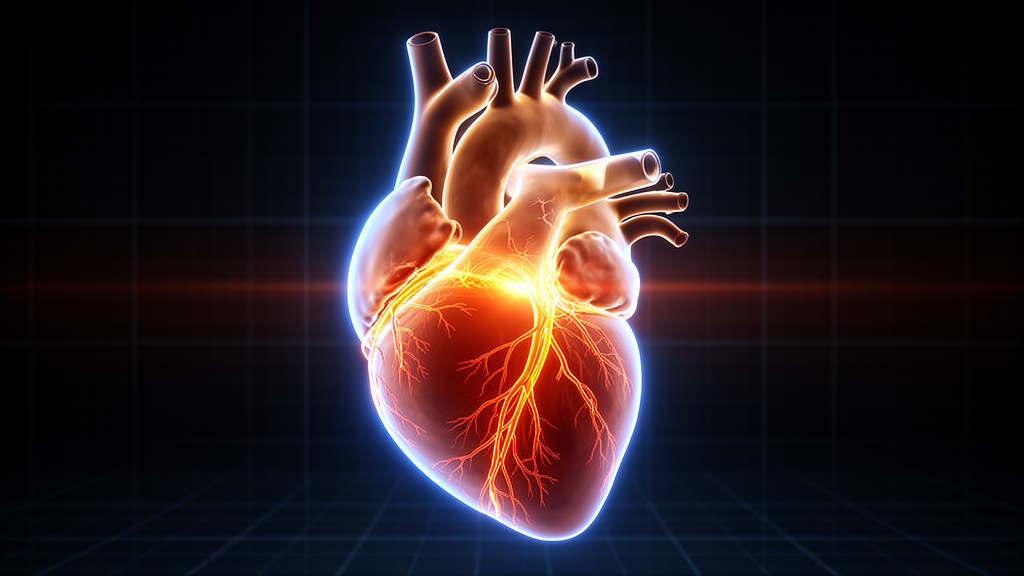
Computational models of the heart have long promised to reveal how electrical storms of arrhythmia begin and how therapies might stop them, but most have quietly skipped over the wiring that makes the heartbeat possible. A team at the Medical University of Graz, working with colleagues at IHU Liryc in Bordeaux, has now built what they describe as the most complete anatomy-guided computational model of the human cardiac conduction system to date, embedding every major component of the heart’s electrical plumbing inside a four-chamber heart and torso reconstructed from magnetic resonance imaging of a 45-year-old male subject. The work, published in Frontiers in Cardiovascular Medicine, shows that simulating a full heartbeat from the natural pacemaker to the ventricles can reproduce a measured 12-lead electrocardiogram with striking fidelity, particularly in the QRS complex that reflects ventricular depolarisation.
The cardiac conduction system is the specialised network that orchestrates every beat: the sinoatrial node generates the rhythm, the atrioventricular node imposes the vital delay between atrial and ventricular contraction, and the His-Purkinje system distributes the impulse rapidly across the ventricles so they contract in near-perfect synchrony. Despite its central role, this system is routinely omitted or oversimplified in computational electrophysiology, where simulations often treat the atria or ventricles in isolation and couple them with ad hoc phenomenological schemes. The Graz-led team argues that this omission is not from lack of recognition but from genuine technical difficulty: the conduction structures are fine-scale and discrete, their anatomy varies between individuals, and they cannot be directly resolved in routine clinical imaging.
To overcome this, the researchers constructed the conduction system manually within the subject-specific heart mesh, guided by anatomical landmarks visible in the imaging data together with geometric descriptions from anatomical, histological and micro-CT studies in the literature. The heart and torso geometry, chamber anatomy, papillary muscle locations and electrode positions were all subject-specific, whereas the conduction system anatomy was literature-guided rather than directly imaged. The sinoatrial node was modelled as a three-dimensional structure about 12 millimetres long, 3 millimetres wide and 2 millimetres thick, embedded in right atrial tissue and electrically insulated by a surrounding fibrous sheath, with electrical contact to the atria permitted only through discrete exit pathways modelled as one-dimensional cables piercing the insulation.
Between the atria, the model explicitly represented Bachmann’s bundle, the principal interatrial connection, as ten parallel one-dimensional cables running from the region of the superior vena cava to distributed insertion sites around the left atrial appendage. Additional posterior routes through the Waterston’s groove, including a posterosuperior bundle and the debated septopulmonary bundle, were also included, along with the rim of the fossa ovalis. In the atrioventricular junction, the team reconstructed the compact node as a disk-like structure 5 millimetres in diameter at the apex of the triangle of Koch, fed by two distinct inputs: an anterior fast pathway crossing the interatrial septum and a posterior slow pathway arriving via the tricuspid isthmus, reproducing the dual-input architecture that also provides the substrate for atrioventricular nodal reentry tachycardia.
Distal to the node, the His bundle was implemented as four parallel insulated cable elements that bifurcate into the left and right bundle branches. The left bundle branch followed the widely described trifascicular configuration, with anterior, septal and posterior fascicles terminating near the bases of the anterior and posterior papillary muscles and at the mid-septum, while the right bundle branch coursed through the septum toward the moderator band region of the right ventricle. Each fascicle anchored a primary Purkinje network of interconnected cables. Because the fine ramification topology of the distal Purkinje network cannot be reconstructed from available imaging, the researchers introduced a deliberate surrogate: the subendocardium of each ventricle was partitioned into septal, anterior and posterior regions using universal ventricular coordinates, with region-specific elevated conduction velocities assigned to each zone to govern activation spread after endocardial breakthrough.
Electrophysiology was computed with a reaction-eikonal formulation, a physics-informed approach that captures activation timing at realistic conduction velocities while running at near real-time speed, far cheaper than full reaction-diffusion simulations. Each region received its own ionic model: the Fabbri model for the sinoatrial node, the Courtemanche model for atrial tissue, the Stewart model for Purkinje cells and the Ten Tusscher-Panfilov model for ventricular myocardium. Conduction velocities were calibrated in a staged, manually supervised procedure, first matching atrial parameters to the measured P-wave and then fixing those while tuning ventricular and His-Purkinje velocities against the QRS complex, with implausible activation sequences rejected along the way.
The simulated activation sequences proved physiologically consistent throughout. Atrial excitation originated in the central leading pacemaker region of the sinoatrial node, broke through into the right atrium along the crista terminalis, and spread preferentially along that ridge toward both venae cavae. Interatrial conduction was dominated by Bachmann’s bundle, with the earliest left atrial breakthrough at the atrial roof delivered via the septopulmonary bundle and a secondary activation site near the left atrial appendage; the posterosuperior bundle contributed minimally under normal sinus rhythm. Two wavefronts converged at the left atrial isthmus, completing atrial depolarisation in a pattern that mirrors high-resolution clinical mapping studies.
Ventricular activation began when the compact node engaged the penetrating His bundle, after which all three left fascicles and the right bundle branch were activated nearly simultaneously. Differences in fascicular length produced staggered myocardial breakthrough times: the left septal fascicle fired first at roughly 30 milliseconds after His bundle activation, followed by the anterior, posterior and right bundle branch fascicles at about 33, 35 and 40 milliseconds. From these junctions the Purkinje network rapidly spread excitation across the endocardium, yielding near-synchronous activation of both ventricles, with the earliest epicardial breakthroughs appearing almost simultaneously on the right ventricular free wall and the anterior interventricular junction, reflecting the thinner right ventricular wall.
The simulated 12-lead electrocardiogram showed close qualitative agreement with the measured recording. Quantitatively, the mean Pearson correlation across the twelve leads was 0.91 for the QRS complex and 0.73 for the P-wave. Measured and simulated QRS durations were 69 and 79 milliseconds respectively, while P-wave durations were 71 and 98 milliseconds and the isoelectric intervals 138 and 112 milliseconds. The authors note that the strongest precordial-lead discrepancies in the P-wave may partly reflect simplifications such as the elevated 2.0 metres-per-second conduction velocity assigned to Bachmann’s bundle cables, chosen to compensate for omitted intramural branches.
The team is careful about what the model does and does not prove. Because electrocardiogram-based calibration is inherently ill-posed, with many parameter combinations capable of producing similar surface waveforms, the calibrated conduction velocities should be read as one physiologically plausible solution rather than a unique parameter set, and the agreement serves as a functional consistency check rather than proof of a unique activation sequence. The conduction system geometry also reflects one anatomically plausible configuration rather than a definitive subject-specific reconstruction, and the atrioventricular node was approximated with atrial ionic formulations because no fully validated human nodal model suitable for whole-heart simulation exists. Repolarisation dynamics were not systematically investigated. Nevertheless, the framework offers a computationally tractable platform for studying conduction system physiology, bundle branch block phenotypes and conduction system pacing strategies, and the authors suggest it could support in silico evaluation of pacing lead placement and therapy planning as cardiac digital twin applications mature.
Subject of Research: Anatomy-guided computational modelling of the complete human cardiac conduction system within a whole-heart electrophysiology framework
Article Title: An anatomy-guided whole-heart framework for computational modelling of the complete human cardiac conduction system
Article References: Kariman, M., Augustin, C. M., Schrotter, T., Gsell, M. A. F., Vigmond, E. J., & Plank, G. (2026). An anatomy-guided whole-heart framework for computational modelling of the complete human cardiac conduction system. Frontiers in Cardiovascular Medicine, 13, Article 1872859. https://doi.org/10.3389/fcvm.2026.1872859
Image Credits: AI Generated
DOI: 10.3389/fcvm.2026.1872859
Keywords: cardiac conduction system, computational modelling, sinoatrial node, atrioventricular node, His-Purkinje system, Purkinje network, 12-lead ECG, cardiac digital twin, electrophysiology, bundle branch block, conduction system pacing, whole-heart model
Cite Scienmag News
Ophelia Keating. (October 25, 2026). Digital heart model captures the full human cardiac conduction system in near real time. Scienmag. https://scienmag.com/digital-heart-model-captures-the-full-human-cardiac-conduction-system-in-near-real-time/
Ophelia Keating. "Digital heart model captures the full human cardiac conduction system in near real time." Scienmag, 25 October 2026, https://scienmag.com/digital-heart-model-captures-the-full-human-cardiac-conduction-system-in-near-real-time/. Accessed 25 October 2026.
Ophelia Keating. "Digital heart model captures the full human cardiac conduction system in near real time." Scienmag. October 25, 2026. https://scienmag.com/digital-heart-model-captures-the-full-human-cardiac-conduction-system-in-near-real-time/


