


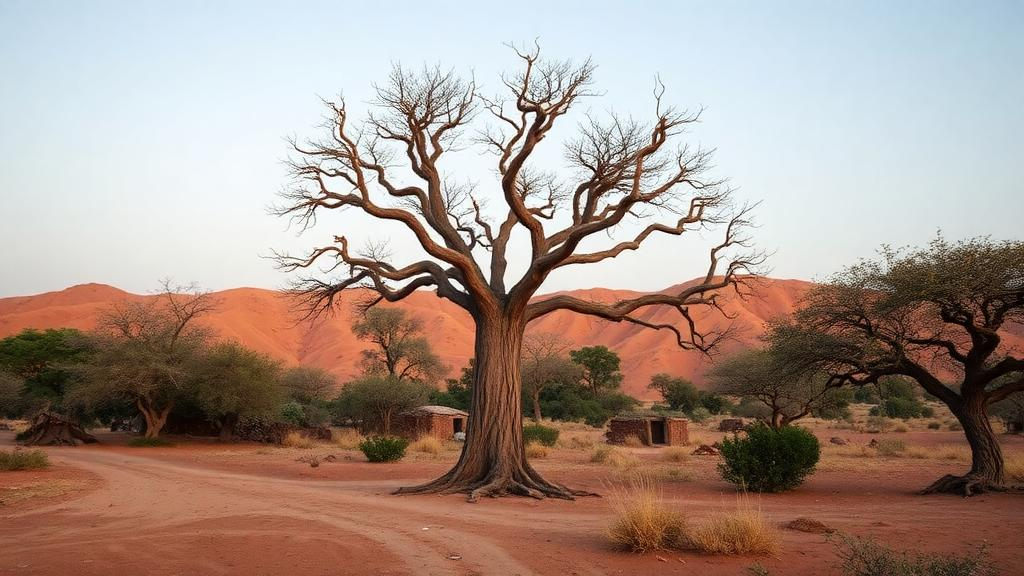
The African baobab remains a pillar of rural livelihoods in northwestern Ethiopia, but its populations there show an unsustainable demographic trajectory, according to a study published as an early-release, peer-reviewed accepted manuscript in Discover Sustainability. Researchers Shiferaw Abebe and Dejene Reda assessed the socio-economic importance, stand structure, and biomass carbon stocks of Adansonia digitata across three land-use types—homesteads, agricultural lands, and natural woodlands—combining household surveys, focus group discussions, and biophysical forest inventory.
The socio-economic data came from 352 households, synthesized with descriptive statistics and thematic coding. Respondents reported relying on baobab for food (84.0 percent), household income (78.5 percent), material applications (73.8 percent), ethnomedicine (72.4 percent), cultural services (45.6 percent), and animal fodder (21.5 percent). These figures document a species that simultaneously functions as a food source, an income generator, a source of materials and medicine, and a cultural fixture for communities in the region.
The ecological measurements came from 72 inventory plots, each 20 by 25 meters (500 square meters). Mean biomass carbon stocks differed significantly across land uses (p < 0.001), peaking in homesteads at 58.61 ± 3.12 megagrams of carbon per hectare, followed by agricultural parklands at 48.15 ± 2.84 and natural woodlands at 43.51 ± 2.45 megagrams of carbon per hectare. The overall mean across the study area was 50.09 ± 1.16 megagrams of carbon per hectare, corresponding to 183.67 ± 4.27 megagrams of carbon dioxide equivalent per hectare stored in living baobab tissue.
The size-class distributions explain why homesteads hold the largest stocks. Homesteads functioned as structural refugia for relict mature trees, while woodlands exhibited a truncated structure completely devoid of mega-tree cohorts exceeding 200 centimeters in diameter at breast height. In other words, the largest individuals persist near settlements but are absent from the least managed parts of the landscape.
The most striking pattern cuts across all three land-use types: juvenile regeneration was critically deficient everywhere the researchers measured. The size-class distributions therefore reveal an unsustainable demographic trajectory in which mature trees dominate the standing population while the next generation is largely absent—a structural profile the authors identify as a severe sustainability challenge for the species in this landscape.
The study identifies four primary drivers of population degradation: unregulated commercial and artisanal gold mining, agricultural land expansion, recurrent wildfires, and intensive extraction of baobab products. These pressures were named as the main factors behind the demographic pattern documented in the inventory.
To reverse the trajectory, the researchers propose institutionalizing community-led assisted natural regeneration, establishing spatial mining buffers, enforcing sustainable harvesting, and integrating germplasm nurseries into national frameworks such as Ethiopia’s Green Legacy initiatives. These recommendations follow directly from the study’s findings on regeneration failure and the identified disturbance drivers.
The carbon accounting adds a measurable dimension to the findings. The overall mean of 183.67 ± 4.27 megagrams of carbon dioxide equivalent per hectare represents the amount stored in living baobab tissue across the surveyed landscape, with the highest concentrations in homestead stands and the lowest in natural woodlands—the same land-use category that lacks the largest trees entirely.
As an early-release manuscript, the study is citable and carries a permanent DOI, though the text remains subject to further edits before the final version of record appears. Its scope is limited to northwestern Ethiopia, and its socio-economic conclusions rest on household survey responses. Even so, the combination of demographic evidence, carbon quantification, and documented community dependence outlines the challenge the authors describe: sustaining both the livelihood benefits and the standing carbon stocks of a species whose juvenile cohorts are currently missing across the surveyed land uses.
Subject of Research: Socio-economic importance and biomass carbon stocks of African baobab (Adansonia digitata L.) in Northwestern Ethiopia
Article Title: Socio-economic importance and biomass carbon stocks of African baobab (Adansonia digitata L.) in Northwestern Ethiopia
Article References: Abebe, S., & Reda, D. (2026). Socio-economic importance and biomass carbon stocks of African baobab (Adansonia digitata L.) in Northwestern Ethiopia. Discover Sustainability. https://doi.org/10.1007/s43621-026-05040-5
Image Credits: AI Generated
DOI: 10.1007/s43621-026-05040-5
Keywords: Socio-economic, importance, biomass, carbon, stocks, African, baobab, Adansonia, digitata, Northwestern, Ethiopia, scientific research
Cite Scienmag News
Violet Maxwell. (October 24, 2026). Baobab carbon stocks peak in Ethiopian homesteads as young trees vanish. Scienmag. https://scienmag.com/baobab-carbon-stocks-peak-in-ethiopian-homesteads-as-young-trees-vanish/
Violet Maxwell. "Baobab carbon stocks peak in Ethiopian homesteads as young trees vanish." Scienmag, 24 October 2026, https://scienmag.com/baobab-carbon-stocks-peak-in-ethiopian-homesteads-as-young-trees-vanish/. Accessed 24 October 2026.
Violet Maxwell. "Baobab carbon stocks peak in Ethiopian homesteads as young trees vanish." Scienmag. October 24, 2026. https://scienmag.com/baobab-carbon-stocks-peak-in-ethiopian-homesteads-as-young-trees-vanish/


