


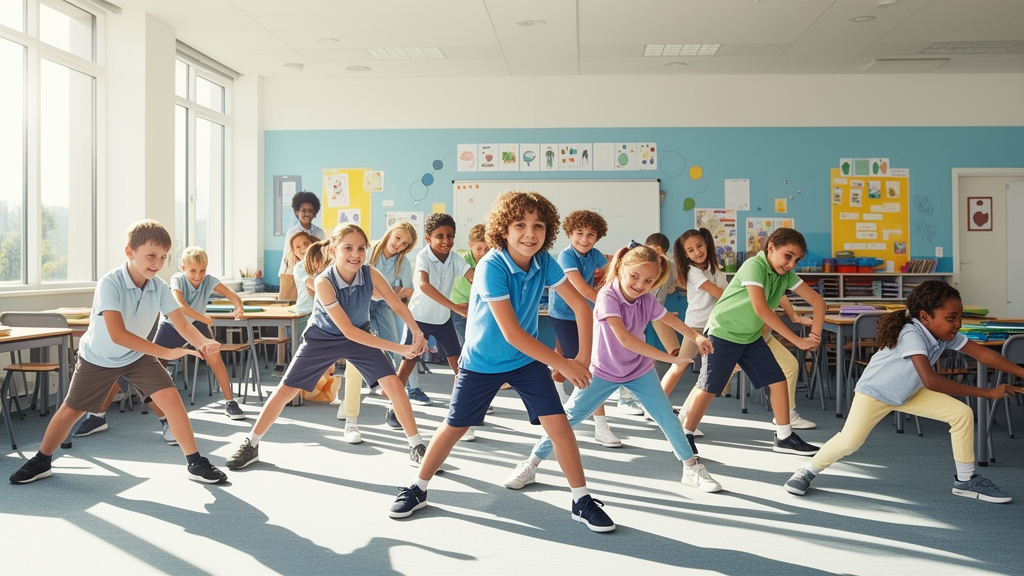
A collection of thirteen studies published in Frontiers in Sports and Active Living argues that physical activity should be treated as a fundamental component of children's education rather than an isolated health behavior. The collection is introduced by an editorial from Souhail Hermassi of Qatar University, Sascha Ketelhut of the University of Bern, Roland van den Tillaar of Nord University, and Abdulla Alneama of Al Arabi Sports Club. It brings together multidisciplinary perspectives on how movement contributes to academic achievement, learning outcomes, and holistic child development in schools, spanning physically active learning, teacher education, physical literacy, motor competence, health promotion, school policy, and child development.
The motivation behind the research topic is grounded in well-documented global concerns. Regular physical activity is widely recognized as a cornerstone of healthy growth and development, with evidence linking it to cognitive development, academic achievement, mental health, social competence, and the establishment of lifelong healthy behaviors. At the same time, rising physical inactivity, sedentary behavior, childhood obesity, and declining physical fitness have become major public health challenges worldwide.
Schools occupy a unique position at the intersection of education and health promotion, offering structured opportunities through high-quality physical education, physically active learning, and supportive environments to embed movement into daily learning experiences. A central theme of the collection is the relationship between physical activity and academic performance. A systematic review and meta-analysis by He and colleagues synthesized evidence indicating that school-based physical activity interventions can contribute positively to both academic achievement and learning outcomes.
Complementing this synthesis, Che and colleagues examined the psychological mechanisms that may underlie these effects, highlighting the importance of self-regulation and self-efficacy as pathways linking activity to achievement. Their work also identified gender and urban-rural differences in these relationships, suggesting that the associations between school-based movement and achievement may not be uniform across populations. The educational value of physical activity, the collection emphasizes, extends beyond achievement measures.
Movement can enhance engagement, self-regulation, and the quality of learning experiences themselves, supporting a more holistic understanding of what educational success means. This perspective is particularly evident in studies focused on physically active learning. Lander and colleagues investigated how physically active learning can be integrated into initial teacher education, preparing new teachers to use these methods from the start of their careers.
In a separate study, the same group introduced an observational instrument for evaluating physically active teaching strategies, giving researchers and school leaders a structured way to assess what actually happens in classrooms. Implementation, however, depends on more than individual enthusiasm. Daly-Smith and colleagues highlighted the capabilities, agency, and professional support that teachers require to implement and sustain physically active learning in schools.
Together with the teacher education findings, these studies underscore that embedding movement into educational practice demands both individual teacher competencies and system-level support. Taking a broader conceptual view, Mandelid advocates a shift from physically active learning toward what the author terms movement-centred pedagogy. This reframing challenges educators and researchers to treat movement as an integral feature of children's learning experiences in its own right, rather than simply a method for achieving educational outcomes.
In this vision, the question is not only how movement can support academic results, but how educational environments can be designed so that physical activity is woven naturally into how children learn every day. A second major theme concerns physical literacy and motor competence in early childhood. Tao and colleagues developed a structured framework for assessing physical literacy among preschool children, providing a foundation for future evaluation and policy development.
Chen and colleagues identified distinct profiles of motor coordination and health-related fitness among preschool children, revealing developmental variability and pointing to the need for targeted interventions rather than one-size-fits-all programs. The collection also explores connections between movement and psychological development. Khorkova and colleagues examined the relationship between movement and creativity, with findings suggesting that innovative pedagogical approaches can simultaneously enhance cognitive creativity, motor creativity, and motor fitness.
Wagner and colleagues demonstrated relationships between muscular strength, neuromuscular control, and resilience, emphasizing the interconnected nature of physical and psychological development. Collectively, these studies reinforce the multidimensional role of physical activity in supporting children's cognitive, motor, and psychosocial growth. Health promotion within school settings forms a third pillar of the research topic.
Li and Ma examined the effects of physical activity on body mass index, motor skills, and sleep patterns, illustrating how active lifestyles influence children's health and development broadly. Teachers emerged as important agents of change, with Kayitesi and colleagues highlighting the role educators can play in fostering healthy behaviors and supporting childhood obesity prevention initiatives. Beyond individual practices, Gardner and colleagues showed how a daily sport uniform policy can facilitate physical activity participation, enhance student comfort and well-being, and promote more inclusive and equitable school environments, demonstrating that institutional policies can shape activity opportunities as powerfully as classroom instruction.
The editorial's authors conclude that effective school-based health promotion requires coordinated action across multiple levels, encompassing children's behaviors, teacher practices, educational environments, and institutional policies. They also acknowledge significant limitations: heterogeneity in definitions and assessment methods across studies, differences across age groups and educational systems, limited longitudinal and experimental evidence, and uncertainty about causal mechanisms linking activity to achievement. Future priorities include longitudinal and intervention studies to clarify causal pathways, evaluation of the long-term sustainability of physically active learning across different educational systems, refinement of physical literacy frameworks and assessment tools, and interdisciplinary research addressing cultural, socioeconomic, and contextual variations that influence implementation and outcomes.
Despite these challenges, the collective evidence from the thirteen contributions supports a clear message: movement belongs at the heart of children's education, not at its margins.
Subject of Research: Integration of physical activity into school settings to support academic achievement, physical literacy, and health promotion in children and adolescents
Article Title: Editorial: Integration of physical activity for academic excellence and health promotion in adolescents and school children
Article References: Hermassi, S., Ketelhut, S., van den Tillaar, R., & Alneama, A. (2026). Editorial: Integration of physical activity for academic excellence and health promotion in adolescents and school children. Frontiers in Sports and Active Living, 8, Article 1986654. https://doi.org/10.3389/fspor.2026.1986654
Image Credits: AI Generated
DOI: 10.3389/fspor.2026.1986654
Keywords: physical activity, academic achievement, physically active learning, physical literacy, motor competence, school health promotion, child development, childhood obesity, teacher education, self-regulation, school policy, adolescents
Cite Scienmag News
Leah Spencer. (October 24, 2026). Research report: Editorial: Integration of physical activity for academic excellence and health promotion in adolescents and school children. Scienmag. https://scienmag.com/research-report-editorial-integration-of-physical-activity-for-academic-excellence-and-health-promotion-in-adolescents-and-school-children/
Leah Spencer. "Research report: Editorial: Integration of physical activity for academic excellence and health promotion in adolescents and school children." Scienmag, 24 October 2026, https://scienmag.com/research-report-editorial-integration-of-physical-activity-for-academic-excellence-and-health-promotion-in-adolescents-and-school-children/. Accessed 24 October 2026.
Leah Spencer. "Research report: Editorial: Integration of physical activity for academic excellence and health promotion in adolescents and school children." Scienmag. October 24, 2026. https://scienmag.com/research-report-editorial-integration-of-physical-activity-for-academic-excellence-and-health-promotion-in-adolescents-and-school-children/


