


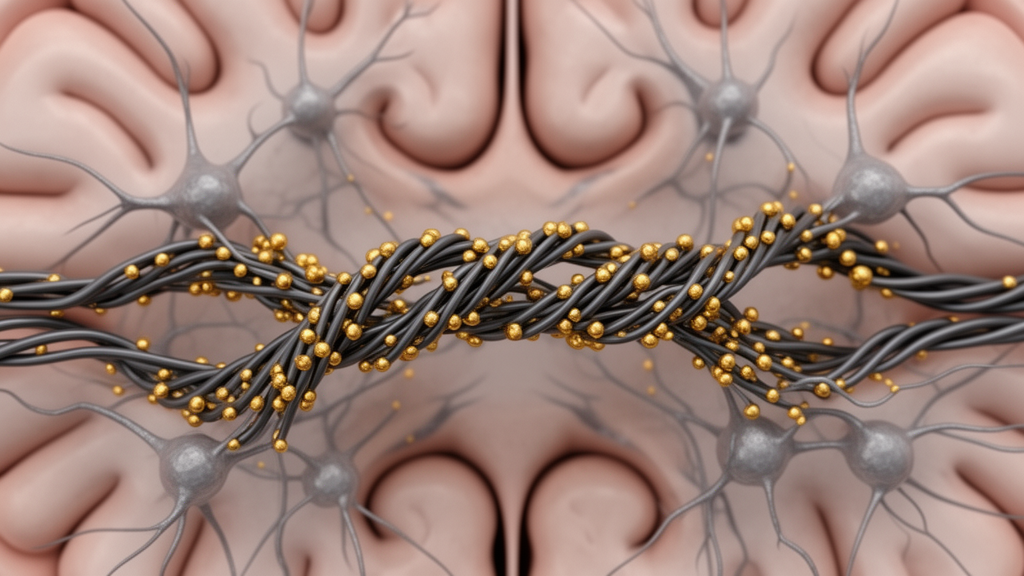
Flexible electrodes that can listen in on the brain’s electrical activity are central to modern neuroscience, but the materials they are made from often force an uncomfortable trade-off between conductivity, strength and softness. A new study in the Journal of Materials Science reports a synergistic strategy to address this: carbon nanotube fibers densified by twisting and then decorated with electrochemically deposited gold nanoparticles. The resulting metal-enhanced fibers were assembled into multi-channel neural electrode arrays and implanted into the hippocampal region of mice, where they acquired electrophysiological recordings during acute two-hour sessions.
The research team began with continuous ribbons of carbon nanotube fiber produced by floating chemical vapor deposition, a technique that grows nanotubes as an aerogel-like web directly in the reactor. These ribbons were then twisted into fibers, a densification step that packs the nanotubes closer together and reduces the voids between them. The twisting serves two purposes: it improves the mechanical integrity of the fiber and provides a substrate for the subsequent metal decoration, allowing the researchers to examine how the structural transformation changes the mechanical response.
Gold nanoparticles were deposited onto the twisted fibers electrochemically, a process in which an applied potential drives metal ions from solution onto the fiber surface. The resulting metal-enhanced fibers reached a maximum electrical conductivity of 2.90 × 10⁵ siemens per meter at a nominal gold deposition thickness of 100 nanometers — a substantial improvement over the unmodified material, whose relatively low conductivity is one of the main obstacles to practical neural interfaces.
Conductivity alone was not the whole story. The researchers found a strong structure-property relationship governing mechanical performance as well. A fiber prepared at a nominal gold thickness of 50 nanometers increased fracture elongation to approximately 28 percent, meaning the material could stretch considerably further before breaking. Mechanical resilience was further demonstrated in bending tests: the electrodes maintained electrical continuity through 5,000 bending cycles, with the relative change in resistance staying below 11 percent throughout.
At the interface between electrode and electrolyte — critical for any device that must transduce ionic currents in brain tissue into electronic signals — electrochemical impedance spectroscopy and cyclic voltammetry revealed mixed capacitive-resistance behavior. Repeatable voltammetric responses were recorded across cycles 22 through 25, although the cathodic charge-storage capacity declined over that window from approximately 95.5 to 81 millicoulombs per square centimeter, a detail the authors report transparently as part of the electrochemical characterization.
The real test came when the optimized fibers were integrated into multi-channel neural electrode arrays and implanted into the hippocampal region of mice using stereotaxic techniques. Electrophysiological recordings were acquired over an acute two-hour session, and a continuous 41.7-minute epoch was quantitatively analyzed using four validated electrode contacts.
The quality metrics from those recordings are the heart of the study. The median impedance magnitude at 1 kilohertz was 13.13 kilohms, a value relevant to how efficiently the electrode couples to neural tissue. Spike-free root-mean-square noise measured 6.45 microvolts, while detected negative events had a median amplitude of 45.97 microvolts. The resulting signal-to-noise ratio was 6.86, equivalent to 16.73 decibels — figures that indicate the fibers could resolve extracellular events above the background noise floor in a living brain.
Carbon nanotube fiber electrodes have long been attractive for neural interfaces because they combine flexibility with electrical function, but the material’s low conductivity, insufficient mechanical strength and the difficulty of implanting such fine, floppy structures have limited practical implementation. The strategy demonstrated here attacks all three weaknesses at once: twisting densifies the fiber structurally, and the gold nanoparticle layer improves the electrical pathways while the underlying fiber preserves the flexibility that rigid silicon or metal-wire probes lack.
The authors emphasize that the work establishes a rational design framework for high-performance, flexible neural electrodes and constitutes a promising platform for next-generation neural interfaces. Because the findings rest on acute recordings in mice over a limited epoch and a small number of validated contacts, they represent an early-stage materials demonstration rather than a validated long-term implant; chronic biocompatibility, long-term stability of the gold layer and performance over extended recording periods remain questions for future work. Still, by showing that a single synergistic modification — densification plus electrochemical metallization — can deliver both a 2.90 × 10⁵ S/m conductor and a mechanically robust, implantable electrode, the study offers a concrete materials platform for advanced neuroscience applications.
Subject of Research: Electrochemically gold-modified carbon nanotube fibers for neural sensing
Article Title: Electrochemically gold-modified carbon nanotube fibers for neural sensing
Article References: Ullah, N., Sun, J., Duan, M., Deng, H., Ning, J., Zheng, H., & Yan, Y. (2026). Electrochemically gold-modified carbon nanotube fibers for neural sensing. Journal of Materials Science. https://doi.org/10.1007/s10853-026-13964-6
Image Credits: AI Generated
DOI: 10.1007/s10853-026-13964-6
Keywords: Electrochemically, gold-modified, carbon, nanotube, fibers, neural, sensing, scientific research
Cite Scienmag News
Cassandra Pierce. (October 24, 2026). Twisted Carbon Nanotube Fibers with Gold Nanoparticles Record Brain Signals in Mice. Scienmag. https://scienmag.com/twisted-carbon-nanotube-fibers-with-gold-nanoparticles-record-brain-signals-in-mice/
Cassandra Pierce. "Twisted Carbon Nanotube Fibers with Gold Nanoparticles Record Brain Signals in Mice." Scienmag, 24 October 2026, https://scienmag.com/twisted-carbon-nanotube-fibers-with-gold-nanoparticles-record-brain-signals-in-mice/. Accessed 24 October 2026.
Cassandra Pierce. "Twisted Carbon Nanotube Fibers with Gold Nanoparticles Record Brain Signals in Mice." Scienmag. October 24, 2026. https://scienmag.com/twisted-carbon-nanotube-fibers-with-gold-nanoparticles-record-brain-signals-in-mice/


