


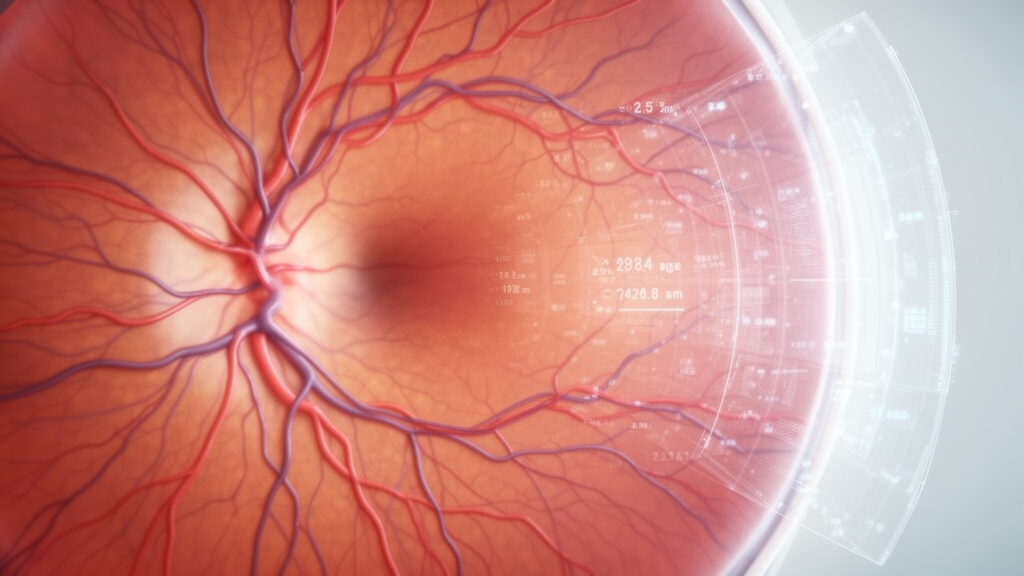
Researchers have reported a new, non-invasive way to estimate a person’s chronological age: measuring how the blood vessels at the back of the eye respond to flickering light, then feeding those dynamic responses into a machine learning model. The study, published as an open-access article in Scientific Reports, is presented by its authors as the first demonstration that retinal vascular reactivity can serve as a functional biomarker for estimating chronological age.
The approach centers on the retinal arteries and veins, whose diameters change when the retina is stimulated with flicker light. Rather than relying on a single static measurement, the team captured vessel diameter changes across three flicker cycles, building a time series that describes how each vessel reacts, recovers, and reacts again. These dynamic patterns of vascular function formed the raw material for age prediction.
Several machine learning and deep learning models were trained and compared on this task. The best-performing model was the Extra Trees Regressor, an ensemble method that builds many decision trees on randomized splits of the data and averages their outputs. When applied to the flicker-induced vessel reactivity signals, it achieved a mean absolute error of 9.3 years, a root mean squared error of 12.4, and a mean absolute percentage error of 17.7 percent.
The authors describe this level of performance as demonstrating acceptable reliability and accuracy for a first demonstration of the concept. A mean absolute error of 9.3 years means that, on average, the model’s age estimate deviated from a person’s true chronological age by that margin.
Beyond raw prediction accuracy, the study addressed the question of interpretability. The researchers applied Local Interpretable Model-agnostic Explanations, known as LIME, to their time series age estimation model. According to the authors, this provided valuable insights into the key features influencing the predictions, revealing which aspects of the vessel response patterns carried the most weight in the model’s age estimates.
The team frames the work as a contribution to personalized anti-aging medicine, arguing that individualized insights into aging could come from accessible and reliable tools for assessing chronological age. Because the measurement relies on non-invasive dynamic vessel response recordings, the authors position the method as offering a unique contribution compared to existing techniques.
The article was published on 22 October 2026 and is being shared early to provide faster access to peer-reviewed, accepted research. The publisher notes that this version is citable and carries a permanent DOI, but remains subject to further edits and will be replaced automatically by the final Version of Record.
By establishing that flicker-induced retinal vascular reactivity can be translated into an age estimate by machine learning, the authors say the study provides a foundation for future research on non-invasive markers of aging.
Subject of Research: Estimating chronological age from flicker-induced retinal vascular reactivity using machine learning
Article Title: Estimating chronological age from flicker-induced retinal vascular reactivity: a machine learning approach
Article References: Assaf, A., Alsaify, B. A., AlJarrah, O. Y., Li, S., Schmidt-Trucksaess, A., Kilani, A., Kotliar, K., & Lanzl, I. (2026). Estimating chronological age from flicker-induced retinal vascular reactivity: a machine learning approach. Scientific Reports, 16(1), Article 33453. https://doi.org/10.1038/s41598-026-75953-8
Image Credits: AI Generated
DOI: 10.1038/s41598-026-75953-8
Keywords: retinal vessels, chronological age, machine learning, Extra Trees Regressor, flicker stimulation, vascular reactivity, biomarker of aging, LIME interpretability, Scientific Reports, non-invasive measurement, Estimating, chronological
Cite Scienmag News
Blake Davidson. (October 24, 2026). Flicker Light Test and Machine Learning Estimate Age from Retinal Vessels. Scienmag. https://scienmag.com/flicker-light-test-and-machine-learning-estimate-age-from-retinal-vessels/
Blake Davidson. "Flicker Light Test and Machine Learning Estimate Age from Retinal Vessels." Scienmag, 24 October 2026, https://scienmag.com/flicker-light-test-and-machine-learning-estimate-age-from-retinal-vessels/. Accessed 24 October 2026.
Blake Davidson. "Flicker Light Test and Machine Learning Estimate Age from Retinal Vessels." Scienmag. October 24, 2026. https://scienmag.com/flicker-light-test-and-machine-learning-estimate-age-from-retinal-vessels/


