


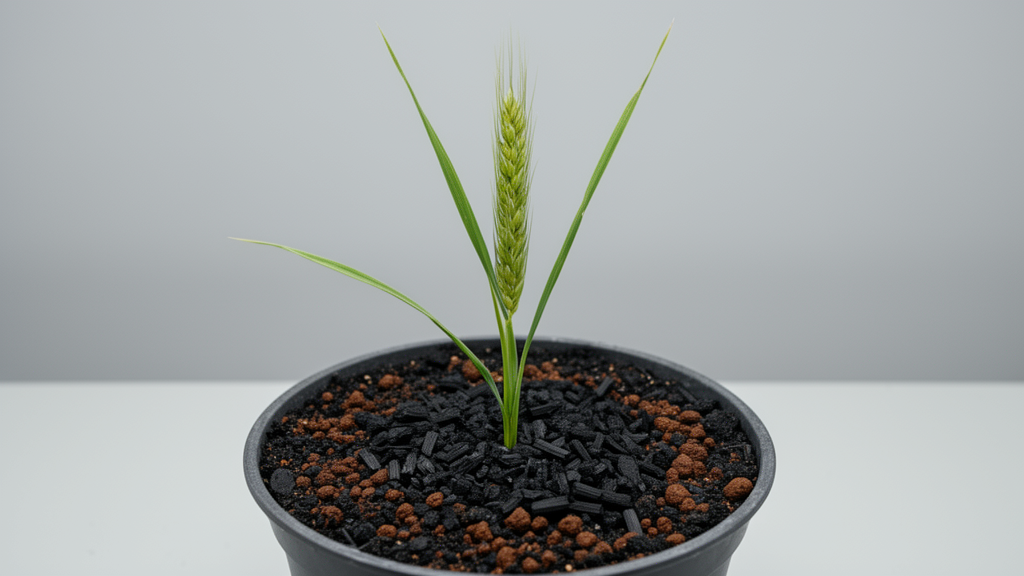
An outdoor pot experiment testing fourteen soil amendment strategies has found that corn stalk biochar, humic acid and rotation with sorghum each measurably relieved the continuous cropping obstacles that constrain foxtail millet (Setaria italica L.) productivity. The open-access study, published in BMC Plant Biology on 23 October 2026, assessed plant growth, photosynthetic pigments, biomass allocation, yield components, nutritional quality and the physicochemical properties of leaves, roots and soil at the maximum biomass stage.
Corn stalk biochar and humic acid stood out for above-ground development. Compared with continuous cropping alone, both treatments significantly increased plant height, stem diameter, leaf SPAD values, leaf thickness, leaf area, spike length and specific leaf weight. Biochar additionally raised leaf tissue density and soil organic carbon, while earthworm castings increased both soil total nitrogen and soil available nitrogen.
Rotation proved to be another effective lever. Alternating foxtail millet with Sorghum bicolor improved plant height, leaf SPAD, leaf thickness, leaf area, spike length, root forking, specific root surface area, soil total nitrogen and available potassium, all at statistically significant levels (P < 0.05). Rotation with mung bean (Vigna radiata) promoted leaf expansion, while the sorghum rotation specifically enhanced root elongation, indicating that different rotation partners leave distinct signatures on crop morphology and soil chemistry.
Humic acid application shifted nutrient partitioning in the plant as well as in the soil. Treated plants showed higher leaf total nitrogen and phosphorus and greater root potassium, alongside elevated soil available potassium. Microbial inoculants produced more targeted responses: Bacillus subtilis and B. megaterium increased leaf organic carbon, while B. mucilaginosus raised root phosphorus concentrations.
To identify which measured variables were most closely associated with yield components, the researchers applied redundancy analysis and hierarchical partitioning across the dataset. Stem weight emerged as the dominant variable, accounting for 26.62 percent of the association with yield components. Grain total starch contributed 7.79 percent, root total nitrogen 5.10 percent and leaf total phosphorus 1.99 percent. These figures describe statistical associations within the experiment rather than proven causal pathways.
Subject of Research: Soil amendment strategies to mitigate continuous cropping obstacles in foxtail millet
Article Title: Soil amendment strategies for continuous cropping obstacles in foxtail millet (Setaria italica L.): impacts on growth, nutrient partitioning, and yield formation
Article References: Zhang, Y., Li, J., Du, Y., Qin, N., Waqar, I., Dai, S., Li, P., Zhu, C., Fu, S., Jing, Y., Zhang, C., & Liang, H. (2026). Soil amendment strategies for continuous cropping obstacles in foxtail millet (Setaria italica L.): impacts on growth, nutrient partitioning, and yield formation. BMC Plant Biology. https://doi.org/10.1186/s12870-026-10207-3
Image Credits: AI Generated
DOI: 10.1186/s12870-026-10207-3
Keywords: foxtail millet, continuous cropping, soil amendments, biochar, humic acid, crop rotation, Bacillus inoculants, earthworm castings, nutrient partitioning, yield formation, pot experiment, Soil
Cite Scienmag News
Alan Morgan. (October 24, 2026). Biochar, Humic Acid and Rotation Ease Foxtail Millet Cropping Obstacles in Pot Study. Scienmag. https://scienmag.com/biochar-humic-acid-and-rotation-ease-foxtail-millet-cropping-obstacles-in-pot-study/
Alan Morgan. "Biochar, Humic Acid and Rotation Ease Foxtail Millet Cropping Obstacles in Pot Study." Scienmag, 24 October 2026, https://scienmag.com/biochar-humic-acid-and-rotation-ease-foxtail-millet-cropping-obstacles-in-pot-study/. Accessed 24 October 2026.
Alan Morgan. "Biochar, Humic Acid and Rotation Ease Foxtail Millet Cropping Obstacles in Pot Study." Scienmag. October 24, 2026. https://scienmag.com/biochar-humic-acid-and-rotation-ease-foxtail-millet-cropping-obstacles-in-pot-study/


