


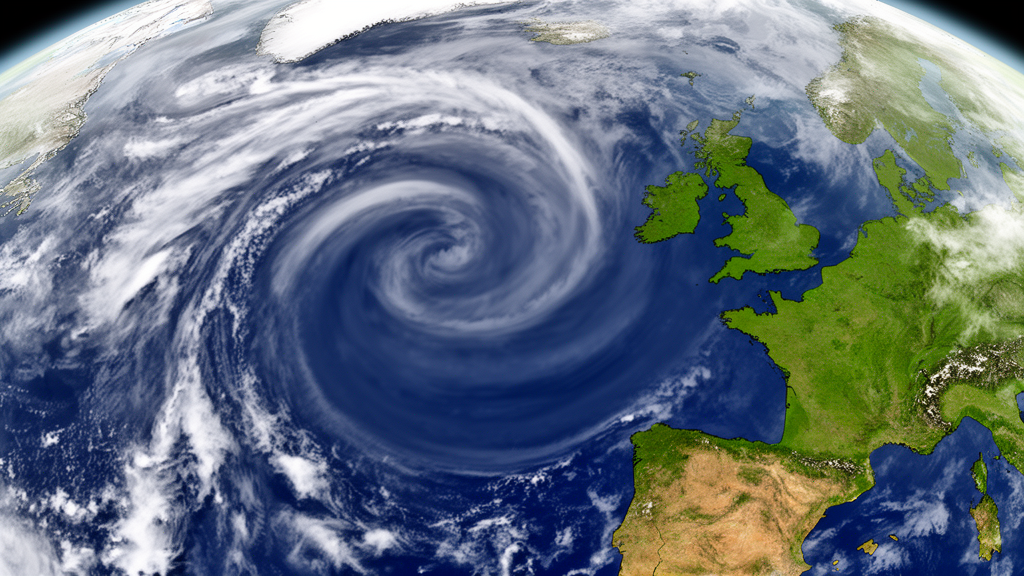
A single, persistent pattern of atmospheric pressure over the eastern North Atlantic appears to govern much of western Europe’s seasonal climate, according to a study published in Climate Dynamics. The research identifies a regional pressure mode known as the West Europe Pressure Anomaly (WEPA) as the leading driver of sea-level pressure variability in the sector spanning 25 degrees West to 15 degrees East and 20 to 65 degrees North, placing it ahead of the North Atlantic Oscillation (NAO), the pattern long regarded as the dominant mode of atmospheric variability over the broader North Atlantic region.
The NAO is defined over the wider North Atlantic domain from 90 degrees West to 40 degrees East and 20 to 80 degrees North. The study’s authors note that this broad-scale dipole fails to fully explain climate variability at mid-latitudes around western Europe, where the impacts of coastal storms and related hydroclimatic events remain poorly captured by the canonical index. To address this gap, the team applied empirical orthogonal function analysis, a statistical technique that extracts dominant spatial patterns from climate data, to monthly mean sea-level pressure fields from the ERA5 reanalysis covering the period 1950 to 2024.
The analysis produced a clear hierarchy of pressure modes. The leading mode corresponded to the West Europe Pressure Anomaly, while the second mode reproduced the canonical NAO pattern. Together, the two modes explained between 67 and 78 percent of the seasonal sea-level pressure variance in the eastern North Atlantic sector, indicating that a small number of patterns accounts for the majority of pressure variability in the region. The authors’ observation that the broad-scale NAO dipole does not fully explain mid-latitude variability around western Europe points to a more locally relevant structure of variability centred on the region itself.
A central result of the study is that WEPA is not a seasonal phenomenon confined to winter. The mode exhibited a remarkably stable spatial structure throughout the annual cycle, and it was strongly correlated with precipitation, near-surface wind speed and significant wave height along the Atlantic coast of western Europe. According to the authors, this demonstrates that WEPA represents a persistent regional mode of atmospheric variability rather than a winter-specific empirical index. The correlations with wind speed and wave height are particularly relevant for the coastal storm and hydroclimatic impacts that the authors identify as poorly captured by the basin-wide NAO framework.
The study also examined how WEPA might evolve under future warming. Using climate model simulations from the CMIP6 archive under the SSP2-4.5 scenario, the researchers found only modest projected changes in the index. When all available ensemble members from the model archive were considered, a weak decrease in the ensemble-mean WEPA index was detected. However, this trend was not reproduced when the analysis was restricted to one ensemble member per model, a method that prevents models with large ensembles from dominating the multi-model statistics. The authors interpret this discrepancy as limited evidence for a robust multi-model climate response, meaning the projected change cannot be clearly distinguished from the internal variability of the climate system.
The findings establish WEPA as a fundamental mode of atmospheric variability governing western European climate, with direct implications for how scientists monitor and interpret hydroclimatic conditions along the Atlantic coast. Because the mode is strongly linked to precipitation, wind and wave conditions across seasons, it may offer a more faithful regional framework than the basin-wide NAO for studying the storm and hydroclimatic impacts highlighted in the study. At the same time, the uncertain future trajectory of the index underscores a familiar challenge in climate science: detecting forced signals against the backdrop of large natural variability. The study, published on 23 October 2026 as article 475 in volume 64 of Climate Dynamics, was led by Ramdane Alkama and colleagues including Didier Swingedouw, Bruno Castelle, Christophe Cassou and Jérôme Ogée.
Subject of Research: A persistent atmospheric pressure mode governs western Europe’s seasonal climate
Article Title: A persistent atmospheric pressure mode governs western Europe’s seasonal climate
Article References: Alkama, R., Swingedouw, D., Castelle, B., Cassou, C., Couallier, J., Raymond, T., & Ogée, J. (2026). A persistent atmospheric pressure mode governs western Europe’s seasonal climate. Climate Dynamics, 64(11), Article 475. https://doi.org/10.1007/s00382-026-08420-9
Image Credits: AI Generated
DOI: 10.1007/s00382-026-08420-9
Keywords: persistent, atmospheric, pressure, mode, governs, western, Europe, seasonal, climate, scientific research
Cite Scienmag News
Sloane Callahan. (October 23, 2026). Persistent Atlantic pressure pattern governs western Europe’s seasonal climate. Scienmag. https://scienmag.com/persistent-atlantic-pressure-pattern-governs-western-europes-seasonal-climate/
Sloane Callahan. "Persistent Atlantic pressure pattern governs western Europe’s seasonal climate." Scienmag, 23 October 2026, https://scienmag.com/persistent-atlantic-pressure-pattern-governs-western-europes-seasonal-climate/. Accessed 23 October 2026.
Sloane Callahan. "Persistent Atlantic pressure pattern governs western Europe’s seasonal climate." Scienmag. October 23, 2026. https://scienmag.com/persistent-atlantic-pressure-pattern-governs-western-europes-seasonal-climate/


