


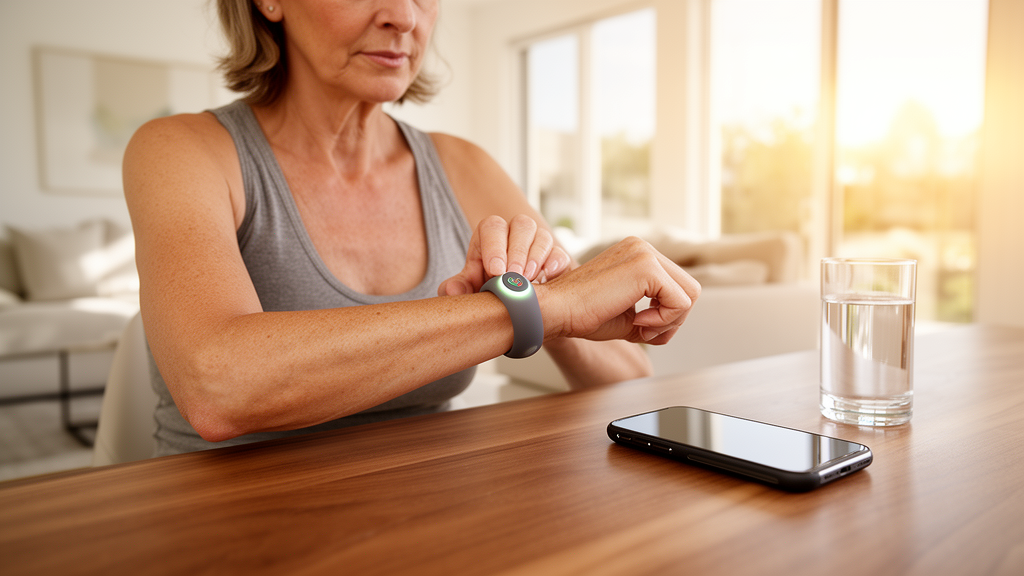
Ten pediatric brain tumor survivors with hypothalamic dysfunction wore a co-created smart wristband for two weeks and kept it on for a median of 99.4 percent of the time, according to a pilot study published in Frontiers in Endocrinology. The device, called the EndoWatch, was developed at the Princess Máxima Center for Pediatric Oncology and University Medical Center Utrecht together with design engineers from Corsano Health, design researchers from Eindhoven University of Technology, and patient representatives from the Dutch Pituitary Foundation and the Dutch Pediatric Cancer Society. The first version of the wearable was conceived as an external hypothalamus for patients whose hypothalamus, the brain’s control center for body temperature, sleep, thirst, appetite and hormone regulation, no longer functions properly after treatment for a suprasellar tumor. The pilot evaluated adherence and user experience only, not clinical performance.
The clinical problem the device addresses is formidable. Suprasellar low-grade brain tumors, such as adamantinomatous craniopharyngioma and suprasellar low-grade glioma, are associated with excellent survival rates, but the tumor and its treatment can damage the hypothalamus that sits directly above the pituitary gland. The consequences include disturbed thermoregulation, disrupted sleep-wake rhythms, changes in emotional behavior and impulse control, and pituitary hormone deficiencies. Among the most serious risks is central adrenal insufficiency, in which patients cannot mount an adequate cortisol response to physical or emotional stress; delayed treatment of an adrenal crisis can be life-threatening. Patients with arginine vasopressin deficiency and adipsia, who cannot rely on thirst to guide fluid intake, face dangerous fluctuations in serum sodium. Many also develop hypothalamic obesity, driven by insatiable appetite and reduced energy expenditure, which patients and parents identify, together with chronic fatigue, as the most debilitating outcomes of the condition.
Because no one-size-fits-all treatment exists for hypothalamic dysfunction, day-to-day management falls largely on parents and caregivers, who effectively function as the patient’s external hypothalamus. They perform frequent temperature checks for those with thermodysregulation, monitor fluid balance daily in patients with adipsia, and adjust hydrocortisone stress dosages in anticipation of fever or emotionally demanding events such as hospital visits. This around-the-clock vigilance can severely affect family life. The research team hypothesized that continuous passive monitoring by a smart wearable could relieve some of this burden: earlier recognition of rising or falling body temperature, better insight into sleep quality, tracking of daily activity, and detection of physiological stress through pulse rate variation could, in principle, allow more timely interventions and give patients a greater sense of control.
The EndoWatch was built on an existing certified platform rather than developed from scratch. The team adapted the Corsano CardioWatch 287-2, a wearable certified under the European Union Medical Device Regulation and by the United States Food and Drug Administration for medical use, originally designed for continuous cardio-respiratory monitoring in adults. The wristband contains multiple sensors: accelerometry, photoplethysmography, electrocardiography, temperature sensing and galvanic skin response. Data stream via Bluetooth to a smartphone application and onward to a cloud-based research platform compliant with the General Data Protection Regulation and the Health Insurance Portability and Accountability Act. Importantly, the intended population and use in this project extend beyond the original scope of the device’s certifications, a point the researchers acknowledge as relevant for future validation.
Before any patient wore the device, the team spent months in co-creation. Five patient-parent dyads were introduced to the concept and asked about their current self-management of temperature dysregulation, sleep problems, obesity, activity and hydrocortisone timing, as well as their unmet needs. Their input, discussed in a multidisciplinary team that included pediatric oncologists, endocrinologists, dieticians, sleep experts, physiotherapists and statisticians, was translated into specific design requirements. The first EndoWatch design monitored core body temperature in degrees Celsius, pulse rate in beats per minute, sleep stages including awake, light, deep and REM sleep, a sleep score in percent, activity type and daily step count. A patient diary in the app allowed users to report symptoms, stress episodes and medication changes, a feature the patient-parent dyads explicitly supported.
The EndoWatch-I study enrolled ten patients with acquired hypothalamic dysfunction, defined by the presence of at least two of several criteria, including reduced resting energy expenditure below 80 percent measured by indirect calorimetry, hyperphagia, overweight or obesity, disturbed circadian rhythm, behavioral disorders, temperature regulation disorder, pituitary dysfunction or vasopressin deficiency with adipsia. Eight participants were children with a mean age of 10.8 years, and two were adults aged 18.9 and 31.0 years. The cohort was severely affected: seven of the eight children had central hypocortisolism, seven had vasopressin deficiency, four had adipsia, five had temperature dysregulation and seven had sleep disturbances. One adult participant had Down’s syndrome and required full parental care, and two patients were wheelchair-bound with visual and cognitive impairment. Participants wore the device for fourteen days and completed the daily diary while freely exploring the app, with no additional instructions.
Adherence, the primary outcome, was measured as the percentage of wearing time based on pulse rate recordings obtained from the research portal. The median across all ten patients was 99.4 percent, with an interquartile range of 22.8. Eight of ten participants completed the full study period. The two who discontinued early did so for device-related reasons: one participant removed the watch after three days because of difficulties related to blindness, which led to discomfort, lack of understanding of the device and low motivation, while another wore it for eight of fourteen days and cited wristband discomfort. Questionnaires, answered on a five-point Likert scale, showed that all learnability statements were rated neutral or better by both patients and parents. Three quarters of parents did not find the watch burdensome for their child, and 87.5 percent wished for their child to continue wearing it. Most patients and parents disagreed that constant health-related information caused stress, although one of four patients did report feeling stressed by it.
The interviews, conducted with nine of the ten participants, revealed a clear pattern of strengths and shortcomings. Facilitators included the absence of a screen on the wearable, which reduced distractions; easy attachment and weekly charging; an intuitive, visually appealing app layout; timely charging and diary reminders; and a stable Bluetooth connection that continued monitoring and reliably synchronized data when the wristband and smartphone were temporarily separated. The barriers were equally instructive. The app could be installed on only one smartphone, which had to stay near the wristband for Bluetooth connectivity, making remote monitoring by parents impossible, for example while they were at work. The diary offered insufficient space for context and did not allow review or editing of past entries. The wristband caused skin irritation in two patients, the charging magnet contact was unstable, and the app failed on older smartphones. Families also requested a fluid diary for adipsic patients, wristbands in different colors and materials, and more relevant metrics for wheelchair-bound users.
Crucially, the study’s findings were not merely reported but translated directly into a second EndoWatch design, with all change requests granted. The new version introduces a separate, simplified parent app that displays real-time measurements remotely, keeps the diary exclusively in the patient app, allows detailed reporting of symptoms, stress events, contextual information and medication changes with access to historical entries, and offers alternative wristbands in different colors and materials. The authors emphasize that this first study assessed only adherence and user experience; the device’s ability to detect clinically meaningful hypothalamic dysregulation was not evaluated, and the wearable has never been tested or validated in children or young adults. A larger prospective study, the EndoWatch-II study, is planned to systematically evaluate the clinical functionality of the second design.
The researchers are candid about the limitations of a ten-patient pilot, noting that the heterogeneity that made the cohort informative also complicates interpretation of aggregate findings, and that patient inclusion will remain constrained by the rarity of the condition, though the centralization of pediatric oncology care in the Netherlands provides access to a relatively large cohort. They also look ahead to possibilities beyond the current device, including integration of continuous subcutaneous sodium monitoring for adipsic patients, which does not yet exist but could in theory mirror glucose monitoring in diabetes, and app features supporting the management of hyperphagia and hypothalamic obesity. For now, the EndoWatch remains a promising concept at an early stage: a device that families helped design, wore almost without interruption, and whose flaws they helped name, moving from an idea toward a tool that could one day share the load carried by the external hypothalamus in families’ homes.
Subject of Research: A co-created smart wearable for monitoring hypothalamic dysfunction in pediatric brain tumor survivors
Article Title: Co-creating the EndoWatch – a smart wearable device for the management of hypothalamic dysfunction in pediatric brain tumor survivors: a pilot study
Article References: Hulsmann, S. C., Petras, S. B., Fraboulet, P., Lu, Y., de Graaf, J. P., Plieger, W., Noordmans, H. J., Tissing, W. J. E., & van Santen, H. M. (2026). Co-creating the EndoWatch – a smart wearable device for the management of hypothalamic dysfunction in pediatric brain tumor survivors: a pilot study. Frontiers in Endocrinology, 17, Article 1963615. https://doi.org/10.3389/fendo.2026.1963615
Image Credits: AI Generated
DOI: 10.3389/fendo.2026.1963615
Keywords: hypothalamic dysfunction, pediatric brain tumor, wearable device, craniopharyngioma, pilot study, co-creation, hypothalamic obesity, central adrenal insufficiency, vasopressin deficiency, health monitoring, pediatric endocrinology, caregivers
Cite Scienmag News
Nathaniel Bowman. (October 23, 2026). Smart Wearable for Hypothalamic Dysfunction Shows High Adherence in Pilot Study. Scienmag. https://scienmag.com/smart-wearable-for-hypothalamic-dysfunction-shows-high-adherence-in-pilot-study/
Nathaniel Bowman. "Smart Wearable for Hypothalamic Dysfunction Shows High Adherence in Pilot Study." Scienmag, 23 October 2026, https://scienmag.com/smart-wearable-for-hypothalamic-dysfunction-shows-high-adherence-in-pilot-study/. Accessed 23 October 2026.
Nathaniel Bowman. "Smart Wearable for Hypothalamic Dysfunction Shows High Adherence in Pilot Study." Scienmag. October 23, 2026. https://scienmag.com/smart-wearable-for-hypothalamic-dysfunction-shows-high-adherence-in-pilot-study/


