


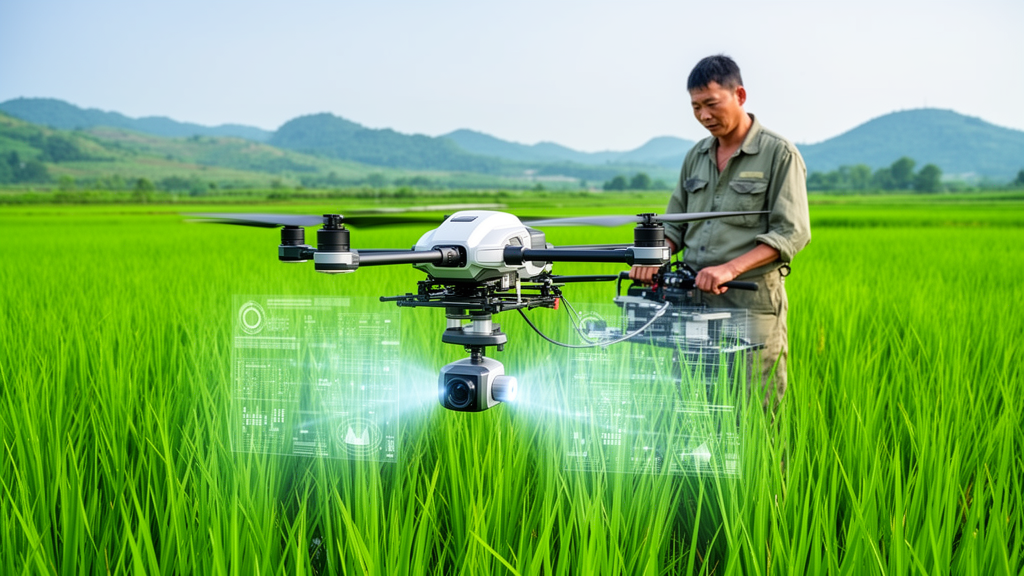
Researchers from the Chinese Academy of Agricultural Sciences have demonstrated that the expansion of the rural digital economy significantly enhances the green total factor productivity of the planting industry in China. Published in the journal Frontiers in Sustainable Food Systems, the study utilizes a double machine learning framework to analyze provincial panel data spanning from 2011 to 2022. The findings indicate that digital integration allows agricultural sectors to decouple output growth from environmental pollution, offering a viable pathway for sustainable food production in a major agricultural economy. This empirical approach addresses the critical need for rigorous statistical methods capable of isolating the specific impacts of digitalization amidst complex, high-dimensional economic variables.
The study focuses specifically on the planting industry rather than the broader agricultural sector, which includes forestry, animal husbandry, and fishery. By narrowing the scope, the researchers aimed to reduce data noise and capture the distinct input-output characteristics of crop production. The core explanatory variable, the rural digital economy, is measured through a multidimensional framework that accounts for the spillover of macro-level digital resources into rural areas. This perspective recognizes that rural digitalization relies heavily on the low-cost sharing of urban digital infrastructure, software, and services, rather than on isolated local hardware investments.
To quantify the dependent variable, the team employed the Slacks-Based Measure-Global Malmquist-Luenberger model. This non-radial efficiency model incorporates both desirable outputs, such as planting output value and carbon sequestration, and undesirable outputs, including carbon emissions and land surface pollution. The model allows for the decomposition of productivity into pure green technology progress and green technology efficiency. By using a mixed-scaling approach for input variables like labor and machinery, the researchers ensured that the measurement accurately reflected the physical rigidity and time elasticity of agricultural production factors.
The empirical results reveal that the rural digital economy exerts a positive and statistically significant effect on green total factor productivity at the 1% level. However, the impact is not uniform across all dimensions of digital development. Digital industry development and industrial digital transformation show strong positive linkages with productivity growth, driven by e-commerce, digital inclusive finance, and the integration of information technology services. In contrast, basic digital infrastructure alone, such as broadband access and hardware penetration, does not yield a significant direct effect, suggesting that hardware deployment must be accompanied by deeper software integration and industrial application to generate green dividends.
Mechanism analyses further elucidate how digitalization drives these improvements. The study finds that the rural digital economy optimizes inter-sectoral factor allocation by dismantling barriers to labor and capital mobility. This structural reallocation allows high-quality resources to flow more efficiently into agriculture, reducing structural misallocation across the three major economic sectors. Additionally, digital tools such as the Internet of Things and smart machinery significantly reduce agricultural polluting energy intensity. By enabling precision operations and demand-driven irrigation, these technologies minimize redundant fuel consumption and electricity waste, thereby lowering the carbon footprint of agricultural production.
Interestingly, the study finds that while rural digitalization increases government digital policy attention, this heightened administrative focus does not statistically translate into improved green total factor productivity. This disconnect suggests that top-down policy attention may suffer from implementation lags or a lack of alignment with grassroots agricultural realities. The findings imply that relying solely on administrative directives is insufficient for driving green transitions; instead, the tangible benefits of digitalization arise from market-driven structural optimizations and precision energy management rather than immediate technological leaps in the pure production frontier.
Heterogeneity tests reveal that the empowering effect of the rural digital economy is significantly stronger in provinces with larger cultivated scales. Large-scale farming operations can more efficiently spread the high fixed costs of smart machinery and data platforms, and their standardized management structures align better with data-driven technologies. In contrast, smallholders face constraints due to fragmented landholdings and limited financing, which hinder their ability to fully realize digital dividends. While inland and low-density provinces exhibit directionally larger coefficients, suggesting a digital catch-up effect, these regional differences are not statistically significant, indicating that the core benefits of digitalization are broadly applicable but most potent in scale-intensive contexts.
The researchers employed double machine learning to address the challenges of high-dimensional control variables and potential endogeneity. This method uses cross-validation and machine learning algorithms to reduce regularization bias, providing more reliable empirical inference than traditional linear regression models. Robustness checks, including the use of instrumental variables and alternative machine learning algorithms, confirm the stability of the baseline findings. The instrumental variable approach, utilizing historical telephone access data from 1990, helps mitigate concerns about reverse causality, although the authors acknowledge that no instrument can perfectly rule out all unobserved historical confounders.
These findings carry significant policy implications for China and other developing agricultural economies. Policymakers are advised to pivot from hardware-centric infrastructure expansion to enhancing farmers’ digital literacy and promoting shared digital socialized services. By supporting cooperatives and third-party service providers, the high costs of digital equipment can be shared across multiple farms, ensuring that smallholders are not marginalized. Furthermore, leveraging digital technologies for market-based environmental governance, such as carbon credit markets and green premium certifications, can incentivize farmers to adopt eco-friendly practices. This shift from command-and-control regulation to digital-enabled market mechanisms offers a promising strategy for achieving sustainable agricultural development.
The study highlights the transformative potential of the digital economy in addressing the dual challenges of food security and environmental conservation. By optimizing resource allocation and reducing energy intensity, digital tools provide a mechanism for enhancing agricultural efficiency without exacerbating ecological degradation. However, the research also underscores the importance of structural reforms and inclusive policies to ensure that the benefits of digitalization are equitably distributed. As the rural digital economy continues to evolve, its role in shaping the future of green agriculture will depend on the ability to bridge the gap between technological potential and practical implementation in diverse rural contexts.
Subject of Research: Impact of rural digital economy on agricultural green total factor productivity in China
Article Title: Does the rural digital economy enhance green total factor productivity of agriculture? An empirical approach using double machine learning
Article References: Huang, M., Zhu, M., Yu, J., Shen, C., Jin, D., & Wu, J. (2026). Does the rural digital economy enhance green total factor productivity of agriculture? An empirical approach using double machine learning. Frontiers in Sustainable Food Systems, 10, Article 1856495. https://doi.org/10.3389/fsufs.2026.1856495
Image Credits: AI Generated
DOI: 10.3389/fsufs.2026.1856495
Keywords: rural digital economy, green total factor productivity, double machine learning, agricultural sustainability, China, digital agriculture, energy efficiency, factor allocation, Does, rural, digital, economy
Cite Scienmag News
Alan Morgan. (October 23, 2026). Rural Digital Economy Boosts Green Agricultural Productivity in China. Scienmag. https://scienmag.com/rural-digital-economy-boosts-green-agricultural-productivity-in-china/
Alan Morgan. "Rural Digital Economy Boosts Green Agricultural Productivity in China." Scienmag, 23 October 2026, https://scienmag.com/rural-digital-economy-boosts-green-agricultural-productivity-in-china/. Accessed 23 October 2026.
Alan Morgan. "Rural Digital Economy Boosts Green Agricultural Productivity in China." Scienmag. October 23, 2026. https://scienmag.com/rural-digital-economy-boosts-green-agricultural-productivity-in-china/


