


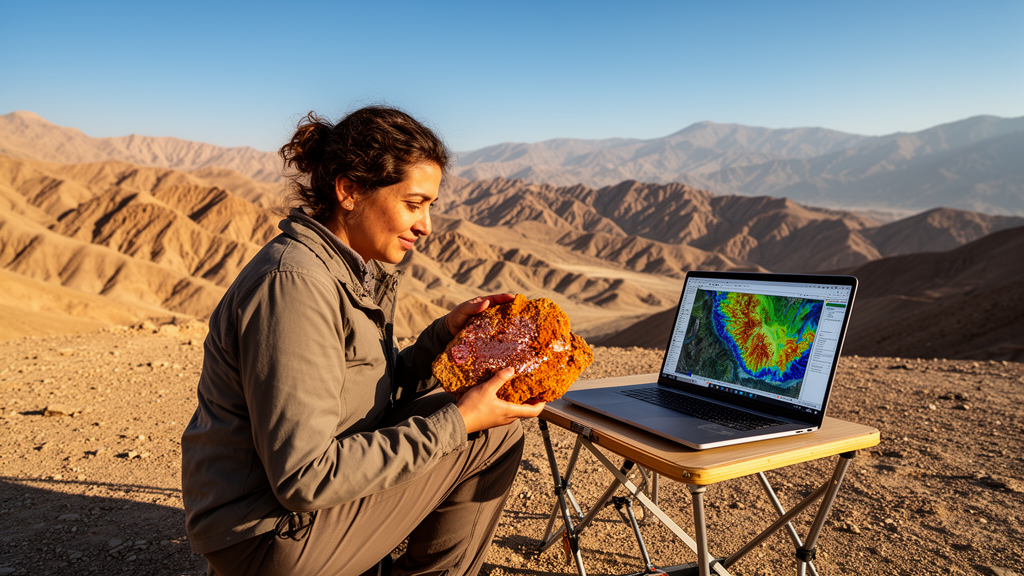
A study published in Earth Science Informatics by Mohammad Reza Samiei, Ali Moradzadeh, Parham Pahlavani and Reza Ghezelbash reports a transfer learning strategy for mineral prospectivity mapping in areas where known mineral occurrences are too scarce to train reliable models. Tested in the Kerman Cenozoic Magmatic Arc of Iran, the method identified all three known porphyry copper deposits in an evaluation zone, while an approach trained only on local data identified just one of the three.
Mineral prospectivity mapping in extensive or inaccessible areas often faces a scarcity of known deposits and occurrences. In these situations, knowledge-driven and unsupervised machine learning methods are commonly used, although their results may not always be reliable. Transfer learning offers an alternative by enabling prospectivity mapping in data-scarce regions through geological similarities with better-studied areas. The authors identified a weakness in this strategy: when evidence layers from different areas are normalized independently, the true spatial and geological significance of samples can be distorted, weakening the transfer.
To address this issue, the team introduced Transferable Layer Normalization, a domain-aware data harmonization strategy applied before transfer learning to preserve cross-domain semantic consistency in evidence layers. Before any transfer, the researchers analyzed Central Moment Discrepancy as an indicator of cross-domain similarity to assess dataset compatibility between the source and target areas.
The case study focused on three mineralized zones within the Kerman Cenozoic Magmatic Arc. The researchers used regression models, including Gaussian Process Regression, Support Vector Regression and Artificial Neural Networks, to predict porphyry copper deposit potential in the target area. A comparison of the local approach, conventional transfer learning and the Transferable Layer Normalization approach using Prediction-Area plots showed that the Gaussian Process Regression model delivered the highest accuracy among the tested configurations.
The study also reported gains in model stability. The average standard deviation dropped from 0.90 percent with the local approach to 0.53 percent with conventional transfer learning, and fell further to 0.39 percent when Transferable Layer Normalization was applied. According to the authors, this highlights substantial improvements in model stability and reliability when their harmonization step precedes transfer in data-scarce exploration districts.
Subject of Research: Transfer learning with Transferable Layer Normalization for porphyry copper prospectivity mapping in the Kerman Cenozoic Magmatic Arc, Iran
Article Title: Transfer learning for mineral prospectivity mapping in limited occurrence areas: methodological improvement and a case study from the Kerman Cenozoic Magmatic Arc, Iran
Article References: Samiei, M. R., Moradzadeh, A., Pahlavani, P., & Ghezelbash, R. (2026). Transfer learning for mineral prospectivity mapping in limited occurrence areas: methodological improvement and a case study from the Kerman Cenozoic Magmatic Arc, Iran. Earth Science Informatics, 19(12), Article 225. https://doi.org/10.1007/s12145-026-02278-5
Image Credits: AI Generated
DOI: 10.1007/s12145-026-02278-5
Keywords: transfer learning, mineral prospectivity mapping, porphyry copper, Kerman Cenozoic Magmatic Arc, Iran, Gaussian Process Regression, machine learning, Central Moment Discrepancy, data-scarce regions, Earth Science Informatics, Transfer, learning
Cite Scienmag News
Violet Maxwell. (October 23, 2026). AI Borrows Knowledge From Data-Rich Regions to Find Copper in Iran. Scienmag. https://scienmag.com/ai-borrows-knowledge-from-data-rich-regions-to-find-copper-in-iran/
Violet Maxwell. "AI Borrows Knowledge From Data-Rich Regions to Find Copper in Iran." Scienmag, 23 October 2026, https://scienmag.com/ai-borrows-knowledge-from-data-rich-regions-to-find-copper-in-iran/. Accessed 23 October 2026.
Violet Maxwell. "AI Borrows Knowledge From Data-Rich Regions to Find Copper in Iran." Scienmag. October 23, 2026. https://scienmag.com/ai-borrows-knowledge-from-data-rich-regions-to-find-copper-in-iran/


