


A robotic citrus harvester tested in a California navel orange orchard has shown that a deceptively simple mechanical trick—a V-shaped guide combined with coordinated twists of the robot arm—can replace a motorized alignment stage and still deliver the short, clean stem cuts that separate fresh-market fruit from juice-bound produce. In field trials on 100 navel oranges, the system detached every target fruit without damage and achieved an average residual stem length of 3.10 ± 3.34 millimeters, with a median of 1.81 millimeters. Ninety-two percent of the fruit met the commonly used quality threshold of less than 10 millimeters of remaining stem, and 52 percent satisfied the more stringent requirement of less than 2 millimeters. The work, conducted by researchers at California State University, Fresno, offers a new path toward robotic harvesting of table-grade citrus.
The challenge stems from the unforgiving quality standards of the fresh-fruit market. Citrus destined for supermarket shelves must leave the tree with a short residual stem: stems left too long can puncture neighboring fruit during washing, packing, and transport, while cuts made too close to the peel risk damaging the fruit itself. Damage near the stem attachment can shift fruit from fresh-market classification toward juice processing, which is why commercially available robotic citrus harvesters have so far been limited mainly to fruit destined for juice production. Whether a harvester can consistently control the length of the stem remaining on each piece of fruit is therefore a decisive measure of its commercial potential.
Yet most existing systems do not measure that metric at all. In a survey of representative stem-cutting citrus harvesters, the Fresno team found that the majority report only detachment success rates and picking times, and few explicitly position the stem relative to the cutter before actuating the blade. Reported times are also difficult to compare across studies, because some describe only the end-effector operation while others include detection, approach, transport, and return motions. The researchers’ own previous design took a direct approach to the problem: a compliant gripper paired with servo-actuated shears mounted on an active two-axis positioning stage, which steered the cutters to the stem and achieved a mean residual stem length of 0.81 ± 0.46 millimeters in standalone trials operated by a human positioning the device at each fruit. The precision was excellent, but the positioning stage added actuators, sensors, weight, and control complexity.
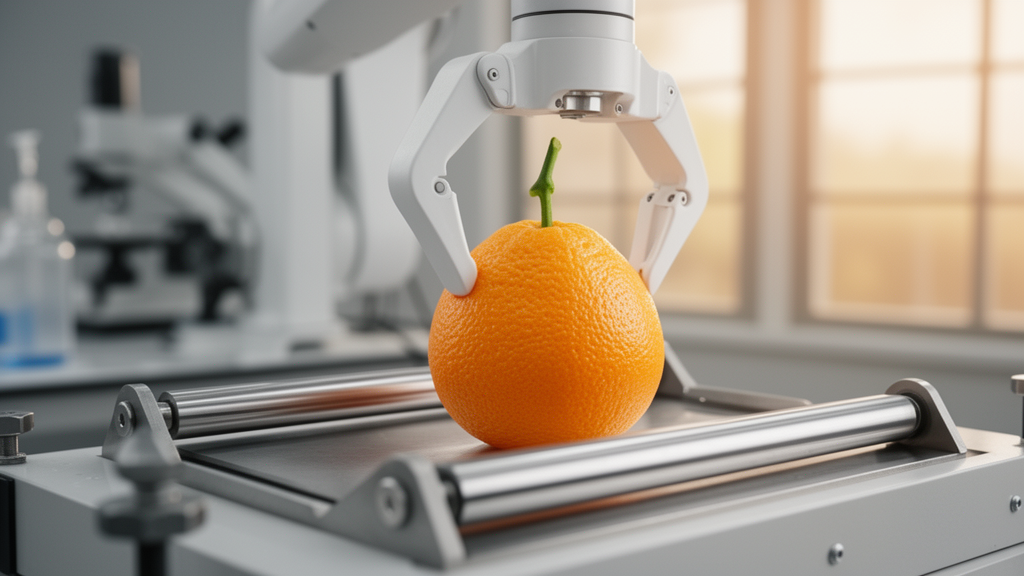
The new system reverses that logic. Instead of moving the shears to the stem, it moves the stem to the shears. The end-effector pairs a compliant three-finger gripper printed from flexible thermoplastic polyurethane with a servo-driven four-bar linkage that actuates a pair of commercial citrus clippers whose concave blades conform to the fruit’s curvature, cutting the stem flush with the peel. Between the fingers sits a V-shaped guide that can accommodate stems misaligned by up to 30 degrees in any direction. After the fruit is grasped, the robot performs a choreographed sequence—a 10-degree clockwise rotation followed by a 10-degree counterclockwise rotation about the tool axis, then a 5-to-10-degree downward rotation of the arm’s fourth joint—that lets the stem settle into the V and come to rest near the base of the cutting blades. The gripper then fully closes and the shears cut.
Transferring alignment from hardware to manipulation paid immediate dividends. The passive end-effector weighs just 0.5 kilograms, a 67 percent reduction from the 1.5-kilogram active design, and its actuator count drops from four to two. The two stepper motors, their drivers, two limit switches, and a pressure sensor all disappear, along with roughly 7.2 seconds of powered stage travel per cycle. Because the stage travel had accounted for 67 percent of the previous end-effector cycle, end-effector operation time fell from 10.79 seconds to about 9.1 seconds. In the field, the system detached all 100 target fruit with a detachment success rate of 100 percent, and no punctures, bruising, or peel abrasion was observed on any harvested fruit.
The integrated platform wraps the end-effector in a full harvesting pipeline. A commercial mobile rover developed by Bonsai Robotics carries a Fairino FR3 six-degree-of-freedom collaborative manipulator and an Intel RealSense D457 RGB-D camera. A YOLOv8 instance-segmentation network, trained on 1,159 annotated images collected in the Fresno Campus Farm orchard and augmented to 2,790 training images, detects and segments citrus and stems, then combines the color imagery with depth measurements to compute each fruit’s three-dimensional position. On the held-out test set, the model achieved a mean average precision at an intersection-over-union threshold of 0.50 of 95.5 percent for oranges but only 53.3 percent for the thin stems, a figure the researchers attribute to the sensitivity of small objects to boundary error; final alignment is handled passively by the guide rather than by the detector. In field validation on 82 fruit, the vision system detected 95.1 percent of citrus and 87.8 percent of stems.
Perception accuracy was sufficient for grasping and centering. Across 47 samples, average fruit localization error was 33.27 ± 15.27 millimeters, dominated by a lateral component of 22.53 ± 16.37 millimeters that the researchers attribute to partial occlusions shifting the perceived centroid. Fruit diameter estimates, based on a spherical model, missed by an average of only 4.07 ± 4.40 millimeters, a 3.81 percent error. Fruit and stem orientation errors averaged 3.1 ± 4.22 and 5.9 ± 7.89 degrees respectively, and all stem orientation estimation errors remained within the guide’s 30-degree tolerance. Because the fruit localization error was smaller than the average harvested fruit diameter of 73.52 millimeters, and because the compliant gripper absorbs positioning error during grasping, the system avoided approach failures attributable to depth errors under sunny and partly cloudy daylight conditions.
The full harvesting cycle averaged 55.1 seconds per fruit, with the manipulator deliberately running at 20 percent of its rated speed to allow operator intervention. A stage-by-stage breakdown revealed that transporting the harvested fruit to the collection bin took 15.52 seconds and returning the arm to its home position took 15.37 seconds, together meaning that manipulator motions accounted for roughly 66 percent of the cycle. Actual end-effector operations were fast: gripping and stem-centering took 7.59 seconds and cutting just 1.53 seconds, while detection required only 0.40 seconds. The arm ran on predefined waypoint sequences without obstacle-aware path planning, and 10 of 100 cycles were interrupted by motion-related events such as branch contact, kinematic singularities, or controller errors, each requiring operator intervention—though in every case the target fruit was still detached.
The most revealing analysis examined why the mean residual stem length of 3.10 millimeters exceeded the 0.81 millimeters of the earlier active design. Every one of the 48 fruit exceeding 2 millimeters showed at least one identifiable complicating condition: non-uniform or crooked stems, extreme stem angles, branching-stem obstructions, or nearby branches or fruit. The 52 fruit harvested without any of these conditions achieved a mean of 1.01 ± 0.56 millimeters, close to the active design’s 0.81 millimeters; the small remaining difference, about 0.2 millimeters, was statistically significant but represents the precision cost of eliminating two alignment actuators under comparable conditions. Weighting each condition group by its share of the sample showed that the 48 compromised fruit accounted for 2.18 millimeters, or 95 percent, of the 2.29-millimeter difference between the two studies’ means. Critically, perception was not the culprit: stem orientation estimation error showed no correlation with residual stem length, and the failure mode was graceful—poor centering left a longer stem but never caused a failed harvest. The authors caution that this comparison is retrospective, and that a controlled test of both end-effectors on the same fruit is needed to fully isolate the contribution of the alignment mechanism.
The study’s authors are careful to frame the results within their scope. All trials took place on navel oranges in a single orchard during one harvest season, on fruit between 80 and 120 centimeters above the ground, in daylight, under continuous operator supervision, with the operator driving the platform, selecting home positions, and starting each cycle. Performance on mandarins, lemons, other canopy architectures, or in low light remains untested, and no techno-economic analysis was performed; in its present supervised, semi-autonomous form the system does not yet offer labor savings compared with manual harvesting. The team nevertheless identified concrete next steps: using the vision system’s existing stem orientation estimates to rotate the end-effector toward the stem axis before approach, scaling the centering rotation to the estimated inclination, adding multi-view imaging to reveal occluded stems, implementing obstacle-aware motion planning, and verifying grasps and cuts automatically from the servo current signals already recorded during the trials. Faster trials at preliminary higher speeds reduced the average harvesting time to 38.6 ± 10.8 seconds per fruit, though at the cost of more frequent protective stops when the arm encountered branches. Together, the results show that passive stem-centering can provide controlled residual stem length with substantially simpler end-effector hardware, with stem-aware control and motion planning as the main steps toward faster and more robust operation.
Subject of Research: Passive stem-centering end-effector for controlled residual stem length in robotic citrus harvesting
Article Title: Passive stem-centering end-effector for controlled residual stem length: Integration and orchard evaluation on a robotic citrus harvesting platform
Article References: Chinnock, B., Catalan, A., Yang, D., Oliva, N., Ellis, A., Nguyen, T., & Bani Milhim, A. (2026). Passive stem-centering end-effector for controlled residual stem length: Integration and orchard evaluation on a robotic citrus harvesting platform. Smart Agricultural Technology, 15, Article 102646. https://doi.org/10.1016/j.atech.2026.102646
Image Credits: AI Generated
DOI: 10.1016/j.atech.2026.102646
Keywords: robotic harvesting, citrus, stem-centering, agricultural robotics, end-effector, navel oranges, machine vision, YOLOv8, fresh-market fruit, residual stem length, orchard automation, compliant gripper
Cite Scienmag News
Denise Maddox. (October 23, 2026). Robot Passively Centers Citrus Stems for Precise Cuts With Simpler Hardware. Scienmag. https://scienmag.com/robot-passively-centers-citrus-stems-for-precise-cuts-with-simpler-hardware/
Denise Maddox. "Robot Passively Centers Citrus Stems for Precise Cuts With Simpler Hardware." Scienmag, 23 October 2026, https://scienmag.com/robot-passively-centers-citrus-stems-for-precise-cuts-with-simpler-hardware/. Accessed 23 October 2026.
Denise Maddox. "Robot Passively Centers Citrus Stems for Precise Cuts With Simpler Hardware." Scienmag. October 23, 2026. https://scienmag.com/robot-passively-centers-citrus-stems-for-precise-cuts-with-simpler-hardware/


