


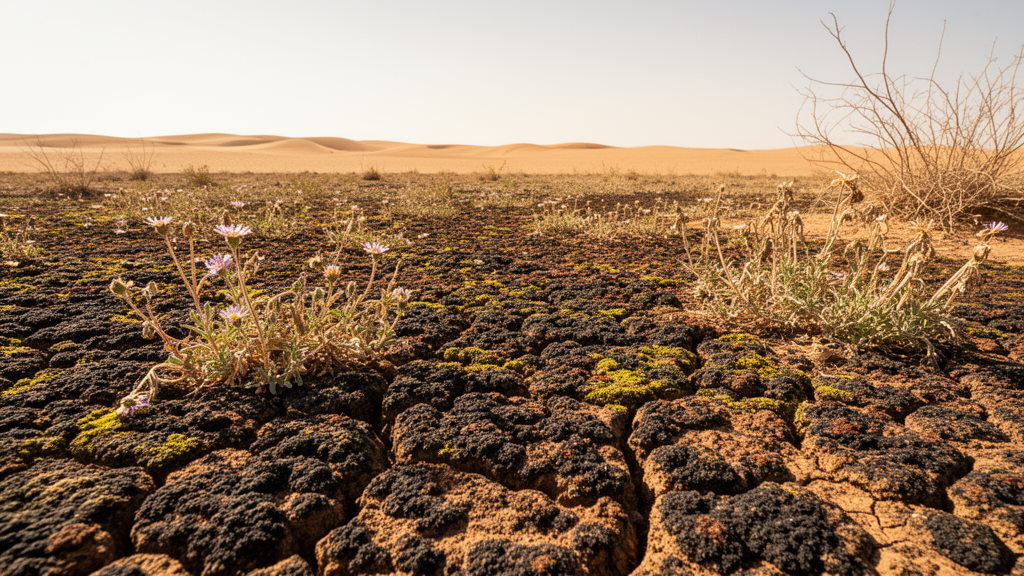
In the Gurbantunggut Desert of Central Asia, the thin living skin that carpets the sand between desert plants may be quietly working against them. A two-year field experiment has shown that biological soil crusts, or biocrusts, the communities of mosses, lichens, cyanobacteria and microorganisms that stabilize dryland surfaces, reduce the productivity of ephemeral plants and, more strikingly, amplify how sharply those plants respond when extreme drought strikes. The findings, published in Plant and Soil, suggest that these crusts play a more complicated role in desert ecosystems than their reputation as soil stabilizers might imply.
The research team compared plots covered by biocrusts with bare sand plots under both ambient conditions and an experimentally imposed extreme drought, achieved by reducing precipitation by 65 percent. Across the two years, they measured soil water content, soil total nitrogen, plant community characteristics, aboveground net primary productivity, known as ANPP, and drought sensitivity. The results revealed a trade-off at the heart of the biocrust effect: the crusts lowered soil water content while simultaneously raising soil total nitrogen, reshaping the resource environment in which the short-lived ephemeral plants complete their rapid life cycles.
The productivity losses traced back to distinct mechanisms depending on the stress involved. Under biocrust cover, ANPP of the ephemeral plant community declined primarily because individual plants grew shorter. Extreme drought, by contrast, cut ANPP mainly by reducing community density, meaning fewer plants persisted rather than the remaining plants simply staying small. When both stresses combined, the picture became more consequential: biocrust cover significantly increased the drought sensitivity of community ANPP, meaning that plant productivity fell more steeply under drought in crusted plots than in bare ones. This heightened sensitivity appeared clearly in the dominant species but was not statistically detectable in non-dominant species, pointing to an uneven burden across the community.
To untangle the pathways behind these effects, the researchers applied structural equation modelling, a statistical framework that can test how multiple variables influence one another in a hypothesized causal network. The analysis showed that the sensitivity of ANPP to drought was more strongly governed by soil water availability than by soil nitrogen availability. In other words, even though biocrusts enrich the soil with nitrogen, the moisture they draw away appears to dominate the plant response when drought intensifies.
The study’s scope carries important qualifications. It was conducted at a single desert site over two years, focused on ephemeral plants, and relied on one experimental drought treatment, so the results should not be generalized to all drylands, all plant functional groups, or longer drought sequences without further testing. The authors also note that the role of biocrusts in mediating plant productivity under extreme drought had remained poorly understood, which is precisely the gap this experiment was designed to address.
Even within those limits, the implications reach into how desert ecosystems may weather a hotter, more drought-prone future. Biocrusts are widespread across the world’s drylands and strongly influence soil water and nutrient availability, so any effect they have on plant drought sensitivity scales with their global footprint. The finding that they can simultaneously suppress productivity and sharpen its response to extreme drought positions them as a significant factor shaping how desert plant communities respond to climate change, particularly for the dominant ephemeral species that anchor much of the short growing season’s productivity.
Subject of Research: Effects of biological soil crusts on ephemeral plant productivity and drought sensitivity in the Gurbantunggut Desert, Central Asia
Article Title: Biological soil crust cover increases the sensitivity of ephemeral plant productivity to extreme drought in Central Asia
Article References: Zang, Y., Zhang, R., Zhang, W., Yin, B., Zhou, X., Zhang, J., Yang, X., Tao, Y., & Zhang, Y. (2026). Biological soil crust cover increases the sensitivity of ephemeral plant productivity to extreme drought in Central Asia. Plant and Soil. https://doi.org/10.1007/s11104-026-09101-6
Image Credits: AI Generated
DOI: 10.1007/s11104-026-09101-6
Keywords: biological soil crusts, biocrusts, ephemeral plants, extreme drought, Gurbantunggut Desert, Central Asia, aboveground net primary productivity, soil water content, soil total nitrogen, drought sensitivity, drylands, structural equation modelling
Cite Scienmag News
Alan Morgan. (October 23, 2026). Desert biocrusts make ephemeral plants more vulnerable to extreme drought. Scienmag. https://scienmag.com/desert-biocrusts-make-ephemeral-plants-more-vulnerable-to-extreme-drought/
Alan Morgan. "Desert biocrusts make ephemeral plants more vulnerable to extreme drought." Scienmag, 23 October 2026, https://scienmag.com/desert-biocrusts-make-ephemeral-plants-more-vulnerable-to-extreme-drought/. Accessed 23 October 2026.
Alan Morgan. "Desert biocrusts make ephemeral plants more vulnerable to extreme drought." Scienmag. October 23, 2026. https://scienmag.com/desert-biocrusts-make-ephemeral-plants-more-vulnerable-to-extreme-drought/


