


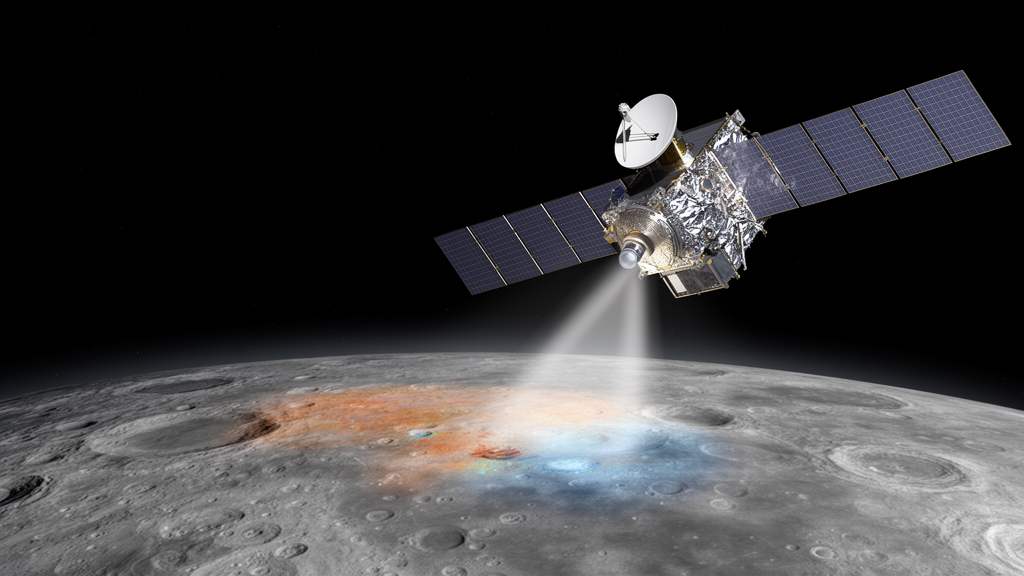
When the European Space Agency’s Jupiter Icy Moons Explorer, JUICE, swung past the Moon and Earth on 19 August 2024 to bend its trajectory toward Jupiter, its Moons and Jupiter Imaging Spectrometer, MAJIS, kept watching. The flyby was designed as an instrument test, but the lunar data it returned have now been analysed in detail by a team led by Francesca Zambon of INAF in Rome, and the results, published in Annales Geophysicae, show that MAJIS acquired the first hyperspectral observations of the lunar surface since the Moon Mineralogy Mapper on Chandrayaan-1, Cassini’s VIMS, and Chandrayaan-2’s Imaging Infrared Spectrometer. For a flagship European instrument still years from Jupiter, the Moon turned out to be a demanding and ultimately convincing proving ground.
MAJIS collected four hyperspectral images, or data cubes, during the flyby, covering an equatorial strip of the lunar nearside that spans Mare Tranquillitatis, Mare Fecunditatis and the adjacent highland terrains, roughly from 11 degrees south to 6 degrees north latitude and from 21 to 61 degrees east longitude. All four observations were taken at a phase angle of about 90 degrees. Orbital constraints meant that only three of the cubes were usable for analysing sunlight reflected off the surface, and the team concentrated on cubes C3 and C4, which enjoyed incidence angles below 60 degrees. Cube C1 was excluded outright because its illumination was too poor, and cube C2, which covers only highland terrain, suffered from unfavourable lighting and strong photometric distortions.
Two instrumental quirks shaped what the team could do with the data. Stray light contaminates the spectral region below about 1.3 micrometres, and the Moon, being so bright, represents a worst case for this artefact. Only cube C4 could be reliably corrected, because the observation was deliberately planned to read out a strip of the detector outside the instrument’s field of view, allowing the stray light contribution to be quantified and subtracted. There is also a spectral gap between roughly 2.22 and 2.35 micrometres where the visible-near-infrared and infrared channels of the instrument meet, which falls inconveniently close to the minimum of the lunar 2 micrometre absorption band and forced the analysts to fit the entire band rather than just its bottom.
The region itself is geologically rich. The dominant surface unit is Upper Imbrian mare, flat lava plains emplaced during large-scale basaltic flooding between roughly 3.85 and 3.2 billion years ago, while the intervening highlands include Nectarian Terra, some of the oldest exposed surfaces on the Moon, formed between about 3.92 and 3.85 billion years ago. Topography from the Lunar Orbiter Laser Altimeter shows the mare floors lying between about 2.6 and 1.0 kilometres below the lunar reference ellipsoid, with surrounding highlands rising above 1.5 kilometres, a vertical contrast that locally exceeds 4 kilometres. Previous missions have established that Mare Tranquillitatis is dominated by iron- and titanium-rich basalts, while Mare Fecunditatis is more heterogeneous, with lower titanium contents and mixtures of highland material.
The core of the analysis rests on the two most diagnostic absorption features in lunar reflectance spectra, centred near 1 and 2 micrometres. These bands arise from electronic transitions of iron, calcium and magnesium ions in mafic silicates, above all pyroxenes, and their positions and depths encode both mineral chemistry and abundance. In cube C4, which covers Mare Tranquillitatis, the band centres shift systematically toward longer wavelengths across the central mare, a signature of iron- and calcium-rich clinopyroxenes. The fresh crater Maskelyne G breaks the pattern: its band centres sit at shorter wavelengths, pointing instead toward a low-calcium pyroxene, likely pigeonite, exposed by the impact. The ejecta blankets of Messier and Messier A in Mare Fecunditatis show the deepest absorption bands in cube C3, marking freshly excavated, minimally weathered material.
Because no reliable photometric correction could be derived from observations taken at a single high phase angle, the team leaned on a ratioing technique, dividing each spectrum by a reference spectrum to cancel multiplicative artefacts and residual calibration effects. A two-step procedure, using an averaged highland spectrum with almost no absorption as the final denominator, sharpened the 1 micrometre band considerably and allowed band centres to be mapped from cube C4. The technique has limits: in the highlands, where intrinsic absorptions are weak, ratioing can suppress the very features of interest, and some spectra there still yield unreliable band centres. Band depths and spectral slopes, which are less sensitive to the stray light contamination, did not require the treatment.
Spectral slopes proved to be a sensitive gauge of surface maturity. The team computed three slope parameters, between 0.55 and 1.50 micrometres, between 1.50 and 2.60 micrometres, and a global slope spanning the full range. Fresh material such as Maskelyne G shows the lowest slopes, consistent with unweathered rock, while mature mare soils are redder and darker. One intriguing result is that a portion of Mare Tranquillitatis near the highland boundary shows steep slopes despite having lower titanium content than the mare’s typical high-titanium basalts, indicating that there the slope is controlled by composition, specifically by the scarcity of opaque ilmenite, rather than by maturity. The highlands, by contrast, are spectrally uniform and sharply divided from the maria at the geological boundary.
The maturity story comes with a caveat the authors stress: the spectral effects of space weathering, in which micrometeorite bombardment and solar wind gradually darken and redden the regolith through nanophase metallic iron, are expected to saturate on timescales of roughly a billion years. The maturity variations mapped by MAJIS should therefore be read as relative indicators of exposure and recent resurfacing, not as a linear clock measuring absolute surface age. Within that framework, a scatter plot of continuum slope against 1 micrometre band depth cleanly separates the feldspathic highlands from Mare Tranquillitatis, and reveals two distinct clusters within the mare itself, one near the highland margin and one in the more central regions.
MAJIS also pushed beyond the range of most previous lunar spectrometers, delivering reflectance spectra out to about 5 micrometres after thermal emission from the sun-warmed surface was removed. Two broad absorption features appear, one near 2.8 micrometres, where hydroxyl or water-bearing phases have previously been reported by M3, and another near 4.8 micrometres, a region largely unexplored in lunar remote sensing where laboratory spectra of pyroxenes and olivines show absorptions. The authors are careful about both. The 2.8 to 2.95 micrometre interval is compromised by a gap in the instrument’s linear variable filter, and the 4.8 micrometre feature could equally be an artefact of the thermal correction, which is inherently degenerate because surface emissivity and reflectance are linked through Kirchhoff’s law. A definitive interpretation is deferred to future work.
The strongest validation came from direct comparison with the Moon Mineralogy Mapper archive. MAJIS-derived maps of 1 micrometre band depth and 2 micrometre band centre agree closely with the published M3 spectral parameter maps in both spatial pattern and absolute values, with mare regions showing deeper mafic bands and longer-wavelength 2 micrometre centres, exactly as expected for iron- and calcium-rich clinopyroxenes. Average spectra of mare soil and the Maskelyne region from the two instruments match remarkably well. The highlands diverge more, which the team attributes to the rugged topography there amplifying shadowing and photometric variation at MAJIS’s 90-degree phase angle, combined with the absence of a photometric correction, rather than to any calibration problem.
For an instrument whose real targets are the icy Galilean moons, the lunar flyby delivered more than a calibration tick. It demonstrated that MAJIS can resolve compositional and maturity variations at regional scale on a body whose mineralogy is already well charted by Chandrayaan-1, Kaguya, Clementine and LRO, and the team notes that the observations validate the instrument’s readiness ahead of its arrival in the Jovian system. The extended spectral coverage beyond 2.6 micrometres opens lines of investigation that earlier lunar missions could not fully pursue, and companion thermophysical analyses of the same MAJIS observations reveal terrain-dependent differences in surface temperature and emissivity between 3 and 5.56 micrometres that mirror the compositional contrasts. The Moon, in this case, served as both a test target and a scientific subject in its own right.
Subject of Research: Hyperspectral analysis of lunar mare and highland regions observed by the MAJIS instrument during the JUICE Moon-Earth flyby
Article Title: Spectral analysis of lunar regions observed by MAJIS during the JUICE Moon-Earth flyby
Article References: Zambon, F., Altieri, F., De Sanctis, M. C., Le Mouélic, S., Piccioni, G., Poulet, F., Langevin, Y., Royer, C., Tosi, F., Karatekin, O., Mura, A., & Carli, C. (2026). Spectral analysis of lunar regions observed by MAJIS during the JUICE Moon-Earth flyby. Annales Geophysicae, 44(2), 1167-1199. https://doi.org/10.5194/angeo-44-1167-2026
Image Credits: AI Generated
DOI: 10.5194/angeo-44-1167-2026
Keywords: JUICE, MAJIS, Moon, hyperspectral imaging, Mare Tranquillitatis, Mare Fecunditatis, pyroxene, space weathering, lunar mineralogy, ESA, spectroscopy, planetary science
Cite Scienmag News
Violet Maxwell. (October 23, 2026). JUICE spectrometer maps lunar minerals on its way to Jupiter. Scienmag. https://scienmag.com/juice-spectrometer-maps-lunar-minerals-on-its-way-to-jupiter/
Violet Maxwell. "JUICE spectrometer maps lunar minerals on its way to Jupiter." Scienmag, 23 October 2026, https://scienmag.com/juice-spectrometer-maps-lunar-minerals-on-its-way-to-jupiter/. Accessed 23 October 2026.
Violet Maxwell. "JUICE spectrometer maps lunar minerals on its way to Jupiter." Scienmag. October 23, 2026. https://scienmag.com/juice-spectrometer-maps-lunar-minerals-on-its-way-to-jupiter/


