


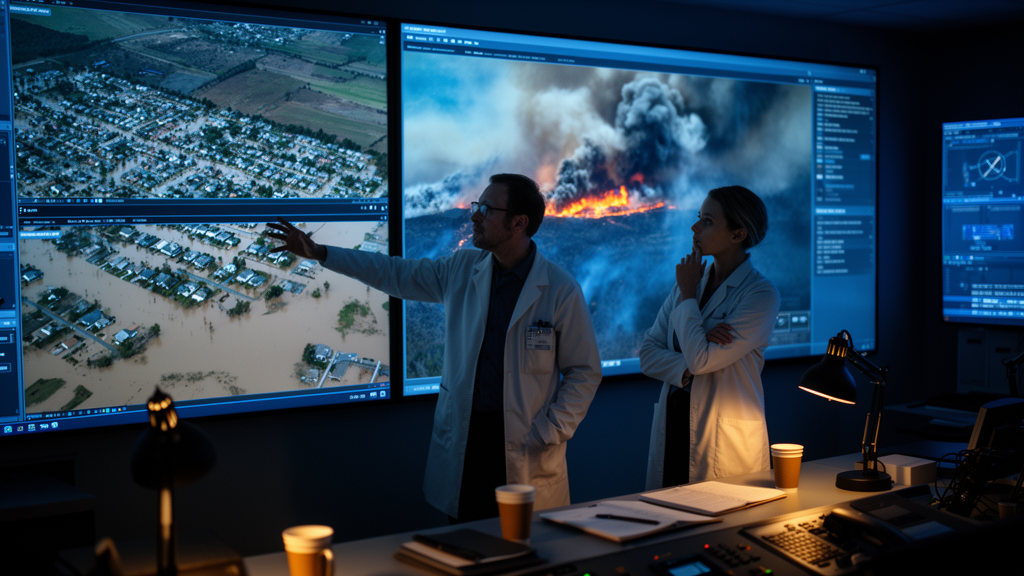
When NASA opened the entire Landsat archive to the world in 2008, and the European Space Agency followed with near-real-time Copernicus radar data from 2014, geohazard scientists gained something close to a superpower: the ability to watch the ground move almost anywhere on Earth without ever setting foot there. Downloads of Copernicus data rose by 133 percent between 2016 and 2019, and researchers now map earthquake strain, volcanic deformation and land subsidence across entire continents from a desk in Leeds or Edinburgh. But a new qualitative study of UK-based geohazard remote sensing researchers suggests that this freedom has outpaced the field’s ethical thinking, leaving scientists who study some of the world’s most vulnerable communities without the training, guidance or review systems needed to recognise the risks they may be creating.
The study, published in Geoscience Communication by Jessica Payne of the University of Leeds and Kate Donovan of the University of Edinburgh, is built on 13 semi-structured interviews and three focus group discussions with researchers who use satellite data to study earthquakes, volcanoes, landslides and subsidence. Participants came from academia, industry and government research organisations, and most were drawn from the Centre for the Observation and Modelling of Earthquakes, Volcanoes and Tectonics (COMET). Using a constructivist grounded theory approach, in which data collection and analysis proceeded together and emerging themes shaped later sampling, the authors distilled five themes: the contested role of ethical review, the ethics of studying regions without visiting them, responsibilities towards imaged societies, tensions between desired impact and academic pressure, and the ethical implications of open data.
The most striking finding is a mismatch between what researchers think ethics means and what the authors argue it should mean. When asked about ethical review, most academic participants framed the issue almost entirely in terms of personal privacy and image resolution. Because the medium-resolution Sentinel-1 radar data many of them use cannot resolve individual people, many concluded that no ethical questions arise at all. Around a quarter of interviewees responded favourably to introducing ethical review for satellite geohazard research, roughly two-thirds held mixed views, and one was firmly against it, fearing that review could block environmental research that raises hazard awareness. The authors argue this narrow framing misses the point: ethical risks lie not only in whether individuals can be identified, but in research aims, methodology and the real-world consequences of publishing results about communities who never consented to being studied.
That consent gap is structural. It is customary international law that any nation may overfly another by satellite without permission, a norm that has held since the late 1950s, and every interviewee the authors asked confirmed that people captured in satellite imagery have no way to consent to its acquisition or use. The authors describe this as a failure of dignity in geoethical terms: imaged communities have no agency over whether data about them is collected, how it is analysed, or how the findings are published. Participants themselves reported taking no measures to mask or exclude areas where people or societies appear in their published datasets, and some justified this by pointing to the similar imagery freely available through Google Earth. Yet the authors note that Google actively pixelates sensitive sites such as military installations in conflict zones, and that community-level harms, such as wrongly classified building damage maps that caused insurance difficulties for homeowners in the Azores, can emerge from derived products even when no individual is identifiable.
The question of whether researchers should study a country they have never visited divided the community sharply. Two-thirds of interview participants defended the right to research anywhere that open data exists, pointing to knowledge gaps in data-sparse regions and to practical realities: some terrain is too dangerous or remote for fieldwork, pandemics can block travel, and PhD budgets rarely stretch to properly compensating local collaborators. But focus group participants held stronger pro-visit views, and one government researcher put the counter-case bluntly, asking what gives external scientists the right to work in somebody else’s country without a working partner. A longer-careered participant also described a generational shift, noting that two decades ago researchers would simply study a region from orbit and publish, whereas collaboration with in-country organisations is now far more expected, partly because remotely studying a former colony can appear colonial in nature.
Collaboration, however, collides with the machinery of academic careers. Several participants described a tension between the ease of fully remote research and the difficulty of building in-country partnerships; one government scientist had spent four years trying to involve local researchers in a city study and was about to publish with no local co-authors, calling the result extractive despite genuine effort. Others reported that meaningful collaboration takes at least ten years of sustained personal contact, a timescale far beyond typical grant lifetimes. Participants also felt pressure from the UK’s Research Excellence Framework and from a global academic culture that prizes generalised, world-leading results over local, applied work such as supporting a volcano observatory. The authors argue that these incentives can push even well-intentioned researchers towards fully remote, globally oriented studies without local engagement, a pattern they link to academic neocolonialism, and they recommend that impact assessment frameworks explicitly value local as well as global impact.
The pressure is most visible in the aftermath of disasters. Focus group participants described a gold rush in which researchers rush to study rare events captured by open-access satellites, sometimes without contacting in-country scientists at all, because the work, as one put it, did not wait. The literature documents the pattern: publications featuring the word tsunami increased roughly tenfold on Scopus between 2004 and 2005 after the Sumatra-Andaman earthquake and tsunami. The authors also point to the L’Aquila earthquake of 2009, after which six members of Italy’s Major Risks Committee and a researcher were found guilty of contributing to deaths through inadequate communication of seismic hazard, as a cautionary example of the responsibility scientists carry when communicating risk. Encouragingly, some participants described informal best practice during the 2023 Türkiye-Syria earthquakes, where UK-based scientists channelled results directly to Turkish colleagues rather than disrupting local response structures, but the authors stress that such behaviour is learned informally and should be formalised through training.
Open data, the engine of the field’s recent expansion, carries its own dilemmas. Researchers described how Copernicus enabled continental-scale studies that were impossible when special access to ESA archives was required, and how volcano observatory staff increasingly process interferometric SAR data themselves rather than relying on external scientists. Yet the authors highlight persistent inequities: researchers in the Global South often lack the storage, compute power and training to process raw SAR data, and the long processing chain from raw data to deformation time series involves opaque choices that can undermine transparency. Reliance on default black-box processing may produce less accurate results that decision makers cannot meaningfully evaluate. Emerging developments, including the European Ground Motion Service launched in 2022 and the NASA-ISRO SAR mission launched in 2025 with its aim of delivering ready-to-use products and cloud-based training, are beginning to lower these barriers.
The study’s recommendations are twofold. First, bespoke ethics training for geohazard remote sensing researchers, built on geoethics, the Sendai Framework for Disaster Risk Reduction and the Disaster Studies Manifesto, covering five topics: geoethical principles, the researcher’s role in disaster risk reduction, decolonisation of geohazard research, best practice for in-country collaboration, and protecting imaged communities as imaging technologies evolve. The authors note that satellite resolution has improved relentlessly, from 80-metre Landsat data in the 1970s to sub-metre commercial imagery today, meaning individuals may become increasingly identifiable in data used by ordinary researchers. Second, they propose a light-touch ethical review system, designed by the remote sensing community itself, applied at project design stage to identify and mitigate ethical risks without becoming the checklist-style bureaucracy that participants feared.
The authors are candid about the study’s limits. All participants were UK-based, most were male, and the sample was concentrated on COMET and InSAR-focused research, so the findings may not generalise to remote sensing communities elsewhere, and the perspectives of in-country communities themselves were not captured. The authors also acknowledge their own positionality as members of the same community. Even so, the picture that emerges is of a field full of scientists who genuinely want to save lives and reduce disaster risk, yet who operate within structures that reward rapid, remote publication over slow, equitable partnership. Whether the community can realign those incentives, the authors suggest, will determine whether the satellite era fulfils its promise for the people living in the disaster zones it watches from above.
Subject of Research: Ethics of using open-access satellite data for international geohazard research, based on interviews and focus groups with UK-based remote sensing scientists
Article Title: Perceptions and recommendations: exploring the ethics of using satellite data to understand, monitor, and publish research on international geohazards
Article References: Payne, J. A., & Donovan, K. (2026). Perceptions and recommendations: exploring the ethics of using satellite data to understand, monitor, and publish research on international geohazards. Geoscience Communication, 9(4), 489-523. https://doi.org/10.5194/gc-9-489-2026
Image Credits: AI Generated
Keywords: satellite remote sensing, geohazards, research ethics, disaster risk reduction, open data, geoethics, InSAR, decolonisation, ethical review, Global South, COMET, Sendai Framework
Cite Scienmag News
Violet Maxwell. (October 23, 2026). Satellite scientists confront the ethics of watching disasters from orbit. Scienmag. https://scienmag.com/satellite-scientists-confront-the-ethics-of-watching-disasters-from-orbit/
Violet Maxwell. "Satellite scientists confront the ethics of watching disasters from orbit." Scienmag, 23 October 2026, https://scienmag.com/satellite-scientists-confront-the-ethics-of-watching-disasters-from-orbit/. Accessed 23 October 2026.
Violet Maxwell. "Satellite scientists confront the ethics of watching disasters from orbit." Scienmag. October 23, 2026. https://scienmag.com/satellite-scientists-confront-the-ethics-of-watching-disasters-from-orbit/


