


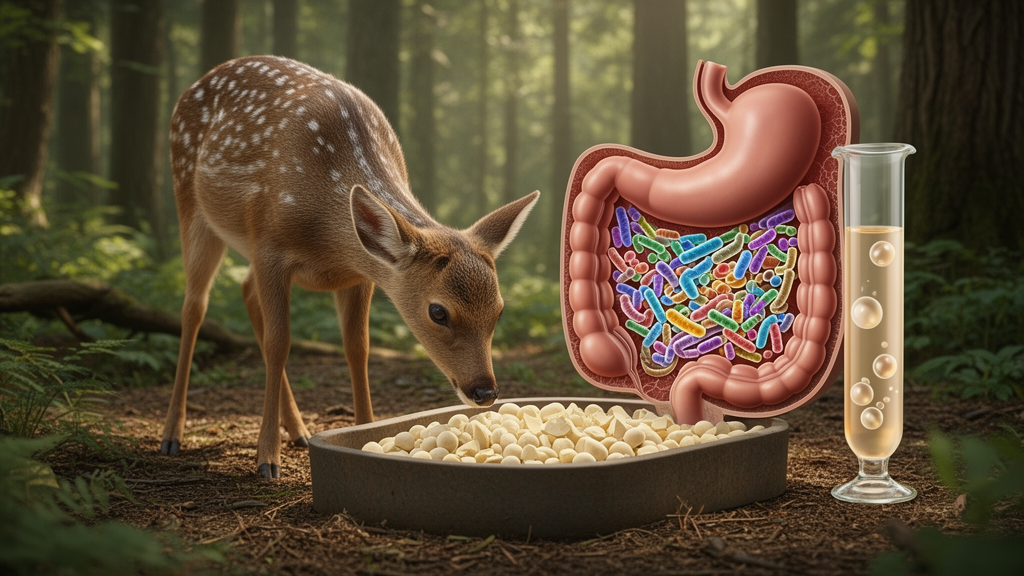
In a 30-day feeding trial, adding 15 grams of wall-broken yeast powder per kilogram of dry matter altered the relative abundance of several gut bacterial taxa and changed the serum metabolomic profile of captive forest musk deer. The randomized experiment involved 14 healthy adult males, with seven animals receiving the yeast supplement and seven receiving a basal diet. Sixty-nine serum metabolites met the study’s differential-metabolite criteria: 63 were more abundant and six were less abundant in the supplemented group. Changes were concentrated particularly in amino acids and their derivatives, hormones and hormone-related substances, glycerophospholipids, carbohydrates, bile acids, and organic acids. The results provide preliminary evidence of metabolic and microbial responses to the feed additive, but they do not establish improved growth, immunity, gastrointestinal health, or breeding performance.
Forest musk deer are small ruminants whose populations have declined sharply in southwest China since the 1950s amid habitat degradation and overexploitation. Captive breeding offers a route to greater musk production and release of captive-born animals, but gastrointestinal disorders are common among captive deer and have constrained the expansion of this industry. The 30-day experiment therefore examined whether a feed additive could alter microbial and metabolic features relevant to captive management. Its scope was narrow: one dose, one 30-day feeding period, adult males, seven animals per dietary group, and serum metabolomics performed on three randomly selected deer per group.
The wall-broken yeast preparation was a single-ingredient product with a reported cell-wall disruption rate above 90%. According to the manufacturer’s quality-control report, it contained 42.20% crude protein, 26.39% polysaccharides, 7.07% moisture, and 7.13% ash. At an inclusion rate of 15 g/kg dry matter, the supplement added approximately 0.65 percentage points of dietary crude protein. The control and supplemented diets were otherwise based on the same ingredients, including Pittosporum truncatum leaves, corn, soybean meal, wheat bran, corn germ meal, minerals, and a vitamin and trace-element premix. Because the diets were not formulated to be exactly equivalent in protein and energy, nutritional differences cannot be completely separated from possible effects of yeast-derived compounds.
Microbial communities were characterized by sequencing the V3–V4 regions of bacterial 16S rDNA genes from fecal samples collected from all 14 deer. Quality filtering, chimera removal, clustering into operational taxonomic units at 97% similarity, and taxonomic annotation produced 2,866 OTUs shared by the two groups, with 987 unique to the control group and 1,097 unique to the supplemented group. Rarefaction curves approached plateaus, suggesting that sequencing captured much of the observed bacterial diversity. Firmicutes, Bacteroidota, and Proteobacteria were the dominant phyla. Their relative abundances differed descriptively between diets, but the principal between-group diversity test did not detect a statistically significant overall shift: ANOSIM based on Bray–Curtis distance produced R = −0.0214 and P = 0.538. Chao1, observed-species, phylogenetic-diversity, and Shannon indices were also lower in the yeast group without significant differences.
Taxa-level responses were more apparent than the overall community result. The supplemented animals had higher relative abundances of the genera Ruminobacter, UCG-005, and Bacteroides, while the relative abundance of Prevotellaceae_UCG-003 decreased. Linear discriminant analysis effect size analysis identified five taxa and one lineage as differentially enriched. The yeast group was characterized by Barnesiellaceae and an unclassified bacterium designated NLAE_z1_H40, whereas the control group showed enrichment of Actinobacteriota, Actinobacteria, Corynebacteriaceae, and Corynebacterium. These findings show that the supplement was associated with taxonomic changes, although the study did not establish that the resulting community was more stable or healthier, and its predicted microbial functions remain computational estimates rather than direct measurements of microbial activity.
Targeted serum metabolomics produced a clearer separation between the dietary groups than the fecal diversity analysis. An orthogonal partial least squares discriminant analysis model reported R2Y of 0.999 and Q2 of 0.65, indicating high explanatory performance and moderate predictive performance within the experimental data. Metabolites were considered differential when their variable importance in projection score was at least 1 and their between-group P value was no greater than 0.05; fold changes described direction and magnitude but were not used as an additional screening threshold. Hierarchical clustering separated the differential-metabolite profiles. Among the increased compounds were estrone, galacturonic acid, histidine, L-glutamic acid, quinolinic acid, deoxycholic acid, and several cyclic dipeptides and lysophosphatidylcholines.
Six metabolites declined in the supplemented group. These included phenylalanyl-lysine, fatty acid 22:4, lysophosphatidic acid 18:1/0:0, and salidroside. Salidroside, for example, fell to 0.44 times its control-group abundance, while several cyclic dipeptides increased sharply: cyclo(proline-leucine) and proline-isoleucine had reported fold changes of 25.06, and cyclo(proline-valine) and glutamate-histidine had values of 22.78. These measurements describe serum composition rather than physiological benefit. The experiment did not directly assess growth performance, feed efficiency, immune markers, disease incidence, reproductive behavior, or longer-term gastrointestinal outcomes, so the elevated estrone and other metabolite changes should not be interpreted as demonstrated improvements in those outcomes.
Pathway analysis placed the differential metabolites in broad KEGG categories and highlighted differences involving ABC transporters, glycerophospholipid metabolism, phenylalanine metabolism, carbon metabolism, and β-alanine metabolism. Amino acids and their derivatives accounted for a conspicuous share of the changes, including histidine, glutamate, quinolinic acid, and multiple peptide-like compounds. Glycerophospholipid signals included lysophosphatidylcholines and lysophosphatidylethanolamines, metabolites involved in membrane remodeling and cellular signaling. The authors proposed that wall-broken yeast may influence nutrient utilization and lipid-related metabolism, potentially through its proteins, nucleotides, and cell-wall polysaccharides. That mechanism remains a hypothesis: the study measured serum metabolites and bacterial relative abundance rather than demonstrating that particular yeast constituents caused the changes through a defined biochemical route.
Correlation analysis linked selected bacteria with serum metabolites but did not establish causality. Ruminobacter was positively associated with quinolinic acid, Lys-Gly, Gly-Lys, and cyclo(proline-leucine), while Prevotellaceae_UCG-004 was positively associated with salidroside and with L-glutamic acid, methyl β-D-galactopyranoside, L-threonine-3-methylaspartate, and histidine. Bacteroides species were negatively associated with a broader set including N-phenylacetylglycine, fatty acid 18:3, several lysophospholipid species, galacturonic acid, proline-isoleucine, fumaric acid, estrone, and maleic acid. These statistical relationships show that taxa and serum compounds varied together, but they cannot show whether microbial changes produced the metabolite shifts, whether the host environment affected both, or whether other dietary and environmental factors contributed.
Several design features limit how far the findings can be generalized. The sample was small because captive forest musk deer are a protected species with limited availability, and only males averaging 4.5 years of age and 7.0 kg were enrolled. The short adaptation and feeding periods may have captured transitional rather than stable long-term responses, and testing only one inclusion rate prevents estimation of a dose-response relationship. The metabolomics subset contained just three animals per group, increasing uncertainty in the biochemical comparisons. Larger, longer studies encompassing both sexes and multiple ages, several yeast doses, and diets matched exactly for protein and energy would be needed to separate additive-specific effects from nutritional effects and to determine whether the observed microbial and metabolic shifts translate into better health, productivity, or breeding outcomes in captive forest musk deer.
Subject of Research: Effects of a wall-broken yeast feed supplement on gut microbiota and serum metabolites in captive forest musk deer
Article Title: Effects of Wall-broken yeast powder on gut microbiota and serum metabolome in captive forest musk deer (Moschus bere-zovskii)
Article References: Wu, Y., Chen, T., Ying, Z., Xie, S., Su, W., Tan, N., Cai, M., Zeng, D., Zhang, C., Huang, Q., Peng, S., Jiang, Z., & Yang, Q. (2026). Effects of Wall-broken yeast powder on gut microbiota and serum metabolome in captive forest musk deer (Moschus bere-zovskii). Frontiers in Veterinary Science, 13, Article 1978027. https://doi.org/10.3389/fvets.2026.1978027
Image Credits: AI Generated
DOI: 10.3389/fvets.2026.1978027
Keywords: forest musk deer, wall-broken yeast, gut microbiota, serum metabolomics, captive breeding, ruminant nutrition, 16S rRNA sequencing, amino acid metabolism, glycerophospholipids, Effects, Wall-broken, yeast
Cite Scienmag News
Morgan Morrow. (October 23, 2026). Wall-broken yeast shifts gut bacteria and serum metabolites in captive forest musk deer. Scienmag. https://scienmag.com/wall-broken-yeast-shifts-gut-bacteria-and-serum-metabolites-in-captive-forest-musk-deer/
Morgan Morrow. "Wall-broken yeast shifts gut bacteria and serum metabolites in captive forest musk deer." Scienmag, 23 October 2026, https://scienmag.com/wall-broken-yeast-shifts-gut-bacteria-and-serum-metabolites-in-captive-forest-musk-deer/. Accessed 23 October 2026.
Morgan Morrow. "Wall-broken yeast shifts gut bacteria and serum metabolites in captive forest musk deer." Scienmag. October 23, 2026. https://scienmag.com/wall-broken-yeast-shifts-gut-bacteria-and-serum-metabolites-in-captive-forest-musk-deer/


