


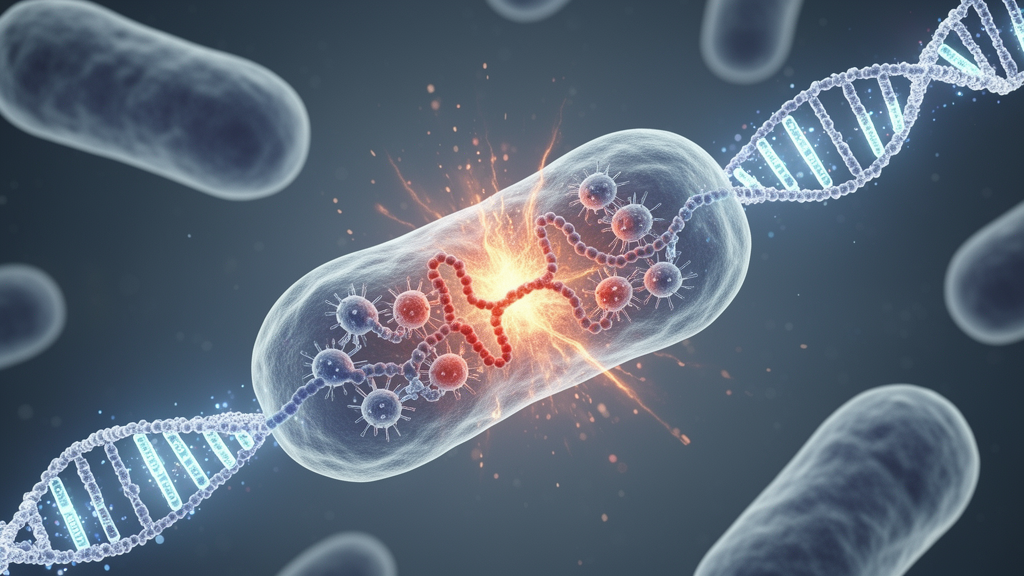
A mini review of the published evidence concludes that prophages can leave their lysogenic state through at least five routes that do not depend on the canonical bacterial SOS DNA-damage response. The five classes are quorum sensing, metabolic or oxidative stress, sub-inhibitory exposure to non-DNA-damaging antibiotics, stochastic fluctuations in repressor expression, and physiological or environmental cues such as bile acids and osmotic stress. This wider regulatory repertoire may allow prophages to become infectious under conditions that do not produce substantial DNA damage, potentially supporting the movement of antibiotic resistance genes among bacteria. The evidence for resistance-gene transfer is nevertheless uneven: functional transduction has been demonstrated in selected laboratory and clinical-isolate systems, whereas much of the evidence from gut and environmental communities remains based on phage production, gene packaging or metagenomic associations.
Temperate bacteriophages persist as prophages integrated into bacterial chromosomes, where they can carry accessory genes with roles in virulence, metabolism and antibiotic resistance. Activation of the lytic cycle can excise the prophage, generate infectious particles and enable transfer of bacterial DNA by generalized or specialized transduction. For more than half a century, this switch was interpreted mainly through the SOS response. DNA-damaging agents such as fluoroquinolones and mitomycin C generate single-stranded DNA, activate the RecA co-protease and promote LexA repressor cleavage, allowing phage lytic genes to be expressed. Strong DNA-damaging treatments can produce high phage titers, but such damaging events may be comparatively uncommon or transient in many clinical and natural environments.
The review classifies quorum-sensing induction as a genetically established SOS-independent mechanism in some Vibrio systems. At high cell density, the host regulator HapR represses the CTXφ repressor gene rstR in Vibrio cholerae, lifting repression of phage lytic genes. Eliminating hapR prevents induction in dense cultures, whereas deleting recA does not. In Vibrio anguillarum phage ΦH20, a phage-encoded LuxR-type receptor detects host acyl-homoserine lactone signals and activates lytic replication when the signal reaches a threshold. Evidence for quorum-sensing control in Pseudomonas aeruginosa and Staphylococcus aureus is less complete: disrupting quorum-sensing machinery can reduce prophage release in biofilms or influence induction of prophages carrying immune-evasion genes, but direct molecular links and full genetic validation are not available for every system.
Metabolic state can also activate prophages without engaging RecA or LexA. In Escherichia coli, the stationary-phase sigma factor RpoS has been associated with activation of lytic genes during carbon limitation, including in recA-deficient strains, although direct biochemical evidence of promoter binding is limited for many phage-host pairs. Oxidative stress supplies another mechanism. In Staphylococcus aureus, pyocyanin-induced high-level oxidative stress triggers prophage-selective activation without RecA, LexA or upregulation of canonical SOS genes such as recN and uvrA. Hydrogen peroxide has also been reported to induce a Lactococcus lactis prophage through oxidation of its CI repressor without RecA activation. Metagenomic observations in gut Bacteroides associated altered induction with short-chain fatty-acid production and no detectable SOS signature, but this is transcriptomic support rather than a complete genetic demonstration.
Sub-inhibitory antibiotics provide the best-documented clinical link between SOS-independent induction and resistance-gene dissemination. Ceftazidime below the minimum inhibitory concentration induces prophage release in Klebsiella pneumoniae through cell-envelope stress, and the response persists in lexA mutants unable to mount a canonical SOS response. In that system, successful transduction of the blaKPC carbapenemase gene has been observed, linking a non-SOS trigger to a functional resistance outcome rather than merely phage production. Sub-inhibitory tetracycline has likewise increased phage-mediated transfer of tetracycline-resistance genes in Escherichia coli isolates from livestock environments. Macrolides and tetracyclines can also disturb the balance between phage repressor synthesis and promoter activity, allowing lytic replication without a DNA-damage signal, and induction has been retained in recA-deficient E. coli in relevant experiments.
Some bacterial lineages make the distinction from canonical SOS signaling particularly clear. Streptococcus pneumoniae lacks a LexA-mediated SOS response and instead uses competence-associated DNA-repair pathways. Its prophage activation after exposure to sub-inhibitory erythromycin is therefore independent of the classical SOS cascade, although the precise connection between ribosomal stress, repressor stoichiometry and induction may differ among phage-host pairs. Trimethoprim-induced induction remains putatively SOS-independent because treated cultures show neither detectable DNA strand breaks nor activation of an SOS reporter. The review therefore cautions against treating all antibiotic classes and host organisms as equivalent. Evidence is strongest when induction persists at comparable levels in isogenic recA or non-cleavable lexA mutants; absence of SOS-gene upregulation offers transcriptomic support, while a stimulus that is simply not known to damage DNA provides only weaker phenotypic evidence.
Spontaneous induction supplies a continuous but usually low-amplitude source of infectious phage. It is attributed to stochastic fluctuations in the concentration of phage repressor protein, allowing a small fraction of lysogenic cells to cross the threshold for lytic gene expression without an external stressor. Laboratory measurements cited in the review place induction frequencies broadly between 10−6 and 10−2 per cell per generation, with substantial variation according to host strain, prophage identity, growth phase and environment. Cultivation and metagenomic studies in soil Bradyrhizobium populations suggest that spontaneous induction accounts for a major share of detectable free phages under baseline conditions, while gut virome surveys report spontaneous release across healthy adult ecosystems. Direct in vivo quantification of the resulting antibiotic-resistance-gene transduction rates, however, remains limited.
Physiological and environmental factors add further routes to the lysogeny-lysis switch. Bile acids can disrupt membrane integrity and induce prophages in commensal and pathogenic gut bacteria without detectable upregulation of canonical SOS genes; conjugated bile acids have also produced species-specific activation among Bacteroidetes. Temperature shifts, pH changes and osmotic stress may alter repressor conformation or the binding of nucleoid-associated proteins such as H-NS to phage promoters. H-NS-mediated repression can be relieved under low-temperature and high-osmolarity conditions, while osmotic induction in Salmonella enterica has been associated with RpoS and no detectable SOS response in transcriptomic assays. These observations are consistent with SOS-independent control, but genetic validation of independence under each specific condition remains incomplete. The review’s comparison of approximate induction magnitudes is therefore qualitative rather than a uniform quantitative ranking.
Four uncertainties prevent a precise estimate of how much resistance dissemination is caused by SOS-independent pathways. First, mitomycin C-induced bursts in model systems such as bacteriophage lambda in E. coli are often 10 to 100 times larger than spontaneous or metabolically induced bursts, but acute burst size does not determine cumulative transfer. The overall contribution also depends on trigger frequency, the proportion of induced phages carrying functional resistance cassettes, transduction efficiency and the environmental persistence of free particles. Second, it remains disputed whether some sub-inhibitory antibiotic effects involve weak DNA damage below conventional detection thresholds, although retention of induction in recA and lexA mutants argues for genuine SOS-independent mechanisms in particular systems. Third, bioinformatic predictions frequently identify resistance genes in prophage regions, yet many such regions are defective, transcriptionally silent or not carried by infectious particles. Fourth, mechanistic research remains concentrated in Gram-negative models, leaving Gram-positive pathogens, strict anaerobes and environmental taxa comparatively understudied.
Resolving these gaps will require functional measurements rather than genomic associations alone. The review calls for quantitative in situ approaches with single-cell or single-virion resolution, standardized assays that test induction and resistance-gene packaging, and direct measurement of successful transduction and recipient resistance. Expanded studies of underrepresented bacterial taxa are also needed to establish whether quorum-sensing, metabolic and environmental circuits are broadly conserved or arose independently in particular phage-host pairs. The evidence already supports concern that routinely encountered signals can activate resistance-carrying phages, but it does not establish the scale of their contribution to antimicrobial resistance in patients or natural ecosystems. Accordingly, strategies such as inhibiting quorum sensing, modifying envelope-stress pathways or reducing prolonged sub-inhibitory antibiotic exposure remain promising possibilities that require validation rather than established interventions.
Subject of Research: Mechanisms and consequences of SOS-independent prophage induction in antibiotic resistance gene transfer
Article Title: SOS-independent prophage induction pathways and their contributions to antibiotic resistance gene dissemination: advances and controversies
Article References: Sima, J., Li, S., Bian, Q., Chen, Y., Ji, S., Yan, Y., Zhao, Z., Liu, A., & Shi, X. (2026). SOS-independent prophage induction pathways and their contributions to antibiotic resistance gene dissemination: advances and controversies. Frontiers in Microbiology, 17, Article 1972752. https://doi.org/10.3389/fmicb.2026.1972752
Image Credits: AI Generated
DOI: 10.3389/fmicb.2026.1972752
Keywords: bacteriophages, prophage induction, antibiotic resistance genes, SOS response, horizontal gene transfer, quorum sensing, metabolic stress, sub-inhibitory antibiotics, transduction, antimicrobial resistance, phage ecology, SOS-independent
Cite Scienmag News
Juliet Wilcox. (October 22, 2026). SOS-independent prophage induction may spread resistance genes beyond DNA damage. Scienmag. https://scienmag.com/sos-independent-prophage-induction-may-spread-resistance-genes-beyond-dna-damage/
Juliet Wilcox. "SOS-independent prophage induction may spread resistance genes beyond DNA damage." Scienmag, 22 October 2026, https://scienmag.com/sos-independent-prophage-induction-may-spread-resistance-genes-beyond-dna-damage/. Accessed 22 October 2026.
Juliet Wilcox. "SOS-independent prophage induction may spread resistance genes beyond DNA damage." Scienmag. October 22, 2026. https://scienmag.com/sos-independent-prophage-induction-may-spread-resistance-genes-beyond-dna-damage/


