


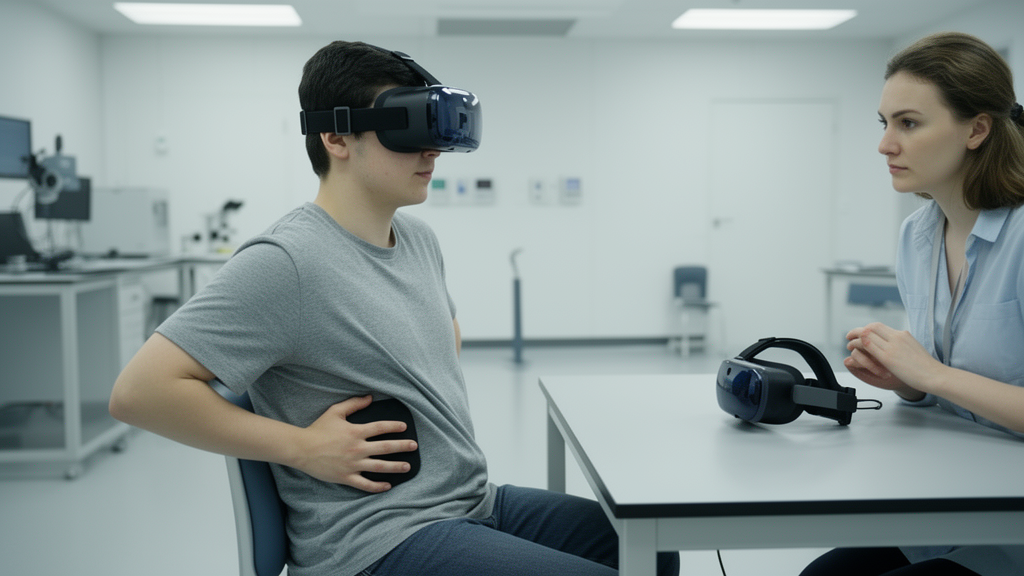
Hip pressure applied against the direction of a turn made scaled virtual rotations harder to detect in a controlled virtual-reality study of 12 adults. Participants performed stationary 90-degree turns while a pneumatic belt applied no stimulation, pressed in the same direction as the turn, or pressed against it. Contralateral pressure shifted the point of subjective equality, meaning the virtual gain judged equal to the physical turn, from a mean of 0.98 without stimulation to 1.04. It also raised the mean 25% detection threshold from 0.72 to 0.81. The findings provide initial evidence that a directional, nonvisual cue can influence rotation-gain perception, although they do not establish that hip pressure generally hides every kind of virtual rotation manipulation.
The system was based on the Hanger Reflex, an involuntary turning tendency elicited by lateral compression of soft tissue. The effect is classically associated with a wire coat hanger pressing against the front and sides of the head, but related responses can be produced around the waist and hips. The researchers built a lightweight belt with four inflatable chambers, one at the front and one at the rear of each hip. Inflating a diagonal pair generated a directional pseudo-force: pressure at the right-anterior and left-posterior hips elicited a leftward rotation tendency, while the mirrored pattern elicited a rightward tendency. Pumps, valves, electronics and power were carried in a backpack, leaving the belt soft and untethered and avoiding rigid contact with the stimulation sites.
The experiment used a within-subject design. Each of the 12 participants completed 324 trials, with 108 turns in each haptic condition. Every virtual turn covered 90 degrees on the yaw axis, while nine gain levels were sampled across the block. A gain of one preserved a one-to-one mapping between physical and virtual rotation; values above or below one scaled the virtual turn relative to the participant’s movement. After each stationary turn, the participant reported whether the virtual movement had felt smaller or greater than the physical movement. The researchers fitted psychometric functions to these responses, using the point of subjective equality, or PSE, to estimate the gain that felt equal to the reference rotation and 25% and 75% thresholds to characterize gain sensitivity. Left and right turns were balanced within each gain and condition, while the order of the three blocks was counterbalanced.
The clearest perceptual effect depended on the direction of stimulation. With ipsilateral stimulation, in which the hip pseudo-force aligned with the intended turn, the mean PSE was 0.93, compared with 0.98 in the unstimulated condition. Participants therefore often judged an underscaled virtual turn as equal to a larger physical rotation, a pattern consistent with the cue amplifying their sense of rotational movement. The mean 25% threshold was 0.64 with ipsilateral stimulation, 0.72 without stimulation and 0.81 with contralateral stimulation. The corresponding mean 75% thresholds were 1.22, 1.24 and 1.26. Parametric bootstrap comparisons found that the contralateral 25% threshold exceeded the ipsilateral value by 0.126, with a 95% confidence interval of 0.068 to 0.200, and the unstimulated value by 0.084, with a 95% confidence interval of 0.024 to 0.135.
PSE also separated the three conditions significantly. The contralateral PSE exceeded the ipsilateral PSE by 0.091, with a 95% confidence interval of 0.057 to 0.124, and the unstimulated PSE by 0.050, with a 95% confidence interval of 0.008 to 0.083. Conversely, the ipsilateral PSE was 0.041 below the unstimulated value, with a 95% confidence interval of −0.082 to −0.011. Evidence at the 75% threshold was narrower: it was 0.059 higher under contralateral stimulation than under ipsilateral stimulation, with a 95% confidence interval of 0.001 to 0.122, but did not differ significantly from the unstimulated condition. The contrast between stimulation directions was therefore clearer than the difference between ipsilateral stimulation and baseline.
The results do not fit a simple rule that any hip pressure makes rotation gains harder to notice. Pressure opposing the turn produced the highest PSE and 25% threshold and was significantly different from baseline on those measures. Pressure aligned with the turn produced the lowest PSE and tended to make virtual rotation feel larger than physical rotation. Its 25% threshold did not differ significantly from the no-stimulation condition, and the same was true of the 75% threshold. The authors therefore described their first hypothesis as only partially confirmed: the two stimulation directions clearly separated the psychometric functions, but the stronger and more consistent effect came from stimulation against the direction of the turn rather than from a uniform displacement relative to baseline.
Hip stimulation also altered the coordination between the head and pelvis. Head orientation was recorded by the head-mounted display, while a waist-mounted tracker supplied hip orientation. The researchers derived angular-speed traces from the two quaternion series and used cross-correlation to estimate the lag between their peak angular speeds. A positive delay meant that the head’s peak angular speed preceded the hip’s peak angular speed. Rotation gain itself had no significant effect on this measure, which remained between roughly 365 and 386 milliseconds across the tested gains. Haptic condition did affect it: the head-hip delay was longest with contralateral stimulation, intermediate without stimulation and shortest with ipsilateral stimulation. Contralateral stimulation added an average 67.6 milliseconds of delay relative to no stimulation and 145.4 milliseconds relative to ipsilateral stimulation.
The authors interpret this pattern as consistent with hip stimulation assisting or perturbing the ordered coordination of a turn. A pseudo-force aligned with the turn may help the pelvis realign with the leading head, while an opposing signal introduces a competing mechanical influence and delays the hip’s peak angular speed. The condition that most delayed head-hip timing also produced the highest perceptual thresholds and PSE, suggesting that altered coordination and reduced detection of the gain may be related. The experiment did not directly manipulate coordination or measure the proposed sensory pathway, however, so it establishes that the two outcomes changed together rather than demonstrating that delayed pelvic rotation caused the perceptual shift. The physiological mechanism of the Hanger Reflex itself also remains debated.
The pneumatic apparatus operated in open-loop mode. Its software controlled which chambers were inflated, when inflation began and how long the pumps ran, but it did not directly measure chamber pressure or contact force. On haptic trials, two diagonal chambers were activated at the start of the rotation, the pumps ran for one second, and the chambers remained inflated for the remainder of the turn before venting at trial end. Each chamber had an independent pneumatic channel comprising a pump and normally open solenoid valve. Although the nominal air volume per chamber was approximately 0.25 litres, the delivered volume could vary with belt tension, reservoir placement and the wearer’s anatomy. Stimulation points were adjusted for comfort rather than calibrated to each participant’s reflex strength or direction, a limitation because Hanger Reflex responses vary among individuals.
Cybersickness measures did not detect a significant difference among the haptic conditions. Simulator Sickness Questionnaire results showed no significant effect of haptic feedback on nausea, disorientation, oculomotor symptoms or total severity. Fast Motion Sickness Scale ratings also did not differ significantly among the conditions, although scores increased with exposure time within a block. With only 12 participants and substantial variation between people, the study was not designed to establish equivalence and cannot exclude smaller discomfort effects. The backpack-mounted hardware also created a comfort burden that the questionnaires did not capture. Explicit comfort and workload ratings, per-user pressure calibration and lighter equipment would be needed before the approach could be described as comfortable or ready for broader use.
The result remains a laboratory demonstration rather than a demonstrated improvement in practical redirected walking. Participants turned on the spot toward a virtual target using a fixed yaw gain; the study did not test natural walking, curved paths, translation gains, different turn amplitudes or changing gain profiles. Each haptic condition occupied a single block, so learning and prolonged exposure could not be assessed. Left and right trials were balanced but pooled after data collection, which limited the authors’ ability to test residual lateral asymmetries. The study also measured perception and body coordination rather than end-to-end navigation performance. Within those limits, it provides initial evidence that contralateral hip pressure can shift perceived rotation toward higher gains and raise the 25% detection threshold, while ipsilateral pressure can amplify the felt magnitude of rotation. Whether these laboratory effects translate into safer, more comfortable or more effective navigation in moving virtual environments remains an open question for future research.
Subject of Research: Directional hip Hanger Reflex stimulation as a nonvisual modulator of rotation-gain perception and head-pelvis coordination in stationary virtual-reality turns.
Article Title: “Hips don’t lie”: mitigating the perception of rotation gains using the hanger reflex in virtual reality
Article References: Brument, H., Epner, J., Gobl, V., & Kaufmann, H. (2026). “Hips don’t lie”: mitigating the perception of rotation gains using the hanger reflex in virtual reality. Frontiers in Virtual Reality, 7, 1934101. https://doi.org/10.3389/frvir.2026.1934101
Image Credits: AI Generated
DOI: 10.3389/frvir.2026.1934101
Keywords: virtual reality, Hanger Reflex, hip stimulation, rotation gains, haptic feedback, motion perception, redirection, head-pelvis coordination, wearable pneumatics, cybersickness, Hips, mitigating
Cite Scienmag News
Denise Maddox. (October 22, 2026). Contralateral Hip Pressure Masks VR Rotation Gains in Controlled Study. Scienmag. https://scienmag.com/contralateral-hip-pressure-masks-vr-rotation-gains-in-controlled-study/
Denise Maddox. "Contralateral Hip Pressure Masks VR Rotation Gains in Controlled Study." Scienmag, 22 October 2026, https://scienmag.com/contralateral-hip-pressure-masks-vr-rotation-gains-in-controlled-study/. Accessed 22 October 2026.
Denise Maddox. "Contralateral Hip Pressure Masks VR Rotation Gains in Controlled Study." Scienmag. October 22, 2026. https://scienmag.com/contralateral-hip-pressure-masks-vr-rotation-gains-in-controlled-study/


