


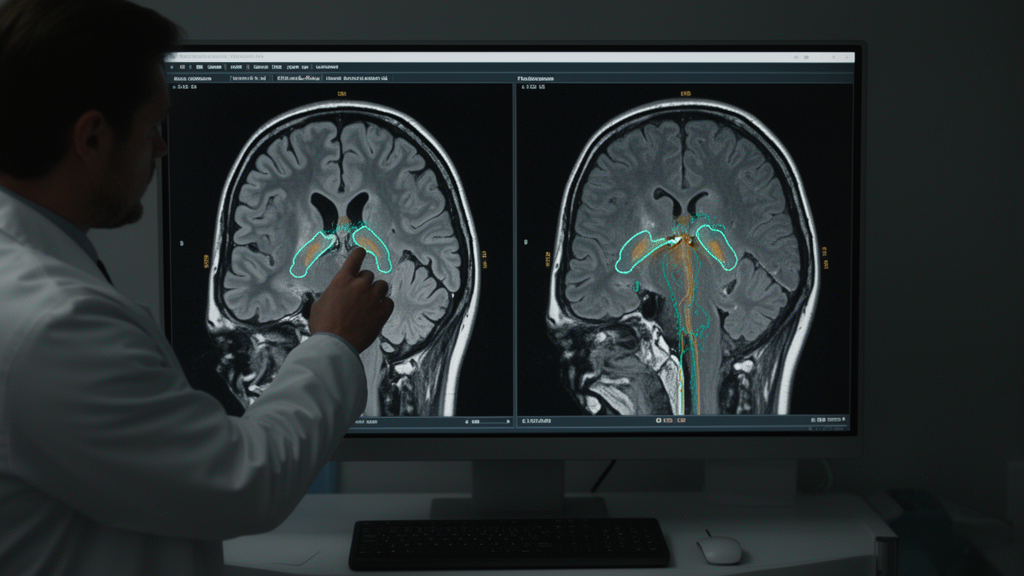
A systematic review and meta-analysis found that people with Parkinson’s disease had lower neuromelanin-sensitive MRI signals in the locus coeruleus than healthy comparison groups. The primary pooled analysis included 14 independent cohorts comprising 1,078 participants with Parkinson’s disease and 543 healthy controls. The standardized mean difference was Hedges’ g = −0.95 (95% confidence interval, CI, −1.32 to −0.57; P = 0.00011), indicating a group-level difference in the direction of lower signal in Parkinson’s disease. The authors emphasize that this pooled result does not establish the diagnostic accuracy of the measurement in individual patients.
The review used neuromelanin-sensitive magnetic resonance imaging, or NM-MRI, to assess locus coeruleus integrity in vivo. Because findings in Parkinson’s disease had varied across cohorts and methods, the researchers searched PubMed/MEDLINE, Embase, the Web of Science Core Collection and Scopus from their inception through 5 September 2026. They included 65 reports, of which 17 contributed data to at least one main pooled outcome. Independent Parkinson’s-versus-healthy-control comparisons were combined with random-effects models, rather than treating repeated reports from the same cohort as independent studies.
The average signal difference was not uniform across the included settings. Between-study heterogeneity for the primary signal analysis was substantial, with I² = 88.4%. The 95% prediction interval extended from −2.28 to 0.38 and crossed zero, showing that the true effect in a new setting could range from substantially lower signal to no difference under the analysis framework. The negative mean effect was preserved across sensitivity analyses, but every specification-level prediction interval crossed zero. The pooled estimate therefore supports an overall association between Parkinson’s disease and lower locus coeruleus signal while indicating that the magnitude of the difference varies across studies and protocols.
The volume analysis produced a lower-heterogeneity result. It included five independent cohorts with 215 participants with Parkinson’s disease and 134 healthy controls. Locus coeruleus volume was also lower in Parkinson’s disease, with Hedges’ g = −0.87 (95% CI, −1.13 to −0.62; P = 0.00071). Heterogeneity for this pooled outcome was 0%, indicating no detected between-study variation under the analysis used. The number of contributing cohorts was nevertheless smaller than for the signal analysis, and the consistency of a pooled group estimate does not by itself demonstrate that NM-MRI can reliably classify individual participants.
Beyond the main signal and volume outcomes, the review extracted 243 secondary-outcome records from 64 of the 65 reports. Of these, 102 records contained directly usable quantitative information. However, no additional outcome cluster simultaneously met the criteria for construct compatibility, cohort independence and numerical poolability. The result limits the extent to which other measurements can be combined across the available literature, and it means the meta-analysis focuses on the two outcomes for which compatible independent data were available.
Overall, the evidence indicates that NM-MRI detects differences in locus coeruleus signal and volume between groups of people with Parkinson’s disease and healthy controls. The signal finding has an average standardized effect of −0.95, but its high heterogeneity and prediction interval that includes zero limit claims that the same difference will be reproduced consistently in every setting. The volume estimate was also negative, with less observed heterogeneity, but it was based on fewer cohorts. Neither result establishes individual diagnostic accuracy, disease causation or a clinical testing performance.
The authors conclude that clinical translation will require harmonized acquisition, analysis and reporting, together with independent, multicentre and longitudinal validation. Those requirements are directed at the field rather than presented as proof that a diagnostic application is currently available. The review was registered with PROSPERO under identifier CRD420261498031. Taken together, its findings support neuromelanin-sensitive MRI as a source of measurable group-level differences in Parkinson’s disease, while preserving uncertainty about how consistently those differences will appear in individual patients or new research settings.
Subject of Research: Meta-analysis of locus coeruleus signal and volume measured with neuromelanin-sensitive MRI in Parkinson’s disease
Article Title: Locus coeruleus abnormalities on neuromelanin-sensitive MRI in Parkinson’s disease: a systematic review and meta-analysis
Article References: Zhao, J., Abuliezi, N., Wei, R., Sun, Y., Aikemu, A., Lei, J., Wu, Y., Tang, B., Guo, J., & Wu, Q. (2026). Locus coeruleus abnormalities on neuromelanin-sensitive MRI in Parkinson’s disease: a systematic review and meta-analysis. Journal of Neurology, 273(11), Article 680. https://doi.org/10.1007/s00415-026-14226-w
Image Credits: AI Generated
DOI: 10.1007/s00415-026-14226-w
Keywords: Parkinson’s disease, neuromelanin-sensitive MRI, locus coeruleus, systematic review, meta-analysis, brain imaging, Hedges’ g, prediction interval, diagnostic accuracy, cohort heterogeneity, Locus, coeruleus
Cite Scienmag News
Diana Fleming. (October 22, 2026). Parkinson’s MRI review finds lower locus coeruleus signal at group level. Scienmag. https://scienmag.com/parkinsons-mri-review-finds-lower-locus-coeruleus-signal-at-group-level/
Diana Fleming. "Parkinson’s MRI review finds lower locus coeruleus signal at group level." Scienmag, 22 October 2026, https://scienmag.com/parkinsons-mri-review-finds-lower-locus-coeruleus-signal-at-group-level/. Accessed 22 October 2026.
Diana Fleming. "Parkinson’s MRI review finds lower locus coeruleus signal at group level." Scienmag. October 22, 2026. https://scienmag.com/parkinsons-mri-review-finds-lower-locus-coeruleus-signal-at-group-level/


