


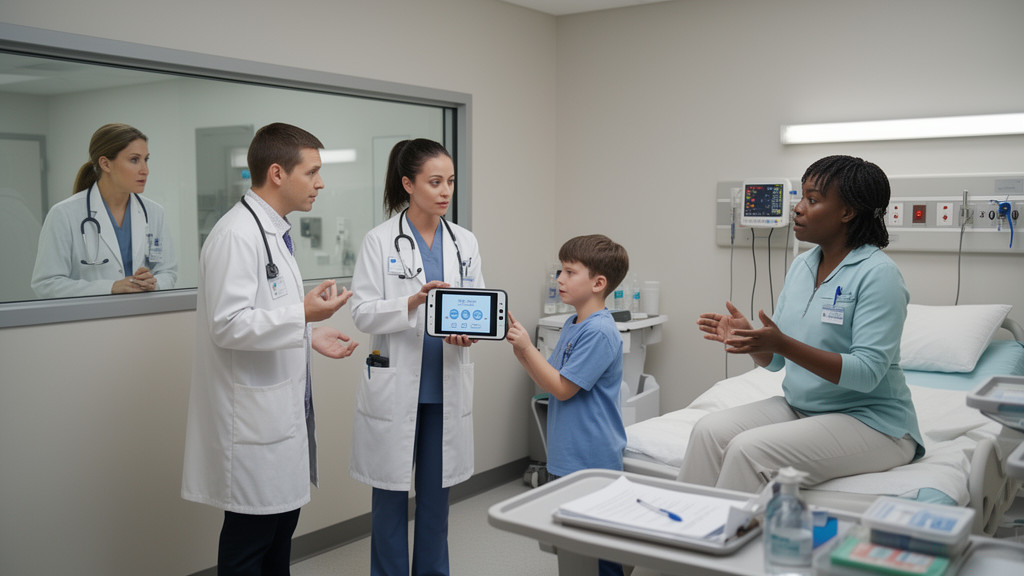
A hands-on program focused on medical devices used by medically complex children was associated with improved caregiver ratings of communication by pediatric residents in an educational study at Advocate Children’s Hospital in Illinois. The study assessed 253 caregiver surveys completed before and after the intervention and included a historical comparison group of 11 residents who had not received the training. On a five-point scale, the average communication score rose from 4.844 before training to 4.934 afterward.
Four of 14 evaluated communication categories showed statistically significant increases. Because the study used a pre-post design, voluntary participation and a small historical comparison rather than randomized assignment, it supports an association between the training and communication ratings but does not establish that the curriculum alone caused the changes. The research focused on first-year pediatric residents at the hospital’s Oak Lawn and Park Ridge campuses.
All 28 first-year residents at the two sites elected to participate. Researchers designed the curriculum around five types of medical devices commonly used by hospitalized children with complex medical needs: central lines, chest tubes, feeding devices, tracheostomies and cerebrospinal fluid shunts. Children with medical complexity often have multiple chronic conditions and may depend on medical equipment as part of everyday care, according to lead author Kelci Butler, D.O. These patients can account for up to half of children admitted to tertiary care hospitals, and pediatric residents may be among the first physicians responsible for their care.
The intervention consisted of five one-hour, in-person workshops that combined instruction with hands-on simulation. Physicians, advanced practice clinicians, nurses and respiratory therapists served as instructors. Sessions were conducted in small groups with no more than 10 residents per instructor, and residents learned from clinicians experienced in using the relevant devices.
The study examined both what residents learned from the technical training and how caregivers rated residents’ communication. The approach was intended to address a gap reported by residents who felt inadequately prepared to meet the needs of children whose care depends on medical technology, while giving them opportunities to develop clearer explanations and discussions with families. Communication was evaluated through a modified 14-item Communication Assessment Tool completed by caregivers.
Researchers contacted family members during the child’s hospitalization, and survey participation was voluntary. Caregivers assessed whether residents communicated in understandable terms, confirmed that families understood the information, encouraged questions, and discussed next steps and follow-up plans, along with other aspects of physician-family communication. The investigators considered direct caregiver feedback useful because it captured resident communication from the perspective of the people involved in the child’s care, a perspective that can be difficult to capture through traditional medical education assessments.
The mean score across the assessment increased modestly from 4.844 before the educational intervention to 4.934 afterward on the five-point scale. The increase in the overall average was accompanied by statistically significant gains in four specific categories: communicating in understandable terms, confirming that the family understood the information, encouraging questions, and discussing next steps and follow-up plans. These results concern caregiver-rated communication.
Residents who completed the curriculum were also compared with 11 earlier residents who had not received the training. The historical comparison showed significant gains in several communication areas among residents exposed to the device-focused program. This pattern was consistent with the possibility that intentional training contributed to communication improvements, rather than the changes reflecting only the additional experience residents gain during residency.
The comparison cannot fully resolve that question, however. Several additional features limit how broadly the results can be applied. The study was conducted at two campuses within one hospital system, every participating first-year resident chose to enroll, and the historical comparison was not a contemporaneously randomized control group.
The pre-post measurements also occurred within the broader experience of residency, so the design cannot completely separate training effects from other changes in resident performance. The tool measured caregivers’ perceptions of communication rather than independently verified clinical competence or patient outcomes. These constraints mean that the findings provide evidence of a promising association at one institution, not definitive proof of a general causal effect across hospitals, resident cohorts or patient populations.
The research team proposed several directions for subsequent evaluation, including testing the program at other hospitals and enrolling a larger sample. The investigators also suggested examining resident knowledge and communication for medically complex patients beyond the five device categories covered by the curriculum. Family involvement was central to how the program was evaluated rather than serving only as an optional supplement.
Butler said the family perspective is particularly important when caring for children with complex medical needs, and future educational approaches could provide more individualized caregiver feedback or involve caregivers as educators to help residents better understand the practical challenges families face. Ultimately, the study tested a focused educational intervention against caregiver-rated communication, not the full quality of care delivered to medically complex children. Its results suggest that hands-on device education may support several communication behaviors that caregivers value, including clearer explanations, confirmation of understanding, invitations to ask questions and discussion of what comes next.
Those measured findings are consistent with the value of involving families more directly in evaluating physician training. Whether the approach can be replicated elsewhere, whether larger studies will find similar results and whether any clinical benefits accompany the higher communication ratings remain questions for future research. The authors reported no relevant conflicts of interest or funding for the study.
Subject of Research: Evaluation of hands-on medical-device training and caregiver-rated communication by pediatric residents
Article Title: Hands-on training may help pediatric residents communicate better with families of medically complex children
Article References: Hands-on training may help pediatric residents communicate better with families of medically complex children. Original publication (Bibliographic details unavailable.)
Image Credits: AI Generated
DOI: Not provided
Keywords: pediatric residents, medical-device training, simulation education, family-centered care, caregiver feedback, physician communication, medically complex children, Hospital Pediatrics, Advocate Children’s Hospital, Hands-on, training, help
Cite Scienmag News
Harold Sullivan. (October 22, 2026). Device Training Linked to Better Pediatric Resident Communication Ratings. Scienmag. https://scienmag.com/device-training-linked-to-better-pediatric-resident-communication-ratings/
Harold Sullivan. "Device Training Linked to Better Pediatric Resident Communication Ratings." Scienmag, 22 October 2026, https://scienmag.com/device-training-linked-to-better-pediatric-resident-communication-ratings/. Accessed 22 October 2026.
Harold Sullivan. "Device Training Linked to Better Pediatric Resident Communication Ratings." Scienmag. October 22, 2026. https://scienmag.com/device-training-linked-to-better-pediatric-resident-communication-ratings/


