

Thursday, October 22, 2026
Science
No Result
View All Result
  • Login
  • HOME
  • SCIENCE NEWS
  • CONTACT US
  • HOME
  • SCIENCE NEWS
  • CONTACT US
No Result
View All Result
Scienmag
No Result
View All Result
Home Science News Earth Science

Satellite analysis reveals divergent phosphorus trends across 15,240 Canadian lakes

October 22, 2026
in Earth Science
Violet Maxwell
By Violet Maxwell Scienmag Editorial Profile - Natural Hazards
Reading Time: 2 mins read
0
Satellite analysis reveals divergent phosphorus trends across 15,240 Canadian lakes

Satellite analysis reveals divergent phosphorus trends across 15,240 Canadian lakes

65
SHARES
587
VIEWS
Share on FacebookShare on Twitter
ADVERTISEMENT

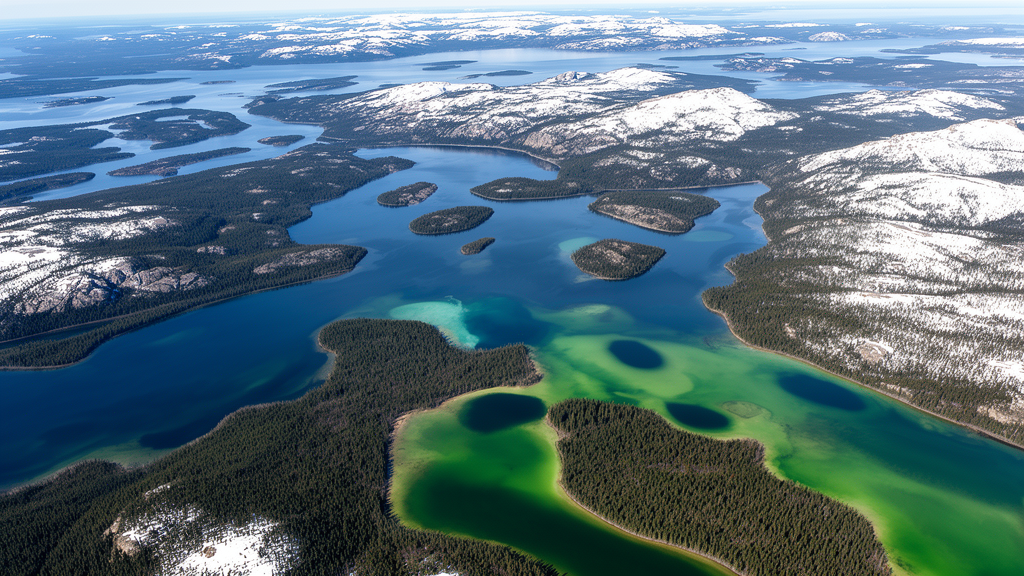
A continental analysis of 15,240 Canadian lakes larger than 5 km² found contrasting phosphorus trends between 1984 and 2025: concentrations increased in Arctic tundra watersheds but declined in boreal forest, temperate forest, agricultural and urban watersheds. The study used a deep neural network trained with 35,452 field measurements and applied to 386,727 Landsat images to reconstruct changes in lake-water total phosphorus across Canada. Arctic tundra lakes showed the strongest reported increase, at an estimated 0.15 micrograms per litre per year.

Estimated annual declines were 0.07 micrograms per litre in boreal forest watersheds, 0.11 in temperate forest watersheds, 0.16 in agricultural watersheds and 0.12 in urban watersheds. These estimates describe changes in concentration within each watershed category rather than comparisons of absolute phosphorus levels between regions. Path analyses associated the Arctic increases with ground warming and soil erosion, findings consistent with permafrost-related phosphorus mobilization.

The analysis did not directly quantify the contribution of every possible process, so it does not establish a single cause for the observed rise. It nevertheless identifies warming-associated changes in northern soils and catchments as relevant pathways in the reconstructed trends. In the boreal, temperate, agricultural and urban watersheds, declining phosphorus concentrations were associated with vegetation greening, hydrological change and reduced human phosphorus inputs.

Surface runoff remained an important influence in agricultural and urban systems. The study demonstrates how field observations and long-term satellite records can be combined to estimate subtle, continent-scale changes in remote lake systems. Its conclusions depend on the deep-neural-network reconstruction and statistical path analyses rather than direct measurements of phosphorus changes at every lake and year.

The reported results indicate that climate change may reinforce or counteract nutrient-management gains, making region-specific climate adaptation relevant to lake management.

Subject of Research: Regional lake phosphorus trends and climatic drivers across Canada

Article Title: Canadian lakes show contrasting phosphorus trends across climatic regions

Article References: Guo, H., Huang, J. J., Zhang, Y., Smol, J. P., Zhu, X., Jiang, L., Li, L., Lin, W., Zhang, H., & Wang, L. (2026). Canadian lakes show contrasting phosphorus trends across climatic regions. Communications Earth & Environment. https://doi.org/10.1038/s43247-026-04113-7

Image Credits: AI Generated

DOI: 10.1038/s43247-026-04113-7

Keywords: Canadian lakes, phosphorus, Arctic tundra, climate change, permafrost, water quality, Landsat, nutrient management, neural networks, watershed runoff, Canadian, lakes

Cite Scienmag News

Violet Maxwell. (October 22, 2026). Satellite analysis reveals divergent phosphorus trends across 15,240 Canadian lakes. Scienmag. https://scienmag.com/satellite-analysis-reveals-divergent-phosphorus-trends-across-15240-canadian-lakes/


Violet Maxwell. "Satellite analysis reveals divergent phosphorus trends across 15,240 Canadian lakes." Scienmag, 22 October 2026, https://scienmag.com/satellite-analysis-reveals-divergent-phosphorus-trends-across-15240-canadian-lakes/. Accessed 22 October 2026.

Violet Maxwell. "Satellite analysis reveals divergent phosphorus trends across 15,240 Canadian lakes." Scienmag. October 22, 2026. https://scienmag.com/satellite-analysis-reveals-divergent-phosphorus-trends-across-15240-canadian-lakes/

Tags: agricultural watershed nutrient changesArctic tundraArctic tundra phosphorus increaseboreal forest phosphorus declineCanadianCanadian lakesCanadian lakes phosphorus trend analysisclimate changeclimate change impact on lake nutrientsdeep neural network for environmental datalakesLandsatLandsat imagery for freshwater studiesneural networksnutrient managementPermafrostphosphorusremote sensing in freshwater ecosystem assessmentsatellite-based lake water quality monitoringsoil erosion and permafrost thaw effectsurban lakes phosphorus dynamicswater qualitywatershed runoffwatershed-specific phosphorus trends
Share26Tweet16
Previous Post

PBP4 Emerges as a Target for Resistant Staphylococcal Infections

Next Post

Review positions crosslinking as a multidimensional regulator of regenerative biomaterials

Related Posts

Six-Year Study Maps Reykjavik Ozone Monitor’s Regional Reach
Earth Science

Six-Year Study Maps Reykjavik Ozone Monitor’s Regional Reach

October 22, 2026
Human and social capital linked to lower provincial CO₂ emissions in Iran
Earth Science

Human and social capital linked to lower provincial CO₂ emissions in Iran

October 22, 2026
Washington field study links acidification, silicon loss and productivity decline
Earth Science

Washington field study links acidification, silicon loss and productivity decline

October 22, 2026
Research report: Editorial: Adaptive environmental policy for strengthening ecological resilience in socio-ecological systems
Earth Science

Research report: Editorial: Adaptive environmental policy for strengthening ecological resilience in socio-ecological systems

October 22, 2026
Fast avalanches may hit tall but not load tall
Climate

Fast avalanches may hit tall but not load tall

October 22, 2026
Flume study quantifies dam-break pressure on sloping wet beds
Earth Science

Flume study quantifies dam-break pressure on sloping wet beds

October 22, 2026
Next Post
Review positions crosslinking as a multidimensional regulator of regenerative biomaterials

Review positions crosslinking as a multidimensional regulator of regenerative biomaterials

  • Mothers who receive childcare support from maternal grandparents show more optimized

    Mothers who receive childcare support from maternal grandparents show more parental warmth, finds NTU Singapore study

    27656 shares
    Share 11059 Tweet 6912
  • University of Seville Breaks 120-Year-Old Mystery, Revises a Key Einstein Concept

    1061 shares
    Share 424 Tweet 265
  • Bee body mass, pathogens and local climate influence heat tolerance

    682 shares
    Share 273 Tweet 171
  • Researchers record first-ever images and data of a shark experiencing a boat strike

    546 shares
    Share 218 Tweet 137
  • Groundbreaking Clinical Trial Reveals Lubiprostone Enhances Kidney Function

    531 shares
    Share 212 Tweet 133
Science

Embark on a thrilling journey of discovery with Scienmag.com—your ultimate source for cutting-edge breakthroughs. Immerse yourself in a world where curiosity knows no limits and tomorrow’s possibilities become today’s reality!

RECENT NEWS

  • eDNA study maps microbial networks on Kraków urban stone
  • Legal mismatch hampers green corridors in China’s Gan River Basin
  • Review positions crosslinking as a multidimensional regulator of regenerative biomaterials
  • Satellite analysis reveals divergent phosphorus trends across 15,240 Canadian lakes

Categories

  • Agriculture
  • Anthropology
  • Archaeology
  • Athmospheric
  • Biology
  • Biotechnology
  • Blog
  • Bussines
  • Cancer
  • Chemistry
  • Climate
  • Earth Science
  • Editorial Policy
  • Marine
  • Mathematics
  • Medicine
  • Pediatry
  • Policy
  • Psychology & Psychiatry
  • Science Education
  • Science News
  • Social Science
  • Space
  • Technology and Engineering

Subscribe to Blog via Email

Enter your email address to subscribe to this blog and receive notifications of new posts by email.

Join 5,151 other subscribers

© 2025 Scienmag - Science Magazine

Welcome Back!

Login to your account below

Forgotten Password?

Retrieve your password

Please enter your username or email address to reset your password.

Log In
No Result
View All Result
  • HOME
  • SCIENCE NEWS
  • CONTACT US

© 2025 Scienmag - Science Magazine

Discover more from Science

Subscribe now to keep reading and get access to the full archive.

Continue reading