


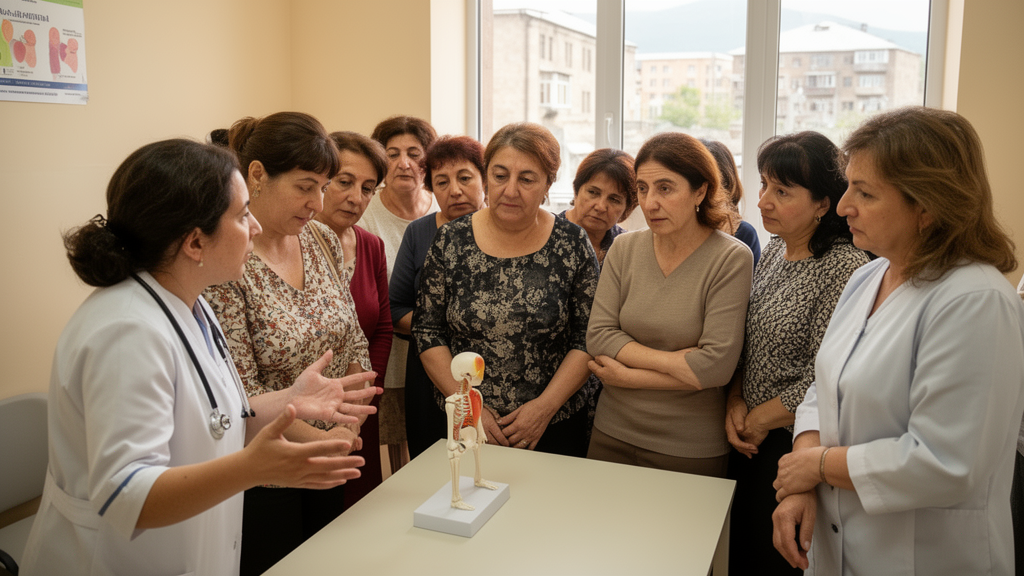
A cross-sectional study of 442 women aged 45–75 in Yerevan, Armenia, found that 76.9% had low osteoporosis knowledge even though 56.3% were classified as having moderate preventive practices. The results describe an association between knowledge and behavior rather than showing that greater knowledge caused women to adopt preventive practices. Researchers used convenience sampling to recruit women who had not previously received a diagnosis of osteoporosis.
Participants completed a structured questionnaire covering osteoporosis knowledge, physical activity, calcium intake, vitamin D intake and bone mineral density screening. The preventive practices were combined into a composite score from 0 to 5. In logistic regression analyses, knowledge and preventive practice were each divided into low and moderate-to-high categories.
Univariate models screened sociodemographic, lifestyle and medical predictors, while a multivariable model entered all candidate predictors simultaneously to identify factors independently associated with preventive practice. The questionnaire results revealed substantial differences among individual preventive practices. Adequate vitamin D intake was reported by 84.6% of participants, and 56.3% had moderate overall preventive-practice scores.
Adequate calcium intake was less common, reported by 39.1%. Bone mineral density screening had the lowest recorded coverage: 27.8% of the women said they had ever undergone it. These figures come from a convenience sample recruited in one city, so they should not be treated as population estimates for all postmenopausal women in Armenia.
Higher education was associated with moderate-to-high rather than low osteoporosis knowledge. In the reported model, women with higher education had 2.56 times the odds of being in the moderate-to-high knowledge category, with p = 0.008. Knowledge was also associated with preventive practice in the multivariable analysis: women with greater knowledge had 1.70 times the adjusted odds of moderate-to-high preventive practice, with p = 0.035.
Positive self-rated health was another independent correlate, corresponding to 2.15 times the adjusted odds of moderate-to-high preventive practice, with p = 0.017. These are adjusted associations and do not demonstrate that either education or knowledge produced the reported behaviors. The findings show that low measured knowledge coexisted with moderate overall preventive behavior, but the aggregate practice score also masks variation between practices.
Vitamin D intake was common, calcium intake was less widespread and prior bone mineral density screening was uncommon. The study was limited by its cross-sectional design, convenience sampling, single-city scope and reliance on questionnaire reports, and it excluded women previously diagnosed with osteoporosis. It also cannot establish whether educational initiatives would change knowledge, preventive behavior or fracture risk.
The authors concluded that targeted educational strategies are needed, while the reported results identify knowledge and self-rated health as factors statistically associated with engagement in preventive practice.
Subject of Research: Osteoporosis knowledge and preventive practices among women aged 45–75 in Yerevan
Article Title: Knowledge–behavior disparities in osteoporosis prevention among postmenopausal women: evidence from Armenia
Article References: Mkrtchyan, S. A., Mardiyan, M. A., Sakanyan, G. H., Dunamalyan, R. A., Babalyan, V. N., & Bilezikian, J. P. (2026). Knowledge–behavior disparities in osteoporosis prevention among postmenopausal women: evidence from Armenia. Archives of Osteoporosis, 21(1), 144. https://doi.org/10.1007/s11657-026-01795-6
Image Credits: AI Generated
DOI: 10.1007/s11657-026-01795-6
Keywords: osteoporosis, postmenopausal women, health knowledge, preventive behavior, bone density screening, calcium intake, vitamin D intake, physical activity, Armenia, cross-sectional study, Knowledge, behavior
Cite Scienmag News
Ophelia Keating. (October 22, 2026). Study links osteoporosis knowledge and preventive practices in Yerevan women. Scienmag. https://scienmag.com/study-links-osteoporosis-knowledge-and-preventive-practices-in-yerevan-women/
Ophelia Keating. "Study links osteoporosis knowledge and preventive practices in Yerevan women." Scienmag, 22 October 2026, https://scienmag.com/study-links-osteoporosis-knowledge-and-preventive-practices-in-yerevan-women/. Accessed 22 October 2026.
Ophelia Keating. "Study links osteoporosis knowledge and preventive practices in Yerevan women." Scienmag. October 22, 2026. https://scienmag.com/study-links-osteoporosis-knowledge-and-preventive-practices-in-yerevan-women/


