


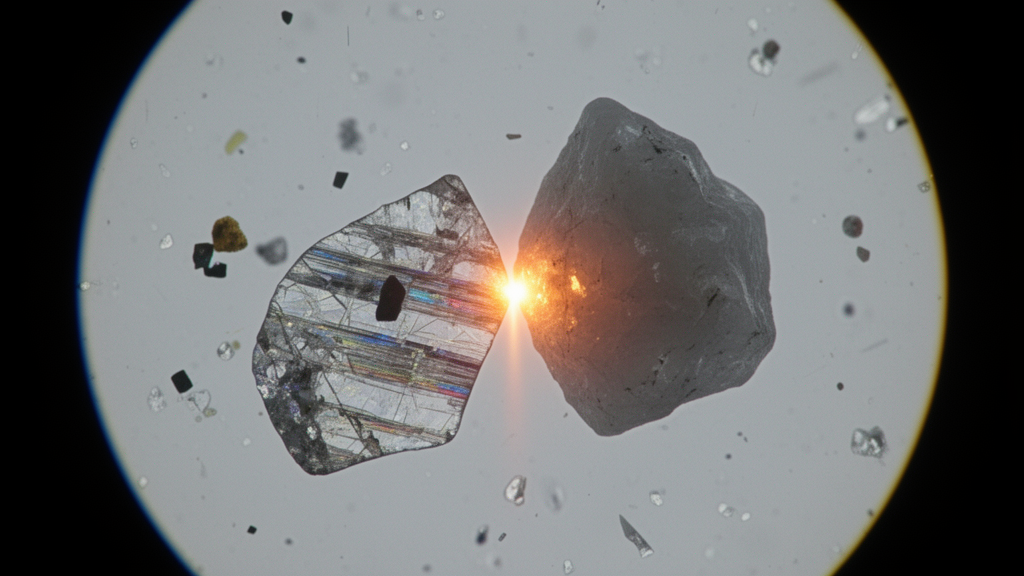
A laboratory study has shown that a single laser-ablation spot in mica or feldspar can yield coupled potassium–calcium and rubidium–strontium ages, providing two potentially different records of a mineral’s history. The method uses laser ablation inductively coupled plasma tandem mass spectrometry, or LA-ICP-MS/MS, to separate calcium and strontium from interfering argon, potassium and rubidium ions inside a reaction cell. Tests on seven previously characterized mineral samples produced typical age uncertainties of about 2% for the rubidium–strontium system and 5% for potassium–calcium dating. The paired dates can be compared at high spatial resolution, allowing researchers to investigate whether cooling, deformation or hydrothermal alteration affected the two isotope systems differently.
The approach can be faster and more spatially selective than conventional bulk-mineral dating, which requires chemical dissolution and column separation before measurement and may inadvertently include calcium- or strontium-bearing inclusions. In the new protocol, a laser samples a small area directly from a polished grain while reactive gases inside the mass spectrometer distinguish daughter elements from their parent isotopes. Potassium-40 decays in part to calcium-40, while rubidium-87 decays to strontium-87, but each parent and daughter pair occupies the same mass, making direct measurement difficult without chemical separation. Laser ablation coupled with tandem mass spectrometry can perform that separation in situ and can avoid much of the contamination associated with inclusions and bulk preparation.
The researchers compared four reaction-gas conditions: sulfur hexafluoride, or SF₆, alone; SF₆ with 2 millilitres per minute of hydrogen; nitrous oxide, or N₂O, with 7 millilitres per minute of hydrogen; and N₂O with 10 millilitres per minute of hydrogen. Calcium and strontium reacted with SF₆ to form fluoride products, whereas the N₂O mixtures mainly produced hydroxide products. Potassium and rubidium were non-reactive with these gases, allowing the parent and daughter isotope pairs to be distinguished. Product-ion scans identified calcium-19 fluoride, strontium-19 fluoride, calcium-17 hydroxide and strontium-17 hydroxide as the principal reaction products used in the measurements.
The experiments were conducted at Adelaide Microscopy, Adelaide University, with a 193-nanometre excimer laser coupled to an Agilent 8900x ICP-MS/MS. The laser used 100-micrometre spots at a repetition rate of five per second. A particularly difficult measurement was mass 40, where abundant argon-40 produced by the argon-fed plasma overwhelmed the incoming ion load and created a substantial background for the target calcium-40 reaction product. Adding hydrogen promoted charge transfer that neutralised argon ions, and no argon reaction products were detected under the tested conditions. Hydrogen also reduced reaction-cell backgrounds, particularly when paired with N₂O.
Among the four combinations, SF₆ with 2 millilitres per minute H₂ produced the highest sensitivity for reacted calcium and the best signal-to-background performance. Increasing the SF₆ flow from 0.38 millilitres per minute caused calcium sensitivity to reach a plateau at 0.57 millilitres per minute when H₂ was present and at 0.77 millilitres per minute without H₂; still higher flows attenuated the signal through increased collisions in the reaction cell. Adding H₂ to SF₆ increased the calcium signal-to-background ratio from 3650 to 5770 in the optimisation test. With N₂O, sensitivity and background both declined as hydrogen flow increased, although the highest signal-to-background ratio was obtained with 10 millilitres per minute H₂. The 7-millilitre-per-minute mixture was retained for mineral comparisons as a compromise between background suppression and signal strength.
Accuracy was evaluated with MDC and Kola phlogopites, Robins Folly and Högsbo muscovites, G17560 polylithionite, and FK-N and Bohus potassium feldspars whose ages had been constrained by previous work. Robins Folly and Högsbo muscovite produced potassium–calcium and rubidium–strontium dates consistent with their reference ages within uncertainty under the suitable gas conditions, indicating that the choice between the fluoride- and hydroxide-based reaction schemes had little effect on accuracy. Bohus feldspar also yielded concordant results: 921 ± 35 million years for rubidium–strontium and 924 ± 66 million years for potassium–calcium with SF₆–H₂. Both agreed with the independently regarded zircon uranium–lead crystallization age of 920 ± 5 million years, although the coupled isotope dates carried larger uncertainties.
Very low-calcium micas exposed a remaining weakness. Kola phlogopite and G17560 polylithionite contained less than 5 ppm common calcium, and their potassium–calcium dates were less reproducible between analytical sessions than their rubidium–strontium dates. When the polylithionite was calibrated against Kola rather than the standard MDC phlogopite, the results became consistent within uncertainty for all four gas combinations, suggesting that the calcium concentration of the correction material should closely match that of the samples. Common calcium can overwhelm the small quantity of radiogenic calcium-40, while contamination from surface particles, previous ablations or mineral inclusions can make the calculated age spuriously young. The study therefore used distilled-water cleaning, five to ten pre-ablation shots and careful selection of stable signal intervals.
The clearest geological payoff appeared in FK-N potassium feldspar, a trace-element reference material from Tamil Nadu Province in India. With SF₆ and H₂, its rubidium–strontium date was 515 ± 22 million years, consistent with the crystallization age of the regional granite, whereas its potassium–calcium date was substantially younger at 437 ± 38 million years. The authors interpret the older result as preserving the granite’s crystallization age and the younger result as recording later hydrothermal activity. This interpretation is based on the sample’s geological context and the two measured dates, rather than a direct observation of the altering fluid or event. The result nevertheless demonstrates how paired isotope systems can expose mineral-scale resetting or alteration that one clock alone might obscure.
Several technical limits remain. The potassium–calcium method depends on the assumed age of the matrix-matched MDC phlogopite, whose potassium–calcium age has not been independently validated; the present accuracy of approximately 2–3% is therefore weaker than the method’s aspirational 1–2% range. Calcium-bearing feldspars present another challenge. In FK-N, only about 1–5% of the measured calcium-40 was radiogenic, and feldspars with more common calcium would be harder to date within 5% precision on a quadrupole instrument. A multiple-collector ICP-MS/MS could improve the precision of calcium-44-to-calcium-40 measurements, but simultaneous measurement of both dating systems is currently possible only with the quadrupole configuration used in this study.
SF₆–H₂ also creates constraints for simultaneous trace-element analysis. Breakdown products formed inside the reaction cell elevated backgrounds for vanadium-51, chromium-52 and chromium-53, yttrium-89, and zirconium-90 and zirconium-91, and these interferences cannot be removed by changing the measurement window. The experiments nevertheless demonstrate that simultaneous potassium–calcium and rubidium–strontium dating is feasible from the same ablation volume in minerals containing roughly 5–300 ppm calcium. Because the initial strontium isotope ratio can be uncertain, whereas the initial calcium-44-to-calcium-40 ratio is effectively invariant within the method’s measurement uncertainty, the approach may also support anchored two-point isochrons and possible applications to detrital minerals. Its broader value lies in directly revealing when two geological clocks recorded in the same grain diverge, potentially sharpening reconstructions of cooling, hydrothermal alteration and the different conditions under which calcium and strontium can be reset.
Subject of Research: Optimizing reaction gases for coupled potassium–calcium and rubidium–strontium dating of mica and feldspar
Article Title: Coupled K–Ca and Rb–Sr dating by LA-ICP-MS/MS – reaction gas optimisation and geological applications
Article References: Gilbert, S. E., Glorie, S., & Lloyd, J. C. (2026). Coupled K–Ca and Rb–Sr dating by LA-ICP-MS/MS – reaction gas optimisation and geological applications. Geochronology, 8(4), 661-678. https://doi.org/10.5194/gchron-8-661-2026
Image Credits: AI Generated
DOI: 10.5194/gchron-8-661-2026
Keywords: LA-ICP-MS/MS, potassium–calcium dating, rubidium–strontium dating, laser ablation, reaction gases, mica geochronology, feldspar geochronology, mineral alteration, isotope analysis, geochronology, Coupled, dating
Cite Scienmag News
Violet Maxwell. (October 22, 2026). One Laser Spot, Two Geological Clocks in Mica and Feldspar. Scienmag. https://scienmag.com/one-laser-spot-two-geological-clocks-in-mica-and-feldspar/
Violet Maxwell. "One Laser Spot, Two Geological Clocks in Mica and Feldspar." Scienmag, 22 October 2026, https://scienmag.com/one-laser-spot-two-geological-clocks-in-mica-and-feldspar/. Accessed 22 October 2026.
Violet Maxwell. "One Laser Spot, Two Geological Clocks in Mica and Feldspar." Scienmag. October 22, 2026. https://scienmag.com/one-laser-spot-two-geological-clocks-in-mica-and-feldspar/


