


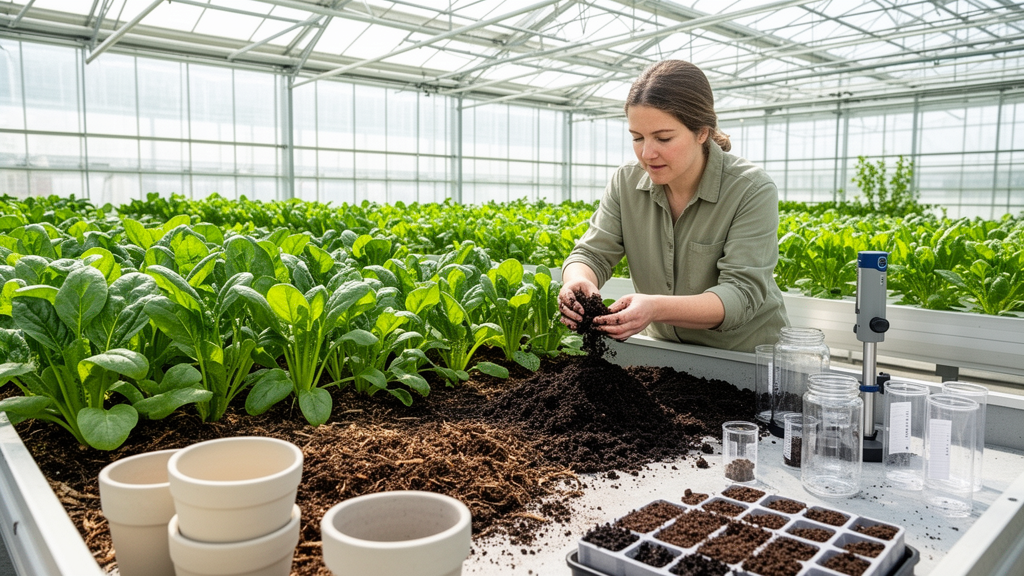
A 50-day greenhouse experiment found that biologically treated domestic wastewater meeting irrigation-water criteria produced measurable changes in the chemistry and bacterial communities of soil planted with spinach. The researchers compared four treatment levels: grit sedimentation alone, grit sedimentation followed by ultrafiltration, and two treatment trains that added anaerobic or aerobic activated-sludge treatment before ultrafiltration. Only the two effluents combining biological treatment with ultrafiltration satisfied all the wastewater-quality requirements examined against the Chinese standard for irrigation of cooked and peeled vegetables. Their use generally increased soil organic carbon and electrical conductivity, lowered pH and supported greater bacterial diversity, with the magnitude of these responses varying by treatment level.
The researchers collected raw domestic wastewater from the grit chamber of a municipal wastewater treatment plant and processed it through the four experimental treatment trains. The initial wastewater contained 450 ± 37 mg/L chemical oxygen demand, 40 ± 5 mg/L ammonium nitrogen, 55 ± 15 mg/L total nitrogen and 5.5 ± 1.0 mg/L total phosphorus. TWW1 consisted of wastewater after grit sedimentation. TWW2 underwent additional ultrafiltration through a flat-sheet membrane with a nominal pore size of 0.45 μm. TWW3 received four hours of anaerobic activated-sludge treatment before ultrafiltration, while TWW4 received two hours of aerobic activated-sludge treatment before the membrane step. The anaerobic reactor operated at a dissolved-oxygen concentration below 0.2 mg/L, whereas the aerobic reactor was maintained above 2 mg/L. Mixed-liquor suspended solids in both biological reactors were initially adjusted to approximately 3,500 mg/L.
Treatment level strongly affected whether the effluents met the cited irrigation criteria. TWW1 and TWW2 retained chemical oxygen demand concentrations of approximately 160–195 mg/L, above the cited limit of 100 mg/L for irrigation of cooked and peeled vegetables. TWW1 also failed the fecal-coliform criterion of 2 × 10⁴ most probable number per litre. No fecal coliforms were detected after ultrafiltration in TWW2, TWW3 or TWW4, indicating effective removal of the tested indicator organisms by the membrane. Physical filtration alone, however, did not reduce the wastewater’s organic load sufficiently for TWW2 to meet the chemical oxygen demand standard. The activated-sludge systems lowered chemical oxygen demand to acceptable levels, and TWW3 and TWW4 consequently met the chemical oxygen demand, fecal-coliform, total-salt and pH requirements evaluated by the researchers.
The experiment used soil collected from the upper 15 centimetres beneath a tree on a campus. After vegetation, litter, roots and other debris were removed, the soil was air-dried and passed through a 5-mm sieve. Its texture was 90.3% sand, 5.7% silt and 3.9% clay. Before irrigation, its pH was 6.17 ± 0.05, its organic-carbon content was 0.37 ± 0.04% and its electrical conductivity was 34.5 ± 1.1 μS/cm. Fifteen plastic pots were filled with 22 kg of soil each, and 15 spinach seeds were planted at a depth of approximately 2 cm in every pot. Each pot received 100 mL of water once daily for 50 days. Four wastewater treatments, a tap-water treatment and a non-irrigated treatment were each represented by three pots, with all results reported as mean ± standard deviation for three replicates.
All four wastewater treatments lowered soil pH relative to the non-irrigated control. Final pH was 5.64 under TWW1, 5.59 under TWW2, 5.70 under TWW3 and 5.81 under TWW4, compared with 6.17 in non-irrigated soil and 6.27 after tap-water irrigation. The researchers associated this acidification primarily with microbial nitrification of ammonium introduced by the wastewater, which releases hydrogen ions. TWW1 and TWW2 contained more ammonium than the biologically treated effluents and were associated with larger pH reductions. Wastewater irrigation also increased soil electrical conductivity because the effluents contained more dissolved ions than tap water. The highest value was 677.2 ± 10.4 μS/cm under TWW1, followed by 496.7 ± 9.6 μS/cm under TWW2. TWW3 and TWW4 produced lower values of 369.8 ± 8.7 and 333.0 ± 7.4 μS/cm, respectively, a difference attributed in part to adsorption and removal of some ions by activated sludge.
Spinach seed germination increased under every wastewater treatment relative to the non-irrigated control, and TWW3 had the highest germination rate among the wastewater treatments. The researchers proposed that moisture and the nitrogen, phosphorus and organic matter supplied by the effluents may have supported early seedling establishment. Wastewater irrigation also increased measured soil organic-carbon content, while tap-water irrigation decreased it relative to the non-irrigated soil. These observations concern germination and soil properties rather than agricultural productivity: the investigators did not measure above-ground biomass, harvest yield, heavy-metal accumulation in edible leaves or pathogen contamination of produce. The closed pots also had no leachate collection, a design that may have increased salt accumulation relative to an open field, where rainfall or additional irrigation could leach some ions away. The soil’s unusually high sand content and low buffering capacity further limit extrapolation beyond the tested conditions.
Sequencing of bacterial 16S ribosomal RNA genes revealed substantial differences between the microbial communities of wastewater-irrigated soil and the controls. Actinobacteriota, Proteobacteria and Acidobacteriota were the dominant phyla across the samples, but their relative proportions changed after irrigation. Proteobacteria and Acidobacteriota were generally more abundant in wastewater-treated soil, whereas Actinobacteriota tended to decline. Alphaproteobacteria and Gammaproteobacteria increased within Proteobacteria, while Vicinamibacteria, Acidobacteriae and Blastocatellia expanded within Acidobacteriota. The study associated these groups with nitrogen transformations and the decomposition of complex organic compounds, respectively. At the genus level, wastewater irrigation was associated with increased relative abundances of Nitrosomonadaceae, Rhizobiales, Nitrospira and Nitrosospira, together with newly detected Luteimonas, Sphingopyxis, Rhodobacter and members of Comamonadaceae.
Bacterial diversity was greatest in soil irrigated with the least-treated wastewater, TWW1, and then decreased in order through TWW2, TWW3 and TWW4. Even so, all four wastewater treatments exceeded the tap-water and non-irrigated controls for observed operational taxonomic units, Chao richness and the Shannon index. In the principal component analysis, the first two components explained 26.5% and 20.7% of the total variance. The four wastewater communities clustered relatively closely together and were clearly separated from the controls, indicating that irrigation with reclaimed wastewater had a stronger association with community structure than the precise treatment level. Of 3,258 detected operational taxonomic units across the samples, 1,202 were shared among all groups, representing 36.89% of the total.
Correlations between bacterial genera and soil properties reinforced the observed community patterns without establishing causation. RB41, an unclassified Vicinamibacterales group and an unclassified Vicinamibacteraceae group were positively correlated with electrical conductivity, with coefficients of 0.97, 0.82 and 0.86, respectively, and negatively correlated with pH. Bacillus, Solirubrobacter, several named or unclassified groups and Streptomyces instead showed positive correlations with pH and negative correlations with electrical conductivity. Sphingomonas and Intrasporangium were positively correlated with soil organic carbon, at 0.98 and 0.93. These are statistical associations within the small pot experiment, not direct evidence that changes in pH, salinity or carbon caused particular taxa to increase. Similarly, enrichment of nitrifying and denitrifying groups is a taxonomic inference from amplicon sequencing rather than a measurement of nitrogen-transformation rates or enzyme activity.
Among the four systems, TWW3—grit sedimentation, anaerobic activated-sludge treatment and ultrafiltration—showed the study’s most balanced overall performance. Like TWW4, it met the irrigation-water requirements evaluated, but it retained more nitrogen and phosphorus and produced lower soil electrical conductivity. It also generated the greatest soil organic-carbon accumulation and the highest seed-germination rate among the wastewater treatments, while TWW4 caused the smallest pH decline. The authors noted that anaerobic treatment could offer agronomic and energy-related advantages when nutrient retention and reduced aeration are priorities, but emphasized that their comparison was qualitative rather than a formal weighted decision analysis. TWW1 was unsuitable under the tested standard because of excessive chemical oxygen demand and fecal coliforms, while TWW2 removed the tested microbial indicator but remained above the organic-load limit. Because the experiment lasted only 50 days, used one highly sandy soil in closed pots and did not assess crop yield or produce contaminants, the findings identify promising treatment combinations but do not establish field-scale agricultural safety or productivity.
Subject of Research: Effects of four wastewater treatment levels on spinach soil chemistry and bacterial communities
Article Title: Responses of soil characteristics and bacterial communities to agricultural irrigation with different treatment levels of wastewater
Article References: Cai, L. (2026). Responses of soil characteristics and bacterial communities to agricultural irrigation with different treatment levels of wastewater. Discover Soil, 3(1), Article 192. https://doi.org/10.1007/s44378-026-00352-4
Image Credits: AI Generated
DOI: 10.1007/s44378-026-00352-4
Keywords: treated wastewater, agricultural irrigation, soil chemistry, bacterial communities, activated sludge, ultrafiltration, spinach, greenhouse experiment, 16S rRNA sequencing, soil salinity, Responses, soil
Cite Scienmag News
Bethany Barker. (October 22, 2026). Treated Wastewater Alters Spinach Soil Chemistry and Microbes in Greenhouse Study. Scienmag. https://scienmag.com/treated-wastewater-alters-spinach-soil-chemistry-and-microbes-in-greenhouse-study/
Bethany Barker. "Treated Wastewater Alters Spinach Soil Chemistry and Microbes in Greenhouse Study." Scienmag, 22 October 2026, https://scienmag.com/treated-wastewater-alters-spinach-soil-chemistry-and-microbes-in-greenhouse-study/. Accessed 22 October 2026.
Bethany Barker. "Treated Wastewater Alters Spinach Soil Chemistry and Microbes in Greenhouse Study." Scienmag. October 22, 2026. https://scienmag.com/treated-wastewater-alters-spinach-soil-chemistry-and-microbes-in-greenhouse-study/


