


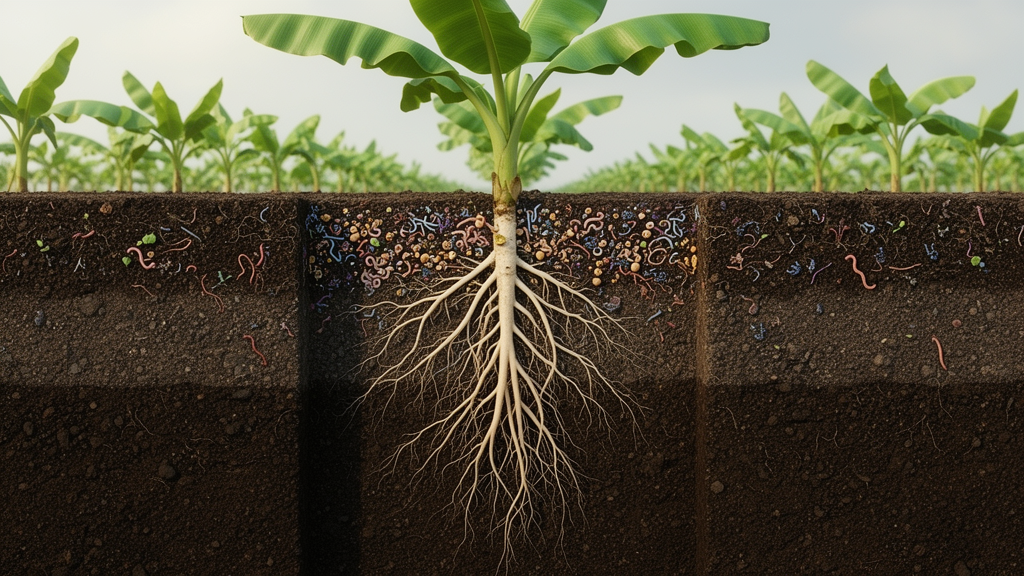
A resistant banana line derived from the Baodao cultivar showed progressively less Fusarium wilt disease across three years of continuous cropping in a study combining rhizosphere microbiome and metabolome analyses. As cropping duration increased from one to three years, the abundance of the fungal pathogen Fusarium oxysporum decreased significantly, while overall microbial abundance increased and plant growth appeared healthier than in a susceptible variety. The observations link prolonged cultivation with a shift in the soil community and chemical profile, but they do not establish that any particular organism or compound caused the reduction in disease.
The researchers compared the susceptible banana variety, designated V, with samples from the resistant line after one, two and three years of continuous cropping, designated S1, S2 and S3. Susceptible plants had lower overall microbial-community abundance than the resistant line at each sampling point. Within the resistant samples, microbial abundance rose with cropping duration, whereas Fusarium oxysporum abundance declined significantly.
The susceptible variety had the highest relative abundance of Fusarium , Bisifusarium , Gibellulopsis and Rectifusarium . Its supported conclusion is that lower disease incidence and reduced pathogen abundance occurred alongside broader changes in the resistant line’s rhizosphere community over successive cropping years. Several organisms were prominent in resistant samples from the later cropping durations.
Rozellomycota sp., Trichoderma virens , Trichoderma asperellum and an unidentified Hypocreaceae species were found at high abundance in S2 and S3 but were not detected in the susceptible variety. Spearman correlation analysis and network analysis using a threshold of absolute correlation greater than 0.6 associated the reduction of Fusarium pathogens with enrichment of potentially beneficial bacteria, including Sphingomonas parvus and Rozellomycota sp. These statistical relationships indicate that the organisms tended to occur together under the sampled conditions; they do not demonstrate that any one organism directly suppressed Fusarium oxysporum . The resistant samples also displayed visually healthier growth than the susceptible variety, accompanying the microbial changes rather than serving as a controlled test of their individual effects.
The metabolomic analysis detected 1,153 compounds in banana rhizosphere soil, including amino acids, phenolic acids, organic acids and flavonols. Seventy-nine compounds decreased significantly in the susceptible variety but increased in S1, S2 and S3. These compounds were negatively correlated with Fusarium oxysporum and positively correlated with Rozellomycota sp. Another set of 47 compounds was associated with Sphingomonas parvus , Bryobacter and other beneficial bacteria.
The combined findings suggest that longer continuous cropping in the resistant line is associated with the enrichment of selected fungi and bacteria and with coordinated accumulation of metabolites that covary with lower pathogen abundance. However, the study design cannot determine whether resistance shaped the rhizosphere, the altered rhizosphere reinforced resistance, or the two processes developed together. Its results identify associations and candidate biological and chemical correlates of Fusarium wilt resistance in the tested banana line; they do not establish a field intervention, biological-control formulation or agricultural recommendation.
Subject of Research: Rhizosphere microbiome and metabolome changes associated with Fusarium wilt resistance in banana under continuous cropping
Article Title: Integrated microbiome and metabolome analysis reveals mechanisms of Fusarium wilt resistance in banana rhizosphere soil under different continuous cropping durations
Article References: Zhao, M., Mo, T., Huang, X., He, H., Long, F., Wu, P., & Zou, Y. (2026). Integrated microbiome and metabolome analysis reveals mechanisms of Fusarium wilt resistance in banana rhizosphere soil under different continuous cropping durations. Frontiers in Microbiology, 17, Article 1853743. https://doi.org/10.3389/fmicb.2026.1853743
Image Credits: AI Generated
DOI: 10.3389/fmicb.2026.1853743
Keywords: banana, Fusarium wilt, Fusarium oxysporum, plant disease resistance, rhizosphere microbiome, soil metabolome, continuous cropping, plant pathology, Trichoderma, beneficial bacteria, Integrated, microbiome
Cite Scienmag News
Morgan Morrow. (October 22, 2026). Resistant banana rhizosphere shifts with longer continuous cropping. Scienmag. https://scienmag.com/resistant-banana-rhizosphere-shifts-with-longer-continuous-cropping/
Morgan Morrow. "Resistant banana rhizosphere shifts with longer continuous cropping." Scienmag, 22 October 2026, https://scienmag.com/resistant-banana-rhizosphere-shifts-with-longer-continuous-cropping/. Accessed 22 October 2026.
Morgan Morrow. "Resistant banana rhizosphere shifts with longer continuous cropping." Scienmag. October 22, 2026. https://scienmag.com/resistant-banana-rhizosphere-shifts-with-longer-continuous-cropping/


