


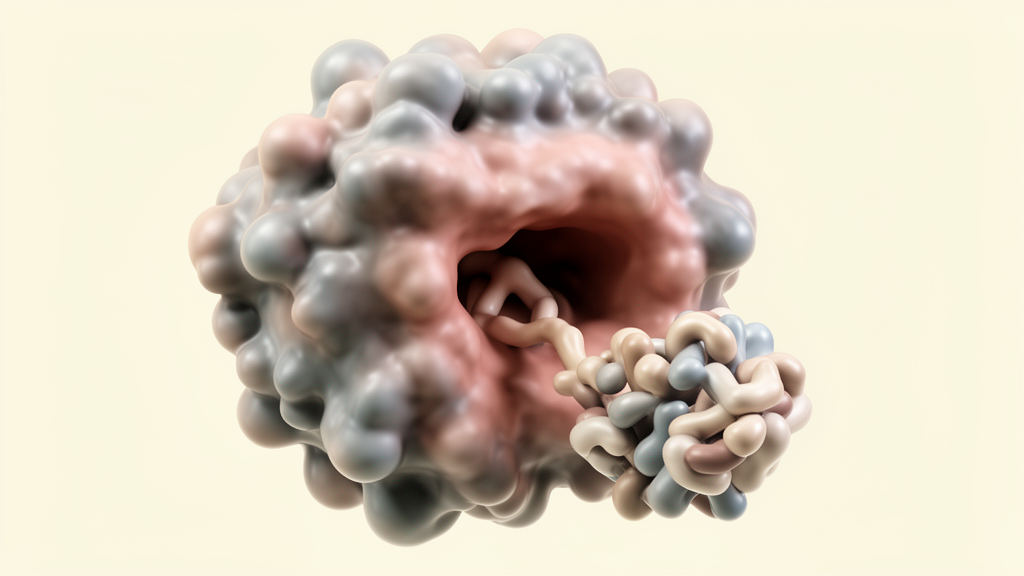
The assembled spike of Andes virus uses four glycoproteins to form a deep central pocket that captures protocadherin-1, according to a structural and functional study of hantavirus receptor recognition. Cryo-electron microscopy showed at near-atomic resolution that the membrane-distal extracellular cadherin domain of human protocadherin-1, or PCDH1, inserts asymmetrically into a cavity created by four Gn glycoproteins in the viral spike. The structure explains why PCDH1 can bind assembled viral particles and soluble spike tetramers but not isolated glycoproteins, and it identifies the molecular features that allow New World hantaviruses to recognize the receptor.
The study also found that four human neutralizing antibodies block PCDH1 engagement through two distinct mechanisms: direct occlusion of the pocket and steric interference from antibody constant regions. Its envelope contains a spike complex made from the glycoprotein Gn, which forms the receptor-binding head, and Gc, the fusion protein. For the principal structural experiment, the investigators expressed a soluble, tetrameric Andes virus spike together with the extracellular EC1–EC4 region of human PCDH1.
The resulting cryo-electron microscopy structure placed one PCDH1 EC1 domain inside a central cavity formed by four Gn molecules. Contacts through the receptor’s BC and FG loops anchored PCDH1 within the pocket, while the geometry of the assembled spike determined whether the receptor could be engaged. That quaternary architecture makes hantavirus receptor recognition dependent on the organization of multiple viral proteins rather than a single linear binding site.
An isolated Gn glycoprotein does not reproduce the surface created when four Gn subunits converge around the spike axis. The findings therefore provide a structural explanation for the observed preference of PCDH1 for intact viral particles or soluble spike tetramers over soluble glycoproteins. The pocket can be compared with receptor-binding sites in alphaviruses that likewise arise only after glycoprotein assembly.
The molecular arrangements are different, however: the EC1 domain of protocadherin-10 binds the western equine encephalitis virus spike laterally through its A, G, F and C beta strands, whereas PCDH1 enters the hantavirus pocket axially through BC and FG loops. The comparison shows that related non-clustered delta-cadherin receptors can use distinctly shaped surfaces on enveloped-virus glycoproteins. The receptor’s own organization adds another layer to the interaction.
PCDH1 is a calcium-dependent cell-cell adhesion protein whose soluble ectodomain fragments can exist in a monomer–dimer equilibrium. Previous structural work showed that PCDH1 can form antiparallel homodimers through an EC1–EC4 interface, but the oligomeric distribution of full-length PCDH1 at the plasma membrane has not been established. The receptor configuration captured in the Andes virus complex is incompatible with that stable antiparallel arrangement because the EC4 domain would not fit into the viral cavity.
Recombinant PCDH1 mutants engineered to remain monomeric did not reduce binding to a recombinant vesicular stomatitis virus displaying the Andes virus spike, whereas stabilizing PCDH1 dimers increased binding. Together, these observations suggest that Andes virus primarily engages monomeric PCDH1 at the cell surface, while transiently exposed EC1 domains on dynamic receptors might also contribute. Mutagenesis and sequence analysis identified three Gn loops—the AB, CD and DE loops—that help shape the PCDH1-binding surface.
Deep mutational scanning of the Andes virus Gn ectodomain found that substitutions in the CD and AB loops can alter affinity for PCDH1. The CD loop was particularly flexible, variable and tolerant of multiple mutations, making it a plausible point of variation during adaptation. The four-subunit pocket could also permit a limited number of amino acid substitutions, distributed among its component Gn molecules, to influence receptor recognition.
These are observations from laboratory mutagenesis and viral systems; they do not establish a particular evolutionary pathway in circulating hantaviruses or show that any specific population has acquired a new receptor. Loop-transfer experiments tested whether receptor specificity could be shifted between New World and Old World hantavirus glycoproteins. In recombinant vesicular stomatitis viruses carrying different hantavirus Gn–Gc combinations, transferring the Andes virus CD loop into the corresponding glycoprotein of Sin Nombre virus or hantavirus Taira virus enabled substantial PCDH1 recognition.
Constructs carrying all three receptor-interacting loops produced a similar result, while the CD loop alone was sufficient in the tested systems. The result identifies sequence variation in Gn as a major determinant of PCDH1 recognition. It does not show that either Old World virus naturally binds PCDH1 or that one has begun evolving toward that behavior.
Structural and functional analysis of four human neutralizing antibodies demonstrated that the recessed pocket can be blocked in more than one way. ANDV-5 and MIB22 recognized epitopes adjacent to, but outside, the central cavity and directly occluded access to PCDH1. ADI-65534 and ANDV-34 did not directly compete with the receptor.
Instead, their antibody constant regions sterically interfered with receptor engagement, allowing them to neutralize the virus by binding an accessible spike surface and preventing PCDH1 from occupying its binding site. The cavity itself is too narrow to accommodate a conventional antibody readily, explaining why the antibodies recognized sites around its rim rather than reaching deeply into the pocket. The separation between the receptor-binding and antibody-binding surfaces suggests a possible route to viral escape.
PCDH1 contacts a relatively small and buried interface, whereas an antibody such as MIB22 engages a broader, more exposed surface. Changes that disrupt the larger antibody interface could therefore leave important elements of receptor recognition intact. Consistent with that possibility, Andes virus escape mutations associated with MIB22 occurred at residues distinct from, and more peripheral to, those critical for Andes virus–PCDH1 recognition.
The study did not directly test receptor use by an escaped strain, so the structural separation remains a mechanism supported by the combined structural and mutational evidence rather than a demonstrated outcome in natural infections. The receptor pocket may also be relevant to how the spike transitions from attachment to membrane fusion. The PCDH1-binding cavity is formed by Gn and does not involve the fusion protein Gc, suggesting that receptor engagement and membrane fusion might be separate events in hantaviruses.
Gn has also been reported to adopt a different tetrameric arrangement at acidic pH, leaving open the possibility that receptor binding could affect fusion activation, although the present structural work does not resolve that question. Antibodies designed to reach conserved residues at the base of the cavity might require unusually long complementarity-determining loops, single-domain antibodies or other biologics engineered for the confined space. Antibodies recognizing epitopes that are partly buried in the intact spike might alternatively prevent formation of the receptor-binding pocket itself.
The findings offer a structural framework for hantavirus antiviral design, but they do not establish a treatment, preventive measure or clinical benefit. The experiments combined cryo-electron microscopy of PCDH1 bound to a soluble Andes virus spike and to virus-like particles, X-ray crystallography of an antibody–glycoprotein complex, mutagenesis, deep mutational scanning, receptor-binding measurements and infection assays using recombinant vesicular stomatitis viruses. These systems reproduced selected molecular and entry characteristics of hantaviruses, but the study did not evaluate natural infection in people, human vaccine responses, disease outcomes, or the safety and efficacy of candidate drugs.
Atomic coordinates, raw sequencing data and analysis code were deposited in public repositories. By revealing that receptor recognition and antibody neutralization depend on precise three-dimensional relationships within the assembled spike, the work identifies a concentrated target for future molecular design while leaving its clinical translation unproven.
Subject of Research: Structural mechanism of protocadherin-1 recognition and antibody neutralization by New World hantavirus spikes
Article Title: Structural basis for protocadherin-1 recognition by New World hantaviruses
Article References: Battini, L., Slough, M. M., Kaur, R., Guo, L., Florez, C., Serris, A., Meola, A., Lasso, G., Tischler, N. D., Alvarez, R., Lambe, U. P., Khera, L., Wang, J., Scott, R. S., Garrido, J. L., Barria, M. I., Josleyn, N. M., Rey, F. A., Herbert, A. S., … Guardado-Calvo, P. (2026). Structural basis for protocadherin-1 recognition by New World hantaviruses. Nature. https://doi.org/10.1038/s41586-026-11184-1
Image Credits: AI Generated
DOI: 10.1038/s41586-026-11184-1
Keywords: Andes virus, hantaviruses, protocadherin-1, viral entry, cryo-electron microscopy, viral spike, neutralizing antibodies, receptor recognition, mutagenesis, structural virology, Structural, basis
Cite Scienmag News
Kristina Jarvis. (October 22, 2026). Hantavirus spike structure reveals recessed protocadherin-1 binding pocket. Scienmag. https://scienmag.com/hantavirus-spike-structure-reveals-recessed-protocadherin-1-binding-pocket/
Kristina Jarvis. "Hantavirus spike structure reveals recessed protocadherin-1 binding pocket." Scienmag, 22 October 2026, https://scienmag.com/hantavirus-spike-structure-reveals-recessed-protocadherin-1-binding-pocket/. Accessed 22 October 2026.
Kristina Jarvis. "Hantavirus spike structure reveals recessed protocadherin-1 binding pocket." Scienmag. October 22, 2026. https://scienmag.com/hantavirus-spike-structure-reveals-recessed-protocadherin-1-binding-pocket/


